
Gemini 4 Carbon vs Claude Fable 5.2 vs Opus 5.5: Pricing, API and Benchmarks
We compared Gemini 4 Carbon, Google's strongest model, with Claude Fable 5.2 and Claude Opus 5.5 on published benchmarks and on three coding tasks of our own. Gemini 4 Argon, a cheaper model from the same family, ran the same tasks. One AI/ML API key runs all four.
Carbon is cheaper per token than both Claude models: $2.33 per million input tokens on AI/ML API, against $4 for Opus 5.5 and $8 for Fable 5.2. In our Python test, all four models passed the 22 checks, but Carbon's request took five minutes and cost the most. On benchmarks, Fable 5.2 scores higher than Carbon on six of the seven tests published for both, and Carbon scores higher than Opus 5.5 on 14 of 16.
What is Gemini 4 Carbon?
Gemini 4 Carbon is the top model in Google's Gemini 4 family, built on Gemini 4 Argon. Google says it's made for hard tasks with many steps, like finding the cause of a bug in a large codebase or checking code for security holes. Google's own teams saw Carbon work on a single task for days and try another way each time it hit a dead end.
All three thinking levels cost the same per token. Google advises testing your tasks at each level and keeping the lowest one that does the job.
What is the Gemini 4 Carbon price?
Google sells Gemini 4 Carbon at an early price until November 30, 2026, and from December 1 every token type costs twice as much.
Google's pricing notes add one more cost: if you let Carbon search Google, each search query is billed on top of the tokens.
On AI/ML API, you pay for Carbon, Argon, Claude Fable 5.2 and Claude Opus 5.5 from one balance. AI/ML API hasn't announced its Carbon price after November 30 yet.
The Claude models also charge for writing to the cache: $10 per million tokens on Fable 5.2 and $5 on Opus 5.5 for a 5-minute cache. We checked all prices on November 10, 2026, and our test costs below are counted at these AI/ML API prices.
How did Gemini 4 Carbon do in our tests?
We ran three coding tasks on Carbon, Fable 5.2, Opus 5.5 and Argon through AI/ML API on November 10, 2026. Every model got the same prompt for each task. Each table shows the thinking level, the output limit and the number of tries for every model. We ran each task once and ran Carbon again when it returned no answer. Time is the length of the whole request. Cost is the token count from the API response times the AI/ML API prices above.
The same word doesn't mean the same amount of work at different companies: high thinking on Gemini and high effort on Claude are separate scales. Our time and cost results hold only for the settings in each row.
Bug fix in Python
The first task was to fix a Python file with three small functions. Among other bugs, it counted a day as 12 hours and merged time intervals wrong. We ran 22 checks on each fix.
Opus finished fastest, and Argon had the lowest charge. Carbon needed both tries to return working code, which took 634 seconds and $0.66 in total.
3D ship scene
The second task was a 3D scene in one HTML file with three.js: a pirate ship sailing on an animated ocean at sunset.
Both Gemini models built a rocking ship on moving waves under a low sun. Carbon added small details, like a skull flag and lit cabin windows, while Argon drew a bigger ship with white foam at the bow. Fable 5.2 and Opus 5.5 spent all 64,000 output tokens before they wrote the page. With a higher limit they might finish, but we didn't test that.
3D black hole page
The third task was also code: a 3D black hole page in three.js, based on the example prompt in Google's Carbon docs.
The prompt asks for many things. We compared one detail on every page: the center, which on a real black hole is a dark shadow.
Fable 5.2 drew the only dark center of the four. Carbon at medium thinking finished first and cost the least, but its center is bright, like Argon's.
The center of Opus 5.5's page is dark in the middle, and Carbon's is bright all the way through. Opus cost about five times as much as Carbon here.
What are the Gemini 4 Carbon benchmark results?
Carbon has scores from three sources: the independent Artificial Analysis index, Google's own table and Anthropic's table for Fable 5.2. Each source uses its own tests and settings, so we show them one by one.
Artificial Analysis Intelligence Index
The Artificial Analysis Intelligence Index combines many reasoning, coding and agent tests into one score. Carbon at high thinking, its top level, scores 60 and is second only to Fable 5.2.
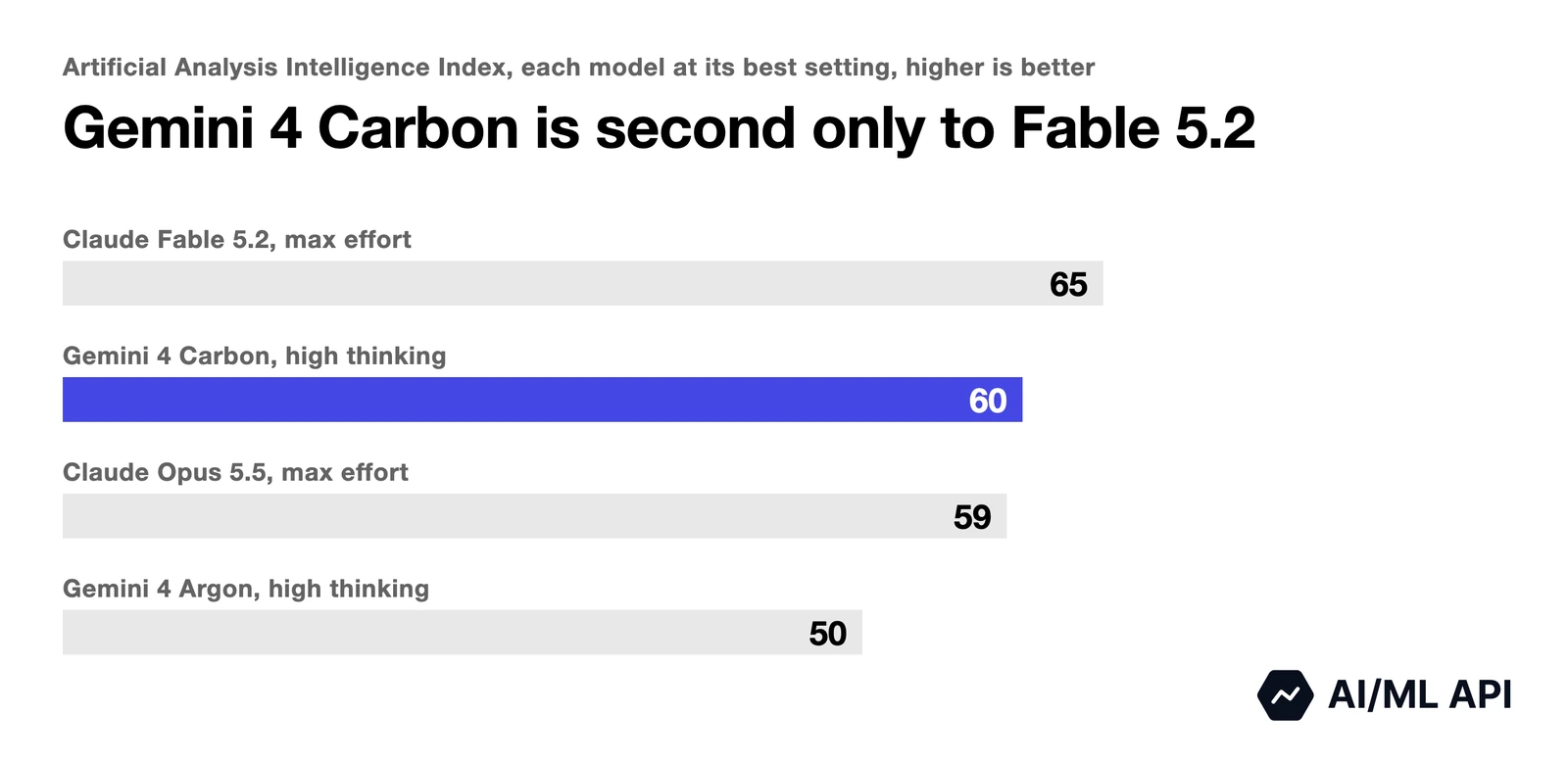
Google's first post about Carbon calls it first on this index with 59, but that score came before the index update and before Fable 5.2 came out.
Artificial Analysis also reports what one index task cost each model at each setting. For Carbon, it counts Google's standard price of $4 and $20 per million tokens, not the early price.
These costs describe the index tasks at these settings, and a task of yours can cost more or less.
Google's benchmark table
Google's table compares Carbon with Argon and Opus 5.5. The three security tests at the bottom ran on the version of Carbon for approved security teams in Google's Fairwind program, without safety filters. They don't show what the public API model scores.
In the full table, Carbon scores higher than Opus 5.5 on 14 of the 16 tests both models have, and higher than Argon on 15 of 16. Opus 5.5 leads on FrontierSWE v2 and OSWorld 2.1, and Argon leads only on RiemannBench.
Google also ranks Carbon first on CursorBench 4.0, WANDR and AutomationBench. It says Carbon finishes a task on these tests for less than half the cost of the next best model from another company. On Google's honesty test of 375 agent tasks, Carbon passed 92% and Argon 70%.
Anthropic's benchmark table
Anthropic's launch table for Fable 5.2 lists Carbon next to it. Scores are at each model's best setting unless the table says otherwise.
In Anthropic's table, Fable scored higher on six of the seven shared benchmarks. Carbon led AutomationBench. The table has no CursorBench score, so there's no Fable 5.2 number to set against Carbon's first place there.
Gemini 4 Carbon vs Fable 5.2, Opus 5.5 and Argon: which to pick?
Gemini 4 Carbon vs Fable 5.2
Fable 5.2 scored higher in Anthropic's table and on the Artificial Analysis index, and it drew the only dark center in our black hole test. Carbon's tokens cost less than a third of Fable's on AI/ML API. Even so, our bug fix cost more on Carbon, because it thought for over 23,000 tokens before it answered. Try Fable on a task where the cheaper model fails your checks, then compare the result and total charge.
Gemini 4 Carbon vs Opus 5.5
Carbon leads Opus 5.5 on most tests in Google's table and costs less per token on AI/ML API today. Opus 5.5 is ahead on OSWorld 2.1, so it's the better first try for an agent that works in desktop apps. On our small bug fix, Opus was also faster and cheaper.
Gemini 4 Carbon vs Argon
Carbon and Argon have the same context window and tools. Carbon spends more tokens on each turn to check its work, so it answers more slowly. Google still calls Argon the right pick for most coding and knowledge work. On our bug fix, the one task where both ran at high thinking, Argon cost about a tenth of Carbon's successful try. Start with Argon and move a task to Carbon when Argon fails it.
How to use the Gemini 4 Carbon API
You can try Gemini 4 Carbon in the browser first and then call it from code. Both ways use one AI/ML API account. Sign up on AI/ML API and add funds to your balance, because Carbon requests are paid.
Option 1: Test Gemini 4 Carbon in the Playground
Open the AI/ML API Playground with Gemini 4 Carbon and Fable 5.2 side by side. Type one prompt and compare the two answers before you write any code.
Option 2: Call Gemini 4 Carbon through the API
Create a Gemini 4 Carbon API key in your AI/ML API account. AI/ML API works with the OpenAI SDK, so you only need a different base URL and model name. The code needs Python 3.10 or newer and the openai package (pip install openai).
reasoning_effort picks the thinking level: low, medium or high. Start with medium and switch to high only for the tasks medium fails. The Gemini 4 Carbon API docs list every other setting.
FAQ
Why does Gemini 4 Carbon return an empty response?
Usually because thinking used the whole output limit, so no tokens were left for the answer. The response then ends with finish_reason set to length and has no text. In our first bug fix try at high thinking, Carbon spent 31,997 of 32,000 tokens on thinking. Raise max_tokens or pick a lower thinking level.
How many output tokens does Gemini 4 Carbon need?
Thinking and the answer share one output limit, up to 65,536 tokens in a normal response. Google advises setting at least 32,768, because Carbon spends more of the limit on thinking than earlier Gemini models. On our bug fix at high thinking, Carbon used 24,480 output tokens, and 23,734 of them were thinking.
How long does a Gemini 4 Carbon request take?
In our tests, from 95 seconds to over five minutes, because Carbon thinks before it answers. Set a long timeout in your client: the code above waits up to 900 seconds.