
Best LLM Models 2026 Compared: Reasoning, Coding, Multimodal & Price
Quick answer
For agentic and multimodal work, GPT-5.5 is the safest all-rounder ($5 / $30 per 1M). For code review and repo reasoning, Claude Opus 4.7 leads ($5 / $25). For speed at low cost, Gemini 3.5 Flash ($1.50 / $9). Best price-to-performance on coding: DeepSeek V4 Pro ($0.435 / $0.87). Cheapest viable API: DeepSeek V4 Flash ($0.14 / $0.28).
Full 11-model comparison table below.
Overview
Something genuinely different happened in the spring of 2026. Within roughly a 30-day window, OpenAI shipped GPT-5.5, Anthropic released Claude Opus 4.7, Google announced Gemini 3.5 Flash at I/O, DeepSeek dropped V4 Pro with MIT licensing and a price cut that cut costs by 75%, and Alibaba unveiled Qwen 3.7 Max with benchmark wins that surprised even close observers of the field. That is not a normal release cadence. That is a simultaneous sprint.
The result is a landscape where the question "which model should I use?" requires a real answer, not a shortcut. An agentic coding pipeline, a real-time customer-facing chatbot, a long-document research workflow, and a self-hosted privacy-sensitive deployment all have genuinely different correct answers today.
This guide is structured accordingly. We start with what to evaluate, move to a full comparison table, then break down the top models in detail before giving use-case-specific picks. Everything is based on publicly reported benchmarks and verified pricing as of late May 2026.
What Changed in 2026
What to Look for in a Top LLM in 2026
Not all benchmarks are created equal. Before comparing models, it helps to know which capabilities actually matter for your workload and which metrics to trust. Here are the dimensions that separate genuinely useful models from headline-grabbing ones.
Top LLM Models in 2026: Complete Comparison Table
The table below covers the most significant models across frontier closed-source, open-weight, and budget categories as of May 2026. Pricing is API-based (per million tokens, input/output). Context windows reflect the maximum available configuration.
Best Frontier LLM Models in 2026
Frontier models from OpenAI, Anthropic, Google, and xAI continue to lead on raw benchmark performance and ecosystem breadth. The gap with open-weight models has narrowed considerably, but on the hardest reasoning tasks and the most complex agentic pipelines, closed-source flagships still hold an edge.
GPT-5.5
OpenAI · Released April 23, 2026
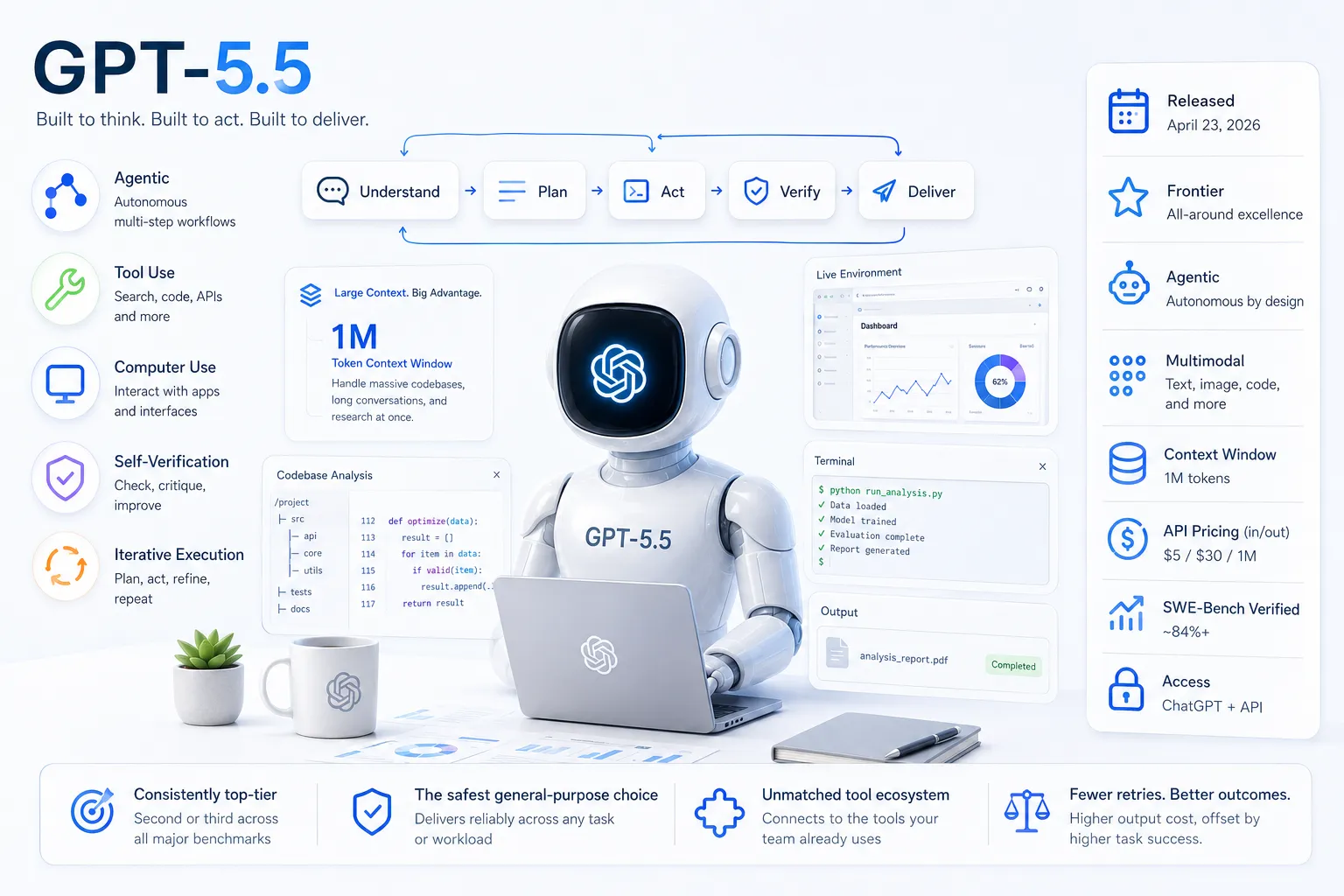
GPT-5.5 is the most complete agentic model available right now. Released on April 23, 2026, it is explicitly designed for autonomous multi-step work — tool use, computer use, self-verification, and iterative task completion. It does not lead any single benchmark, but it consistently places second or third across all of them, which makes it the safest general-purpose choice for teams that cannot afford to specialize by workload. The breadth of its tool ecosystem is unmatched, and its 1M token context window makes it viable for large codebases and research corpora. The output pricing at $30/M is the steepest among frontier models, which does sting at scale, but for complex agentic workflows where fewer retries offset the token cost, the math often works out.
Claude Opus 4.7
Anthropic · Released April 16, 2026
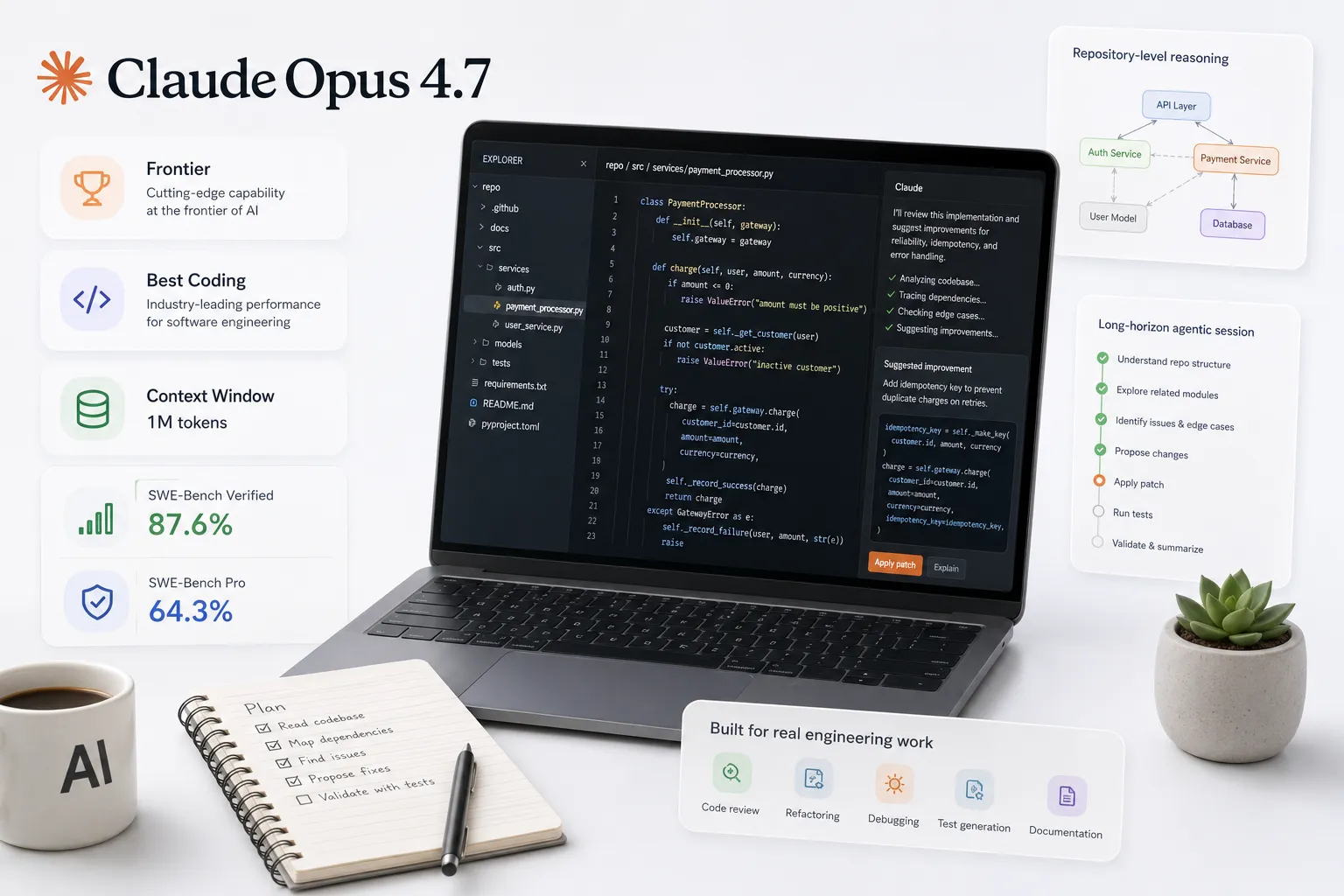
Claude Opus 4.7 is the strongest publicly available model for software engineering. Its 87.6% score on SWE-Bench Verified represents a significant jump over the previous generation, and its SWE-Bench Pro score of 64.3% leads the field on the harder, contamination-resistant variant of the benchmark. For multi-file code review, repository-level reasoning, and long-horizon agentic sessions that require sustained logical consistency, it consistently outperforms every other publicly available model. The output pricing is also slightly more favorable than GPT-5.5 at $25/M — a real advantage at scale given Anthropic's new tokenizer in 4.7 that uses slightly more tokens per input. For teams doing serious software engineering work, this is currently the model to beat.
Gemini 3.5 Flash
Google DeepMind · Released May 19, 2026
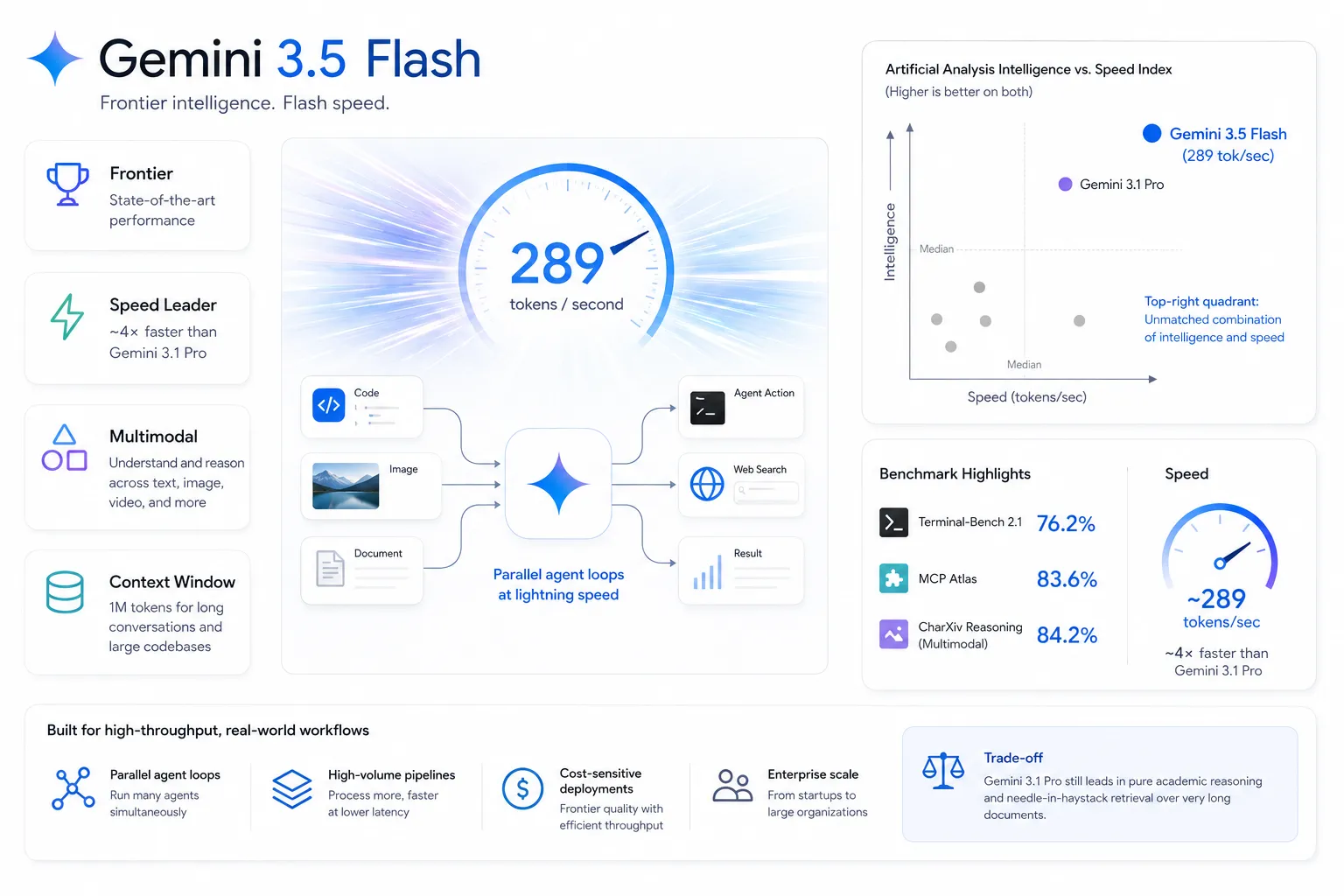
Gemini 3.5 Flash pulled off something unusual at Google I/O 2026: Google's CTO announced that the new Flash model outperforms Gemini 3.1 Pro on nearly every coding and agentic benchmark, while running roughly 4× faster. The raw numbers back this up. On Terminal-Bench 2.1 it scores 76.2%; on MCP Atlas 83.6%; on CharXiv Reasoning for multimodal understanding 84.2% — all ahead of the previous Pro flagship. At 289 tokens per second, it is the only frontier model that sits alone in the top-right quadrant of Artificial Analysis's intelligence-vs-speed index. For teams running parallel agent loops, high-volume pipelines, or cost-sensitive deployments that still need frontier-quality output, this is the current standout pick. The trade-off is that Gemini 3.1 Pro still edges it out on pure academic reasoning and needle-in-haystack retrieval over very long documents.
Grok 4.3
xAI · 2026
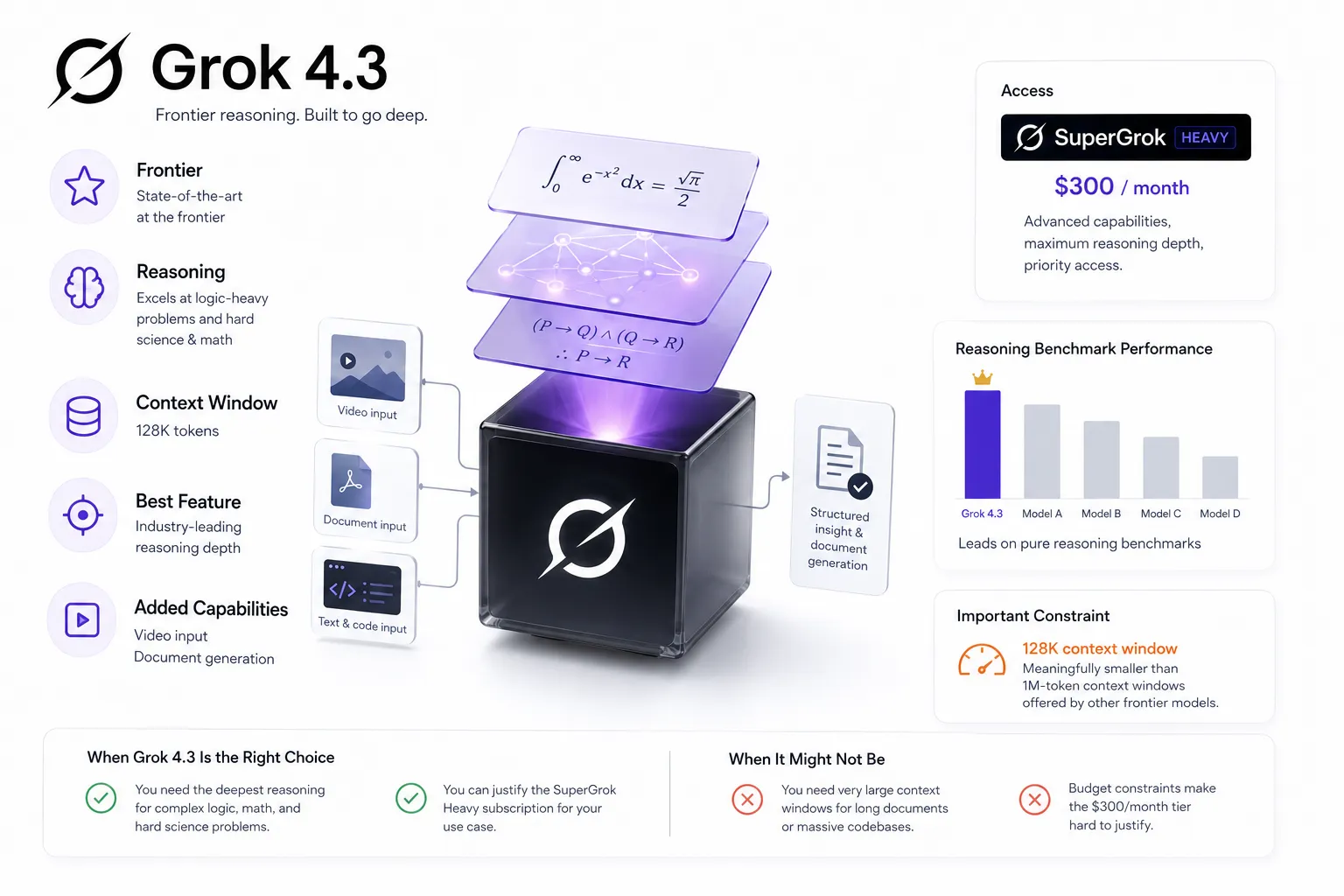
Grok 4.3 is the frontier model that tends to lead on pure reasoning benchmarks, which matters if your workload is logic-heavy or involves hard science and math. The catch is the access model: the capabilities most worth having are behind the SuperGrok Heavy tier at $300/month. For teams that specifically need top-tier reasoning depth and can justify that subscription, Grok 4.3 competes seriously. For everyone else, the context window ceiling at 128K is a meaningful constraint compared to the 1M offered by its peers.
Best Open-Weight LLM Models in 2026
The open-weight story in 2026 is primarily a Chinese-labs story, with Meta and Mistral playing important supporting roles. Kimi K2.6, DeepSeek V4 Pro, and Qwen 3.7 Max now compete directly with frontier closed models on the benchmarks that matter most for developers — at prices that make the math genuinely different.
DeepSeek V4 Pro
DeepSeek · Released April 24, 2026
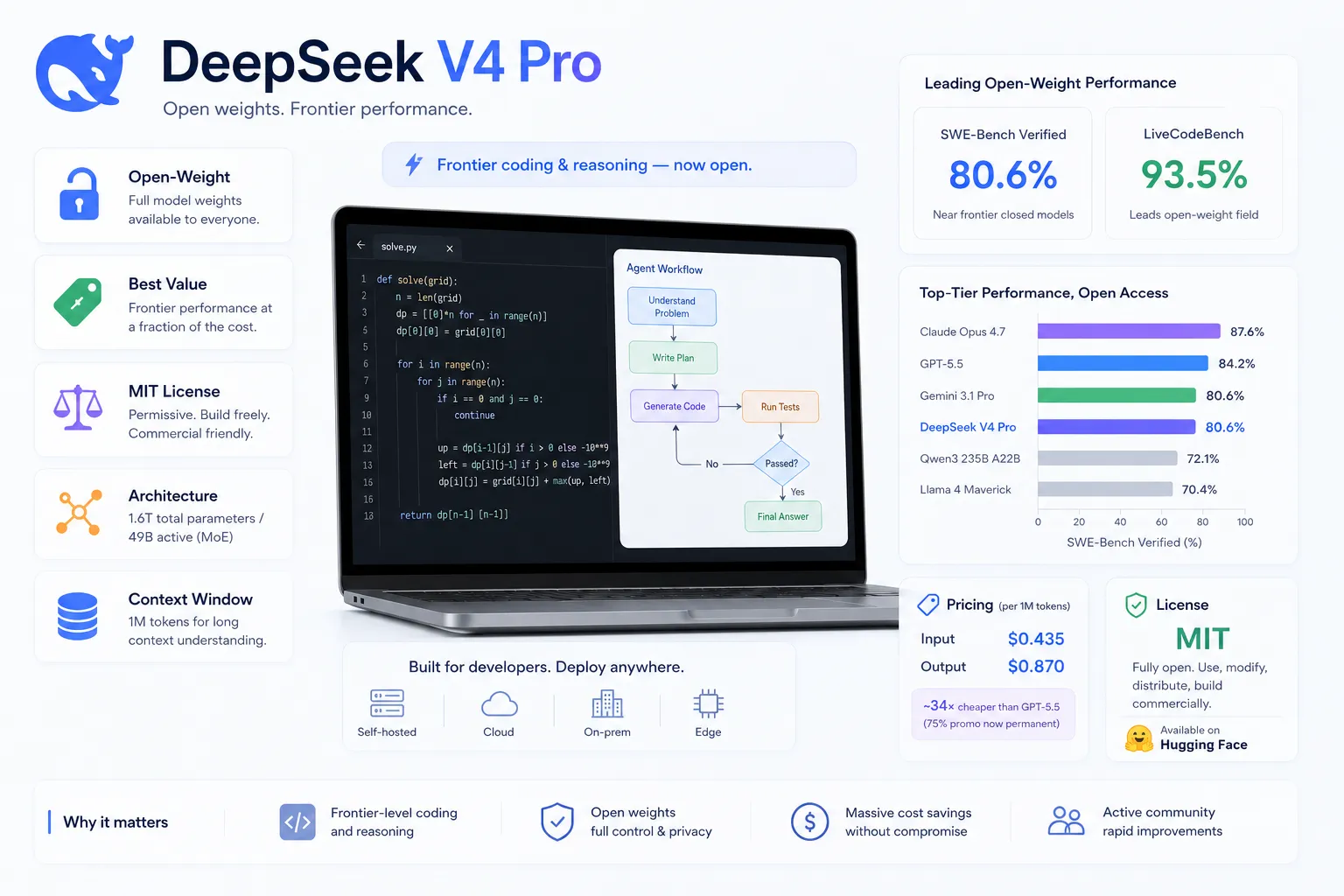
DeepSeek V4 Pro is arguably the most important model release of spring 2026 for developers on a budget. It is the first open-weight model to land within genuine striking distance of Claude Opus 4.7 and GPT-5.5 on real-world coding and reasoning benchmarks, while costing roughly 34× less per output token than GPT-5.5. On SWE-Bench Verified it scores 80.6%, matching Gemini 3.1 Pro and coming within a point of Claude Opus 4.6. On LiveCodeBench, its 93.5% leads the open-weight field by a notable margin. DeepSeek announced in May 2026 that the 75% promotional pricing discount is now the permanent standard rate, settling at $0.435/M input and $0.87/M output. The weights are MIT-licensed and available on HuggingFace. For any team where cost is a primary constraint and coding quality is the primary need, this is the most important model to evaluate.
Qwen 3.7 Max
Alibaba · Released May 20, 2026
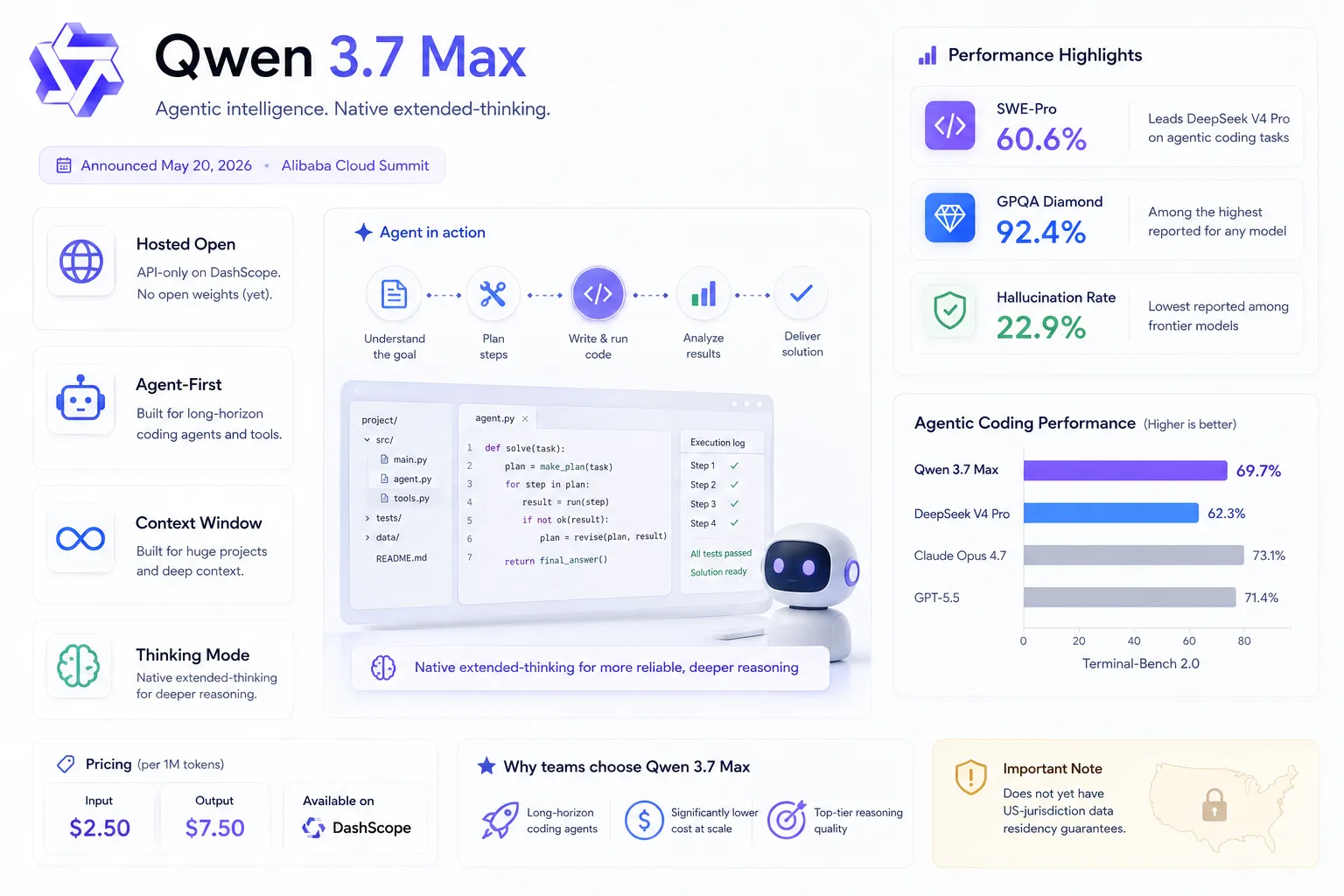
Announced on May 20, 2026 at the Alibaba Cloud Summit, Qwen 3.7 Max is the newest entry in a competitive field and it arrived with real benchmark wins. Its SWE-Pro score of 60.6% and Terminal-Bench 2.0 score of 69.7% put it ahead of DeepSeek V4 Pro on agentic coding tasks. Its GPQA Diamond score of 92.4% is among the highest reported for any model. The extended-thinking mode is native, not an add-on, and Alibaba reports the lowest hallucination rate among frontier models at 22.9%. For teams that need long-horizon coding agents at a meaningfully lower price than Claude Opus 4.7 or GPT-5.5, this is a serious option to evaluate. Note it does not yet have US-jurisdiction data residency guarantees.
Kimi K2.6
Moonshot AI · April 2026
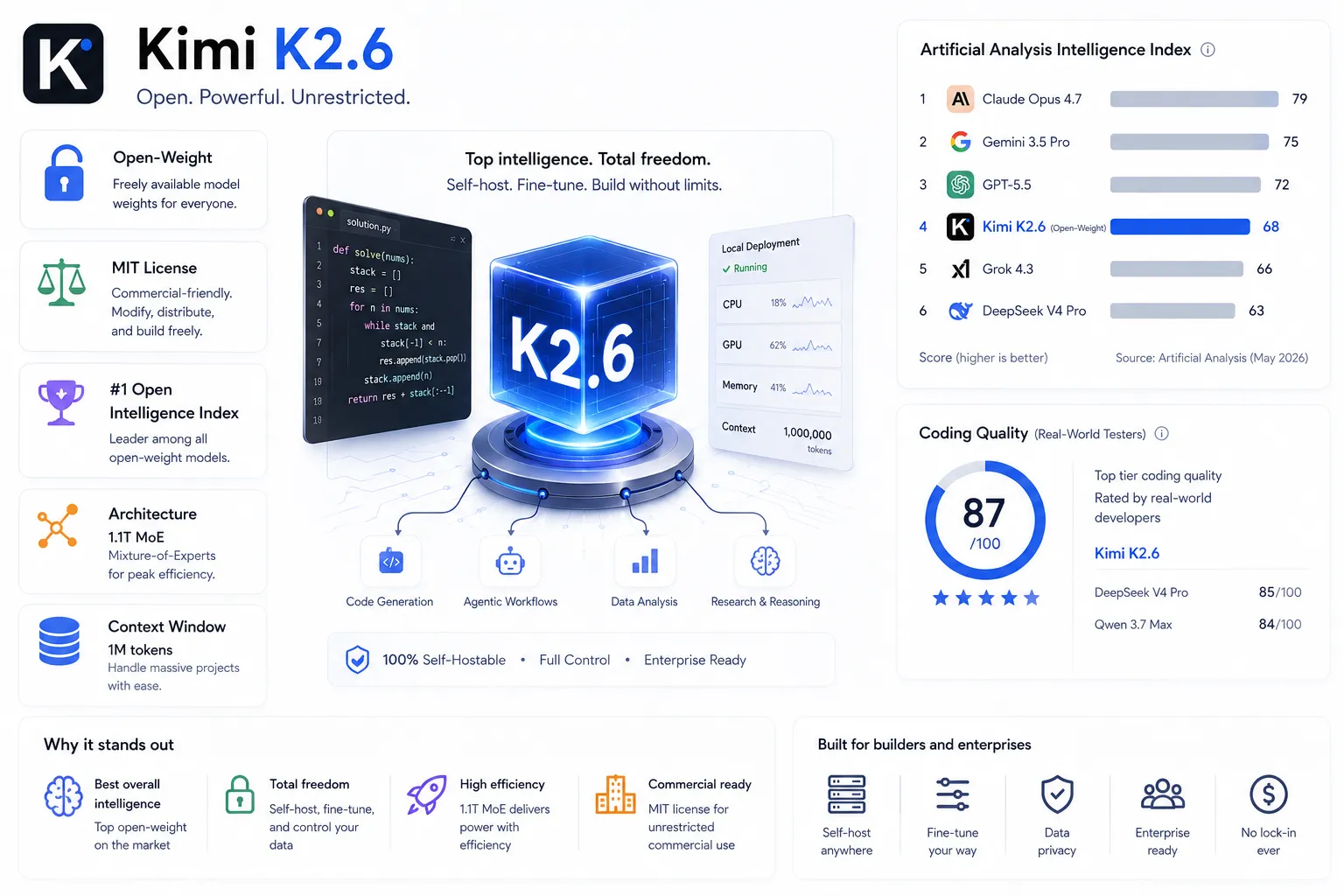
Kimi K2.6 holds the top position on the Artificial Analysis Intelligence Index among all open-weight models, ranked fourth overall, behind only Anthropic, Google, and OpenAI's flagships. Its 1.1T parameter MoE architecture is MIT-licensed, making it freely self-hostable and fine-tunable. In practical coding benchmarks, real-world testers have rated it at 87/100 for coding quality, placing it in the top tier alongside DeepSeek V4 Pro. For teams that need the best overall intelligence profile in a self-hostable model with a clean commercial license, Kimi K2.6 is currently the strongest option available.
Meta Llama 4: Scout and Maverick
Meta's Llama 4 family remains the most important open-weight option for teams that need a model with strong Western institutional backing, broad community tooling, and extreme flexibility in deployment. The family comes in two main variants serving different needs.
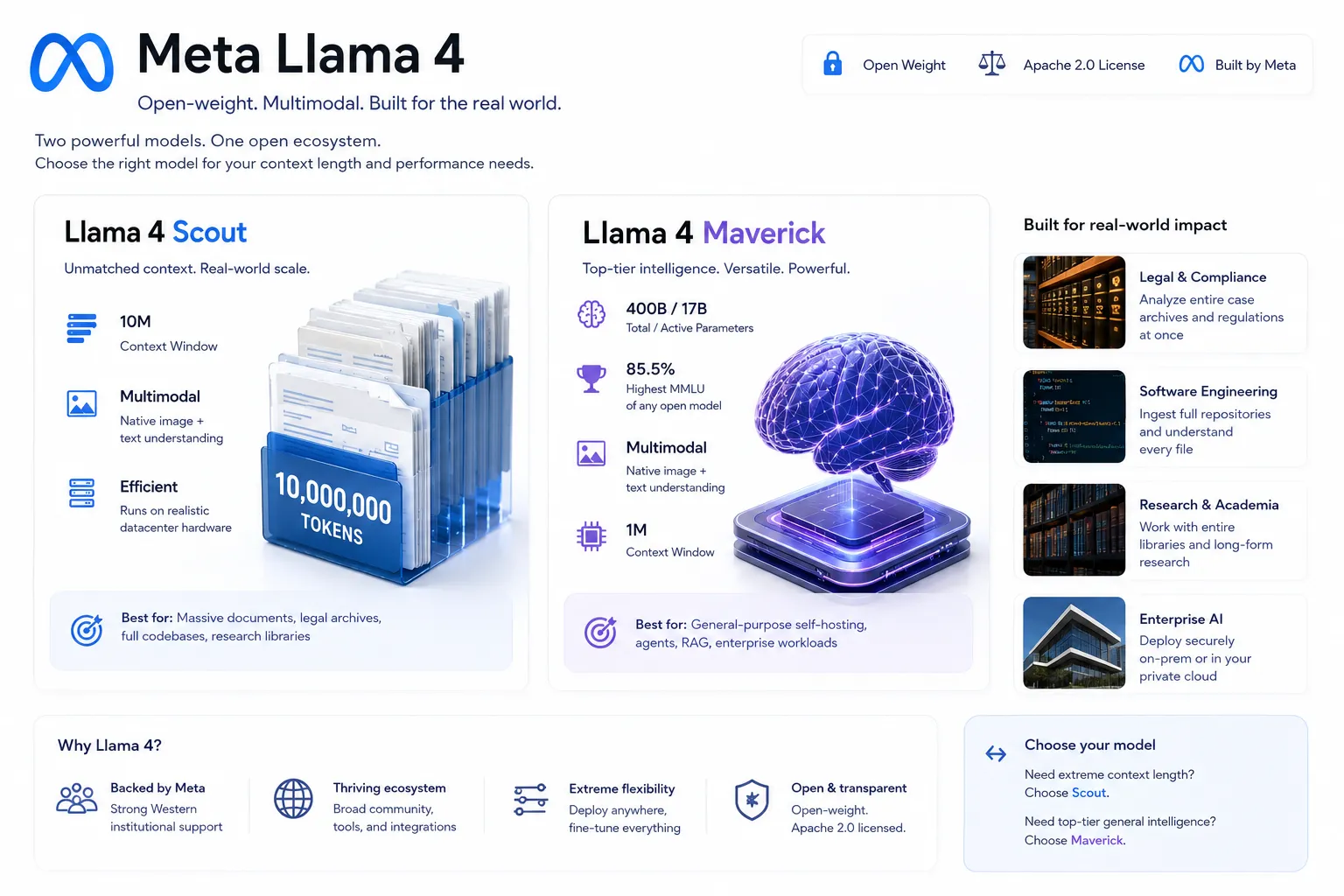
- Llama 4 Scout holds a record that nothing else comes close to: a 10-million-token context window, making it the only realistic option for truly massive document collections — entire legal case archives, full software repositories, large research libraries. It is natively multimodal and runs on realistic datacenter hardware.
- Llama 4 Maverick, the larger 400B-total / 17B-active variant, is capped at 1M context but has the highest raw MMLU of any open model at 85.5%. Both are natively multimodal. For general-purpose self-hosting where context length is not extreme, Maverick is typically the starting point. Scout is the right answer the moment you need to fit more than a few hundred pages into a single context.
Mistral Large 3
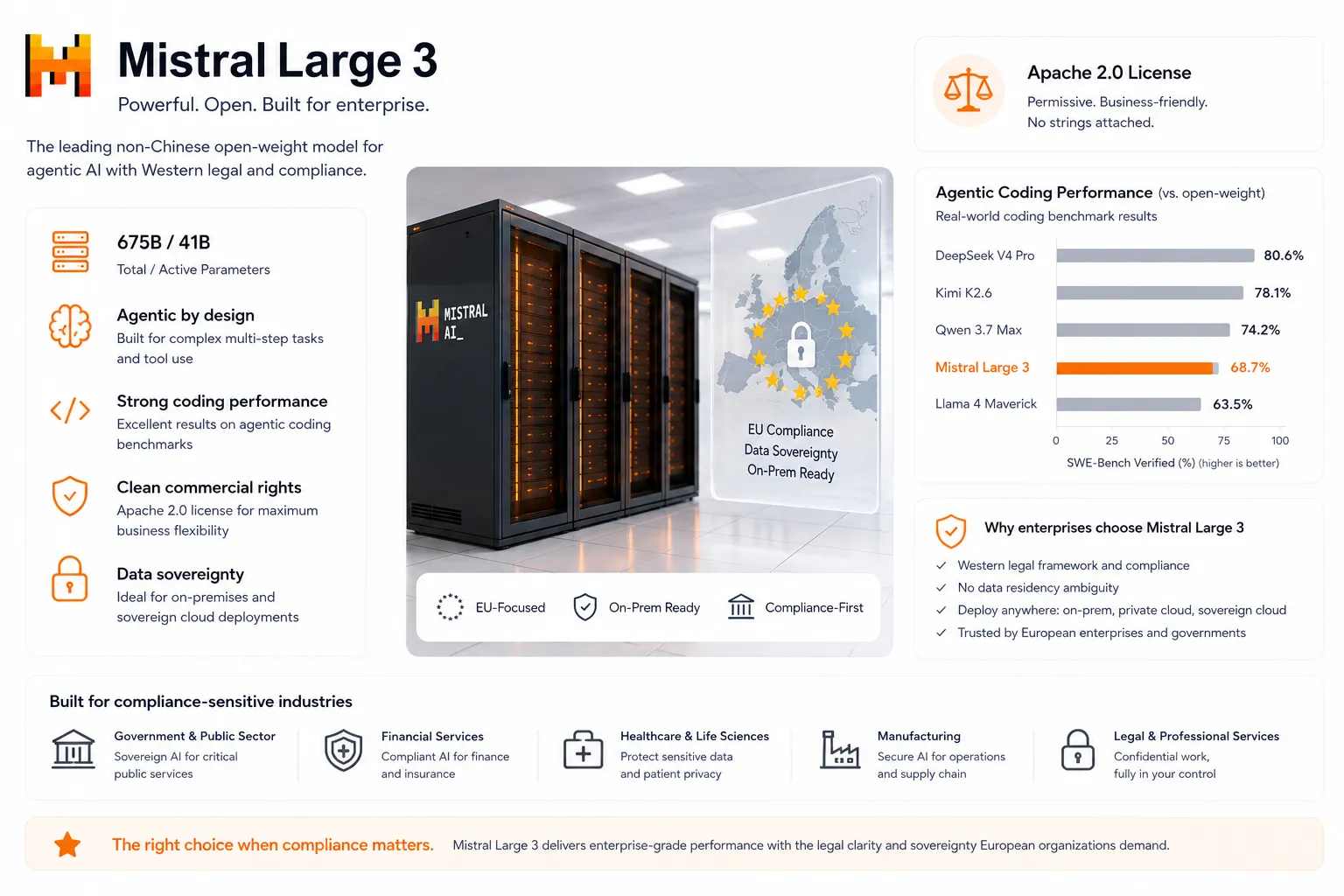
Mistral Large 3 (released December 2025) is the strongest non-Chinese open-weight option for agentic tasks with a Western legal and compliance profile. At 675B total / 41B active parameters, Apache 2.0 licensed, it delivers strong agentic coding performance and remains the go-to recommendation for European enterprises that need on-premises deployment with clean commercial rights and no ambiguity around data sovereignty. It trails the Chinese open-weight leaders on raw coding benchmarks, but for compliance-sensitive environments the trade-off is frequently worth it.
Best LLM by Use Case in 2026
The fastest way to find your model is to match your primary workload to the pick below, then read the full profile above before committing. These recommendations reflect late-May 2026 public benchmarks and pricing — verify current specs before production deployment.
Best LLM for Coding
→ Claude Opus 4.7
87.6% SWE-Bench Verified is the highest of any publicly available model. For multi-file review, repository reasoning, and long-horizon debugging sessions, nothing currently matches it. Budget alternative: DeepSeek V4 Pro (80.6%) at a fraction of the cost.
Best LLM for Agentic Workflows
→ GPT-5.5
The broadest tool ecosystem, best-in-class multi-step task execution, and consistent performance across every dimension. For complex autonomous pipelines where you can't afford to specialize, GPT-5.5 is the safest general bet. Gemini 3.5 Flash at 4× the speed is the right pick when throughput matters more than ceiling quality.
Best LLM for Reasoning
→ Grok 4.3 / Claude Opus 4.7
Grok 4.3 leads on pure academic reasoning benchmarks. Claude Opus 4.7 follows closely and has the broader ecosystem. For hard science, math, and logic-intensive tasks, these two trade the top position depending on the benchmark. Qwen 3.7 Max's 92.4% GPQA Diamond makes it a budget-conscious alternative worth testing.
Best LLM for Long-Context Tasks
→ Llama 4 Scout (10M) / Gemini 3.1 Pro (1M, best retrieval)
For sheer context length, Llama 4 Scout is untouchable at 10M tokens. For high-quality retrieval within long contexts at 1M tokens, Gemini 3.1 Pro still leads on MRCR v2, and Claude Opus 4.7 leads the document retrieval benchmark MRCR 1M at 92.9%.
Best LLM for Multimodal Apps
→ Gemini 3.5 Flash
Native support for text, image, audio, video, and PDF in a single API. 84.2% on CharXiv Reasoning for multimodal understanding. Faster and cheaper than any other model with comparable multimodal capability. For real-time applications that need to process mixed media, this is the current standard.
Best Open-Weight LLM
→ Kimi K2.6 (overall) / DeepSeek V4 Pro (coding)
Kimi K2.6 leads the Artificial Analysis Intelligence Index among open-weight models. DeepSeek V4 Pro leads on competitive coding. Both are MIT-licensed. For US-jurisdiction compliance concerns, Llama 4 Maverick or Mistral Large 3 (Apache 2.0) are the Western alternatives.
Best Value-for-Money LLM
→ DeepSeek V4 Pro / Gemini 3.5 Flash
DeepSeek V4 Pro at $0.435/$0.87 per million tokens delivers 80.6% SWE-Bench Verified — comparable to closed frontier models at 34× lower cost. Gemini 3.5 Flash at $1.50/$9 gives you near-Pro agentic quality at 4× frontier speed. For absolute cheapest viable coding: DeepSeek V4 Flash at $0.14/M input.
Best LLM for Multilingual Tasks
→ Qwen 3.5 / Qwen 3.7 Max
Qwen 3.5 supports 200 languages and dialects — more than any other model in the field. Qwen 3.7 Max extends this with stronger agentic capabilities. For multilingual customer service, content generation, or global enterprise use cases, the Qwen family currently leads by a significant margin.
Frontier Closed Models vs Open-Weight LLMs in 2026
Two years ago this was a straightforward comparison. Closed frontier models had a commanding quality lead. Open-weight models were good for experimentation, cost control, and use cases where you genuinely couldn't send data to an external API. That trade-off was clear.
In 2026, the trade-off is genuinely more nuanced. DeepSeek V4 Pro sits within a few benchmark points of GPT-5.5 and Claude Opus 4.7 on coding — while costing 34× less per output token. Kimi K2.6 ranks fourth on the Artificial Analysis Intelligence Index, above several closed-source models. The gap that was easy to paper over with "the closed model is better" is no longer that easy to see on most practical benchmarks.
Self-hosting a single-host model (DeepSeek V4 Flash, Qwen 3.5 smaller variants, Gemma 4) typically beats hosted API pricing once you cross roughly 5 million tokens per day. For multi-node frontier MoE models (Kimi K2.6, DeepSeek V4 Pro), that threshold rises to 30–50 million tokens per day. Below those numbers, the hosted API is almost always cheaper when you factor in engineering time.
Before committing to self-hosting infrastructure, test your actual workload through AI/ML API's playground — you get access to every major model in this guide (DeepSeek V4, Claude Opus 4.7, Gemini 3.5 Flash, GPT-5.5, Llama 4, Mistral Large 3) under a single bill, with no token caps. Open the Playground →
Which LLM Should You Choose?
The fastest path to the right answer: match your constraint and primary need below. These are starting points, not final verdicts — the right choice depends on your specific data, tooling, and scale.
Conclusion
The spring 2026 LLM releases changed something real. Not the benchmark numbers in isolation, those move every quarter, but the competitive structure underlying them. For the first time, a team with serious cost constraints has a credible path to frontier-quality coding and reasoning without paying frontier-tier prices. DeepSeek V4 Pro and Kimi K2.6 are not consolation prizes. They are legitimate answers to hard problems.
At the same time, closed frontier models still hold the edge where it matters most: the hardest academic reasoning tasks, the broadest agentic ecosystems, and the most complex multi-modal workflows. GPT-5.5 and Claude Opus 4.7 are not merely expensive by inertia. They earn their price tags for specific workloads.
The most important shift, though, may be the Flash-tier story. Gemini 3.5 Flash beating the previous Pro flagship on coding and agentic benchmarks while running 4× faster signals something that applies beyond Google's product line: the assumption that "efficient" and "capable" are in tension is no longer reliable. The best model for your agent loop might be faster and cheaper than the best model for a one-shot hard reasoning problem.
Pick your primary workload. Benchmark two or three candidates against your actual data. Watch the leaderboards. The model that was right in March may not be right in September — and in 2026, that is simply the new normal.
Frequently Asked Questions
What is the best LLM in 2026?
There is no single best LLM in 2026. Claude Opus 4.7 leads on coding (87.6% SWE-Bench Verified), GPT-5.5 leads on agentic workflow breadth, Gemini 3.5 Flash leads on speed and multimodal tasks, and DeepSeek V4 Pro leads on cost-to-performance ratio. The right answer depends entirely on your workload, budget, and deployment requirements.
Which LLM is best for coding in 2026?
Claude Opus 4.7 currently leads with an 87.6% score on SWE-Bench Verified — the highest of any publicly available model. For teams with tight budgets, DeepSeek V4 Pro scores 80.6% on the same benchmark at roughly 34× lower output cost. Qwen 3.7 Max and Kimi K2.6 are also strong on agentic coding tasks and worth benchmarking against your specific codebase.
What is the best open-source LLM in 2026?
Kimi K2.6 holds the top position on the Artificial Analysis Intelligence Index among open-weight models, ranking fourth overall across all models. DeepSeek V4 Pro leads specifically on coding benchmarks. Both are MIT-licensed. For Western-jurisdiction compliance, Llama 4 Maverick and Mistral Large 3 (Apache 2.0) are the leading alternatives.
Which LLM is best for agentic workflows?
GPT-5.5 leads on breadth and reliability for complex multi-step agentic pipelines. Gemini 3.5 Flash is the strongest choice when throughput and cost are constraints — it runs 4× faster than comparable frontier models and scored 83.6% on MCP Atlas (tool use benchmark). Qwen 3.7 Max is the emerging budget option for long-horizon coding agents specifically.
Is GPT-5.5 better than Claude Opus 4.7?
It depends on the task. GPT-5.5 has a broader agentic execution profile and the largest production tool ecosystem. Claude Opus 4.7 leads on software engineering (87.6% vs GPT-5.5's SWE-Bench score) and is 17% cheaper on output tokens. For coding-focused teams, Opus 4.7 is the current leader. For general-purpose agentic work, GPT-5.5's breadth gives it an edge.