Kimi K2’s architecture enables deep, adaptive integration into complex digital ecosystems, excelling in tool-driven automation, enterprise orchestration, and multilingual applications through its trillion-parameter design and sophisticated tool-learning pipeline.
Kimi K2 combines expert-driven architecture with robust reasoning and coding skills, offering reliable autonomy for complex, real-world challenges.
What Is Kimi K2?
Kimi K2 is a large language model released by Moonshot AI — the Chinese AI research company behind the popular Kimi assistant product. Unlike many open-source models that prioritize raw reasoning, Kimi K2 was engineered specifically for agentic use cases: tasks where the model must autonomously call tools, execute multi-step plans, write and debug code, and complete real-world workflows with minimal human supervision.
The model uses a Mixture-of-Experts (MoE) architecture with 1 trillion total parameters and 32 billion activated parameters per forward pass. This design makes it remarkably efficient — you get near-frontier performance without paying for a dense trillion-parameter inference every single call. It was pre-trained on a 15.5 trillion token dataset using Moonshot's proprietary MuonClip optimizer, which allowed stable training at scale without a single loss spike or training restart.
Performance Metrics
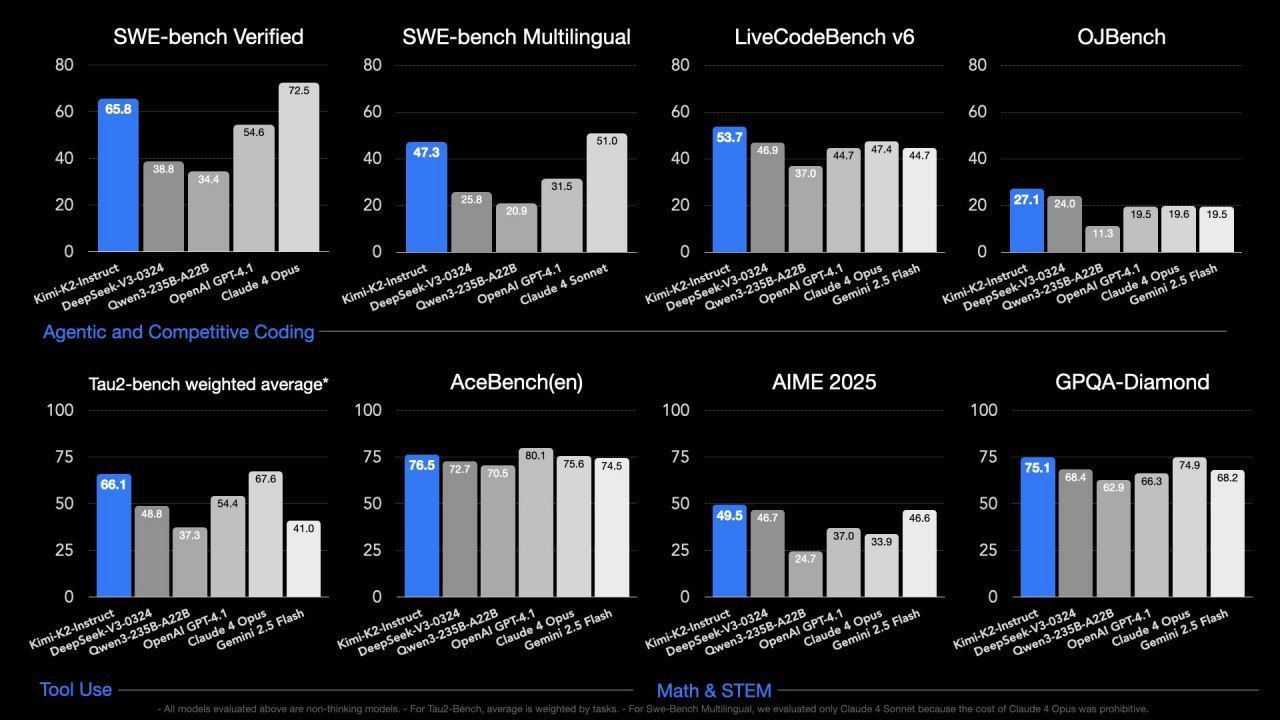
Kimi K2 demonstrates adaptability across diverse scenarios while maintaining stability in repeatable conditions. The upward performance trend suggests improved efficiency in handling complex tasks.
API Pricing
• Input: $0.195 per million tokens
• Output: $3.25 per million tokens
What Kimi K2 Can Actually Do
Most LLM capability lists read like marketing copy. Here's a grounded, developer-oriented look at what Kimi K2 genuinely does well and where it particularly excels compared to its peers.
Native Tool Use
Kimi K2 wasn't retrofitted with function calling — tool use was baked into the training pipeline from the start. It was trained across hundreds of synthetic and real-world environments, meaning it understands tool schemas, handles errors gracefully, and chains multi-step calls reliably.
Advanced Code Generation
65.8% on SWE-bench is a number worth pausing on. This isn't autocomplete — it's the model reading an issue, navigating an unfamiliar codebase, writing a targeted patch, and doing so correctly on the first attempt more than half the time.
Math & Formal Reasoning
At 97.4% on MATH-500, Kimi K2 outperforms GPT-4.1 (92.4%) on advanced mathematical problem solving. For applications that need rigorous step-by-step reasoning — finance, scientific research, theorem proving — this is a meaningful gap.
Multilingual Fluency
Trained on multilingual corpora and validated against the SWE-bench Multilingual suite (47.3% pass@1), Kimi K2 handles code and prose in English, Chinese, and a range of other languages without specialized prompting.
Long-Context Comprehension
The 131,072-token context window lets you pass entire codebases, long PDF documents, or multi-turn conversation histories in a single request. The model maintains coherence and retrieves relevant details from distant parts of the context reliably.
Structured Output
Full support for JSON Mode, Partial Mode, ToolCalls, and built-in web search. Whether you're building pipelines that need deterministic output formats or agents that need to call external services, the API surface has you covered.
Who Is Building with Kimi K2?
Kimi K2's architecture makes it especially well-suited for use cases where the model must act, not just respond. Here's where it delivers the clearest return.
Autonomous Software Agents
If you're building a coding copilot, an automated code review tool, or a CI/CD agent that triages and resolves issues, Kimi K2's SWE-bench performance translates directly. The model can take a GitHub issue, explore the relevant files, write a patch, and output a pull-request-ready diff with minimal scaffolding on your end.
Enterprise Workflow Automation
Complex business processes — document processing, data extraction, API orchestration, report generation — often require a model that can reason across multiple steps and recover gracefully from intermediate errors. Kimi K2's training in real and simulated tool environments means it handles these chains better than models trained primarily on static text.
Research & Data Analysis
The combination of strong mathematical reasoning (97.4% MATH-500) and a 131K-token context window makes Kimi K2 unusually capable at tasks like quantitative literature review, statistical analysis, and structured data extraction from long documents. You can pass a full research paper or a large dataset schema in context and get coherent, grounded analysis back.
Multilingual Products
For teams shipping products to markets in East Asia, Europe, or Latin America, Kimi K2's multilingual training provides a more natural baseline than models trained primarily on English data. It handles code-switching, localization edge cases, and cross-lingual reasoning without needing specialized prompting strategies.
R&D Prototyping with Agents
The open-source availability of the base weights means researchers can fine-tune, extend, or ablate Kimi K2 for specific domains. Teams prototyping novel agentic systems, retrieval-augmented agents, multi-agent networks, custom tool environments, get a strong starting point without the vendor lock-in of proprietary APIs.
Kimi K2 vs. Competing Models
vs. GPT-4.1
GPT-4.1 is a solid general-purpose model, but Kimi K2 beats it on every major coding benchmark — by a wide margin on SWE-bench (65.8% vs ~54%) and LiveCodeBench (53.7% vs 44.7%). For coding and agentic workloads specifically, Kimi K2 via AI/ML API delivers better results at roughly 10× lower input cost. GPT-4.1's advantages are a much larger context window and Anthropic ecosystem integration.
vs. Gemini 2.5 Flash
Gemini 2.5 Flash is fast, cheap, and capable. In structured programming tasks and SWE-bench specifically, Kimi K2 edges ahead (65.8% vs 63.8%). Gemini Flash has the advantage of a million-token context window and deep Google ecosystem integration. For pure coding agent work, Kimi K2 is the stronger default choice.
vs. Claude Sonnet 4
Claude Sonnet 4 produces excellent prose, handles instruction-following with high fidelity, and integrates well into Anthropic's tooling. Kimi K2 outperforms it on zero-shot code generation and agentic, tool-use scenarios, particularly on tasks that require navigating unfamiliar codebases autonomously. Claude Sonnet's advantages lie in nuanced writing tasks and longer multi-turn conversations.
Kimi K2 is a large language model released by Moonshot AI — the Chinese AI research company behind the popular Kimi assistant product. Unlike many open-source models that prioritize raw reasoning, Kimi K2 was engineered specifically for agentic use cases: tasks where the model must autonomously call tools, execute multi-step plans, write and debug code, and complete real-world workflows with minimal human supervision.
The model uses a Mixture-of-Experts (MoE) architecture with 1 trillion total parameters and 32 billion activated parameters per forward pass. This design makes it remarkably efficient — you get near-frontier performance without paying for a dense trillion-parameter inference every single call. It was pre-trained on a 15.5 trillion token dataset using Moonshot's proprietary MuonClip optimizer, which allowed stable training at scale without a single loss spike or training restart.
Performance Metrics
Kimi K2 demonstrates adaptability across diverse scenarios while maintaining stability in repeatable conditions. The upward performance trend suggests improved efficiency in handling complex tasks.
API Pricing
• Input: $0.195 per million tokens
• Output: $3.25 per million tokens
What Kimi K2 Can Actually Do
Most LLM capability lists read like marketing copy. Here's a grounded, developer-oriented look at what Kimi K2 genuinely does well and where it particularly excels compared to its peers.
Native Tool Use
Kimi K2 wasn't retrofitted with function calling — tool use was baked into the training pipeline from the start. It was trained across hundreds of synthetic and real-world environments, meaning it understands tool schemas, handles errors gracefully, and chains multi-step calls reliably.
Advanced Code Generation
65.8% on SWE-bench is a number worth pausing on. This isn't autocomplete — it's the model reading an issue, navigating an unfamiliar codebase, writing a targeted patch, and doing so correctly on the first attempt more than half the time.
Math & Formal Reasoning
At 97.4% on MATH-500, Kimi K2 outperforms GPT-4.1 (92.4%) on advanced mathematical problem solving. For applications that need rigorous step-by-step reasoning — finance, scientific research, theorem proving — this is a meaningful gap.
Multilingual Fluency
Trained on multilingual corpora and validated against the SWE-bench Multilingual suite (47.3% pass@1), Kimi K2 handles code and prose in English, Chinese, and a range of other languages without specialized prompting.
Long-Context Comprehension
The 131,072-token context window lets you pass entire codebases, long PDF documents, or multi-turn conversation histories in a single request. The model maintains coherence and retrieves relevant details from distant parts of the context reliably.
Structured Output
Full support for JSON Mode, Partial Mode, ToolCalls, and built-in web search. Whether you're building pipelines that need deterministic output formats or agents that need to call external services, the API surface has you covered.
Who Is Building with Kimi K2?
Kimi K2's architecture makes it especially well-suited for use cases where the model must act, not just respond. Here's where it delivers the clearest return.
Autonomous Software Agents
If you're building a coding copilot, an automated code review tool, or a CI/CD agent that triages and resolves issues, Kimi K2's SWE-bench performance translates directly. The model can take a GitHub issue, explore the relevant files, write a patch, and output a pull-request-ready diff with minimal scaffolding on your end.
Enterprise Workflow Automation
Complex business processes — document processing, data extraction, API orchestration, report generation — often require a model that can reason across multiple steps and recover gracefully from intermediate errors. Kimi K2's training in real and simulated tool environments means it handles these chains better than models trained primarily on static text.
Research & Data Analysis
The combination of strong mathematical reasoning (97.4% MATH-500) and a 131K-token context window makes Kimi K2 unusually capable at tasks like quantitative literature review, statistical analysis, and structured data extraction from long documents. You can pass a full research paper or a large dataset schema in context and get coherent, grounded analysis back.
Multilingual Products
For teams shipping products to markets in East Asia, Europe, or Latin America, Kimi K2's multilingual training provides a more natural baseline than models trained primarily on English data. It handles code-switching, localization edge cases, and cross-lingual reasoning without needing specialized prompting strategies.
R&D Prototyping with Agents
The open-source availability of the base weights means researchers can fine-tune, extend, or ablate Kimi K2 for specific domains. Teams prototyping novel agentic systems, retrieval-augmented agents, multi-agent networks, custom tool environments, get a strong starting point without the vendor lock-in of proprietary APIs.
Kimi K2 vs. Competing Models
vs. GPT-4.1
GPT-4.1 is a solid general-purpose model, but Kimi K2 beats it on every major coding benchmark — by a wide margin on SWE-bench (65.8% vs ~54%) and LiveCodeBench (53.7% vs 44.7%). For coding and agentic workloads specifically, Kimi K2 via AI/ML API delivers better results at roughly 10× lower input cost. GPT-4.1's advantages are a much larger context window and Anthropic ecosystem integration.
vs. Gemini 2.5 Flash
Gemini 2.5 Flash is fast, cheap, and capable. In structured programming tasks and SWE-bench specifically, Kimi K2 edges ahead (65.8% vs 63.8%). Gemini Flash has the advantage of a million-token context window and deep Google ecosystem integration. For pure coding agent work, Kimi K2 is the stronger default choice.
vs. Claude Sonnet 4
Claude Sonnet 4 produces excellent prose, handles instruction-following with high fidelity, and integrates well into Anthropic's tooling. Kimi K2 outperforms it on zero-shot code generation and agentic, tool-use scenarios, particularly on tasks that require navigating unfamiliar codebases autonomously. Claude Sonnet's advantages lie in nuanced writing tasks and longer multi-turn conversations.










-min-p-130x130q80.png)




.png)


.png)
