
Best AI for Roleplay in 2026: Top LLMs for Character Chat, Storytelling & Immersive RP
Here's the hard truth: most AI chatbots fail at roleplay. Not because they're bad at language, they're surprisingly good at it, but because they fail at the one thing roleplay actually demands: sustained character. They break persona mid-scene, forget a detail you mentioned three messages ago, or snap into FAQ-bot mode the moment you introduce a plot twist that wasn't in the original setup.
In 2026, that gap between capable models and truly great roleplay partners has finally started to close. A handful of LLMs — both commercial and open-weight — have reached a level where the experience starts to feel genuinely collaborative. This guide covers the ones that made the cut, why they work, and how to pick the right one for your specific flavor of RP.
What Actually Makes AI Roleplay Work?
Before diving into models, it helps to understand what separates a great roleplay AI from a glorified autocomplete engine. The gap is real, and it explains why the same model can write brilliant prose in one context and produce something hollow in another.
Roleplay isn't about generating text, it's about inhabiting a character over time. That requires at least three things working together: memory long enough to recall what the character knows, narrative judgment to advance the story rather than just react, and enough creative flexibility to handle whatever you throw at it. When one of those breaks, the whole illusion collapses.
The models worth your attention in 2026 have all made significant strides in context retention and persona consistency. Some are fine-tuned specifically for collaborative fiction. Others are general-purpose LLMs that handle roleplay exceptionally well if you know how to prompt them. The best open-weight options run locally and give you complete control — no safety filters, no session resets, no moderation walls.
How We Ranked These Models
We tested each model across multiple roleplay formats — character dialogue, fantasy world-building, long-form collaborative fiction, dungeon master simulations, and more. Here are the eight criteria that determined the rankings.
Best AI Models for Roleplay in 2026
These are the models that consistently delivered across our testing criteria, ranked from most versatile to most specialized.
MiniMax M2 (Her)
Best overall roleplay model · Strongest for long-session character consistency
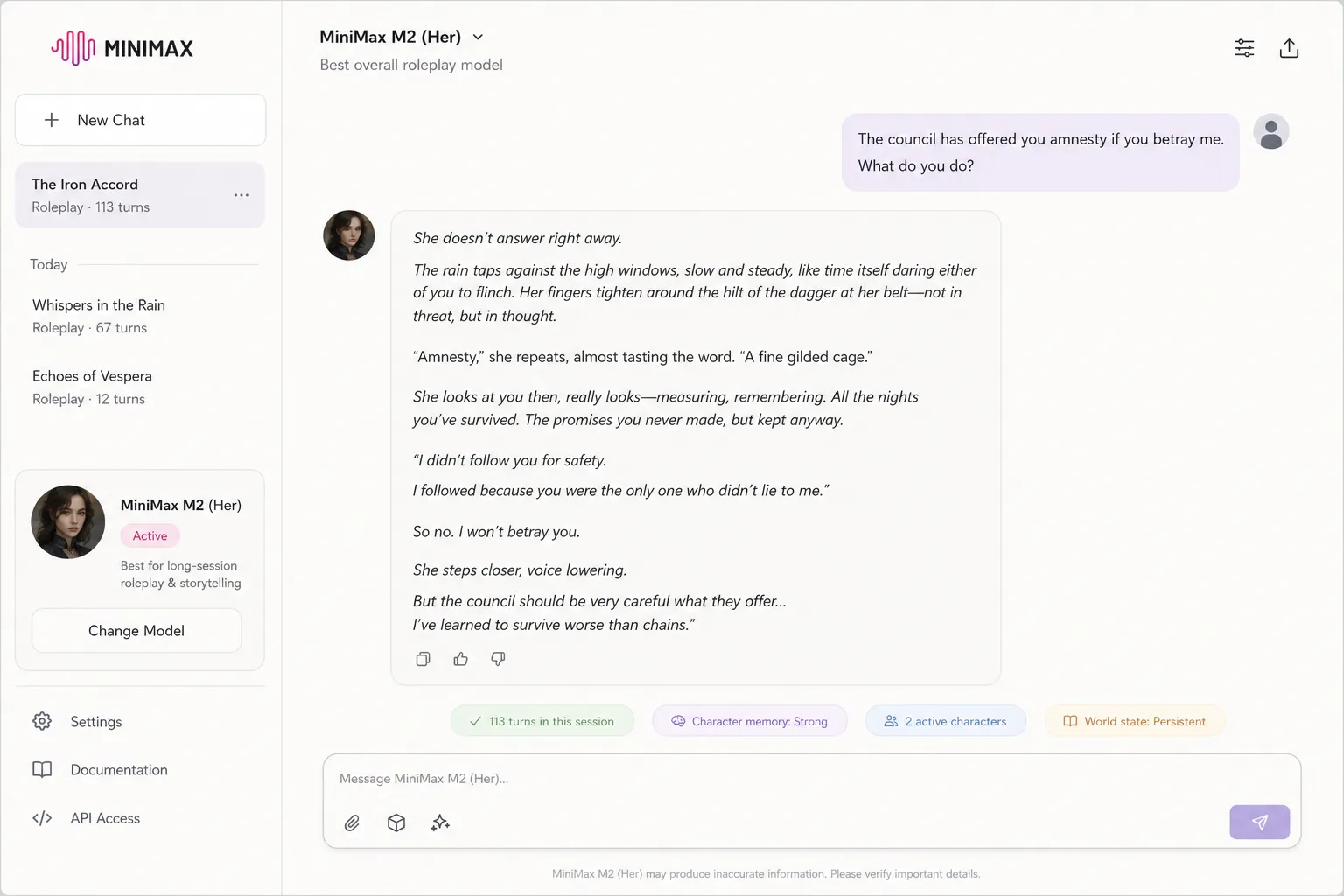
MiniMax M2, particularly its "Her" persona configuration, tops dedicated roleplay leaderboards for a reason that becomes obvious within your first extended session: it treats character consistency as a first-class concern, not an afterthought. Where other models start bleeding persona after twenty or thirty turns, MiniMax M2 holds the thread through a hundred-turn conversation without prompting. It doesn't just remember what your character said, it remembers what your character would say, and adjusts tone accordingly.
The narrative bridging is what sets it apart. When you introduce a new plot element, it doesn't just accept and move on, it folds the new element into what's already been established, maintaining internal story logic that makes the world feel persistent. This is the single hardest thing to get right in collaborative fiction, and MiniMax M2 gets it better than anything else we tested.
- Maintains character voice and motivation across very long sessions without reminders
- Handles moral complexity and dark themes without breaking the narrative frame
- Excellent at multi-character scenes where different personas need distinct voices
- Available via AI/ML API alongside the broader MiniMax model family
Claude Sonnet 4.6
Best for nuanced characters · Excellent prose quality · Strong emotional range
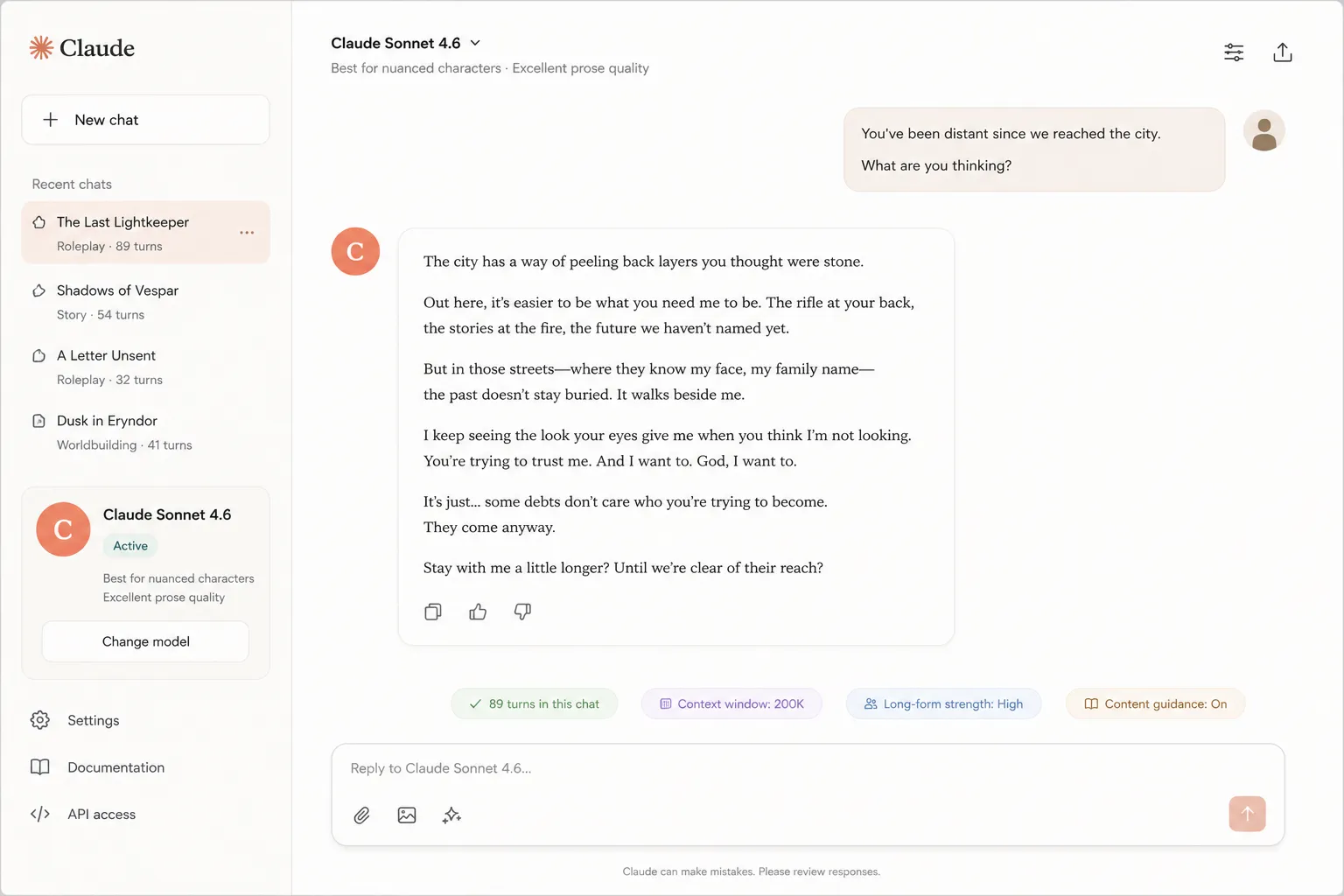
Claude Sonnet 4.6 brings something the other models often lack: genuine prose craft. The dialogue doesn't just feel contextually appropriate — it feels written. Characters have idiosyncratic speech patterns, subtext lands, and moments of silence are handled with surprising elegance. For collaborative fiction where the quality of the writing itself matters, Claude is unmatched among commercial API models.
It's particularly strong for slow-burn character work: psychological depth, relationships that develop gradually, morally ambiguous figures who are hard to categorize as hero or villain. The model understands subtext in a way that makes sophisticated narrative setups actually pay off. The tradeoff is that Claude applies more content judgment than some alternatives, making it a better fit for mature literary work than fully uncensored scenarios. Available on AI/ML API with consistent performance under load.
- Best prose quality of any commercial model for narrative roleplay
- Exceptional at building morally complex, psychologically layered characters
- Handles long-form collaborative stories with strong structural awareness
- Claude 4.5 Haiku available as a fast, cost-efficient option for lighter RP sessions
GPT-5.5
Best for instruction-following · Strong dialogue structure · Broad genre range
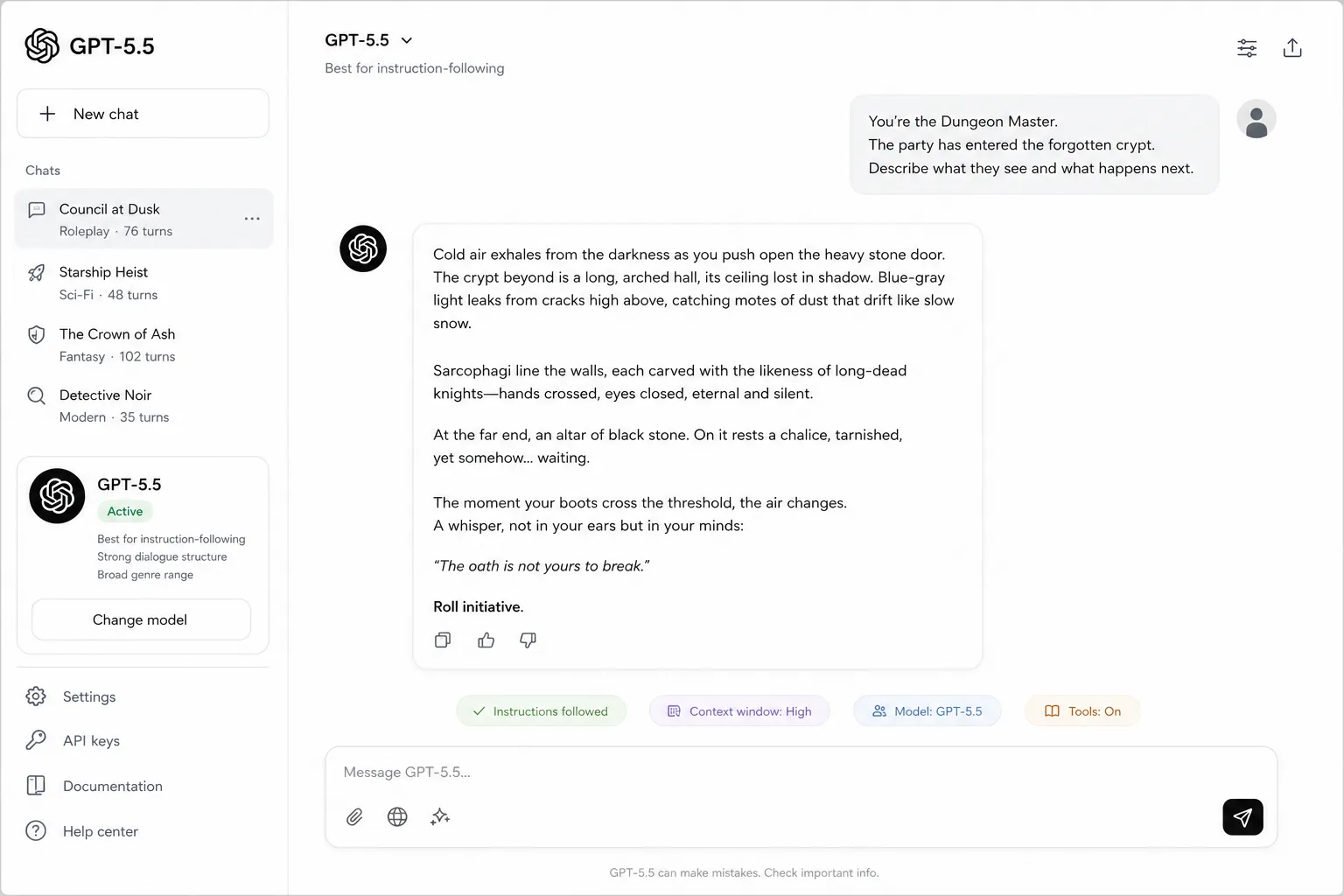
GPT-5.5 is the model that will do exactly what you ask — which turns out to be extremely useful when you have a detailed character setup or a complex world you've spent time building. Hand it a thorough system prompt with specific character traits, backstory, and behavioral rules, and it will honor those instructions with impressive fidelity. This makes it the best choice for players who treat their AI roleplay sessions more like directed theater than improv.
It handles genre switches well — the same model can convincingly inhabit a Victorian drawing room scene and a grimy cyberpunk alley within the same session. AI/ML API lists GPT-5.3, 5.4, and 5.5 as available, giving you options depending on budget and speed requirements.
- Follows complex multi-point character briefs more reliably than most alternatives
- Broad genre range with consistent quality across fantasy, sci-fi, historical, and modern settings
- Strong at structured multi-NPC scenarios like dungeon master sessions
Meta Llama 3.1 / 3.2 Family
Best open-source for roleplay · Highly tunable · Strong community ecosystem
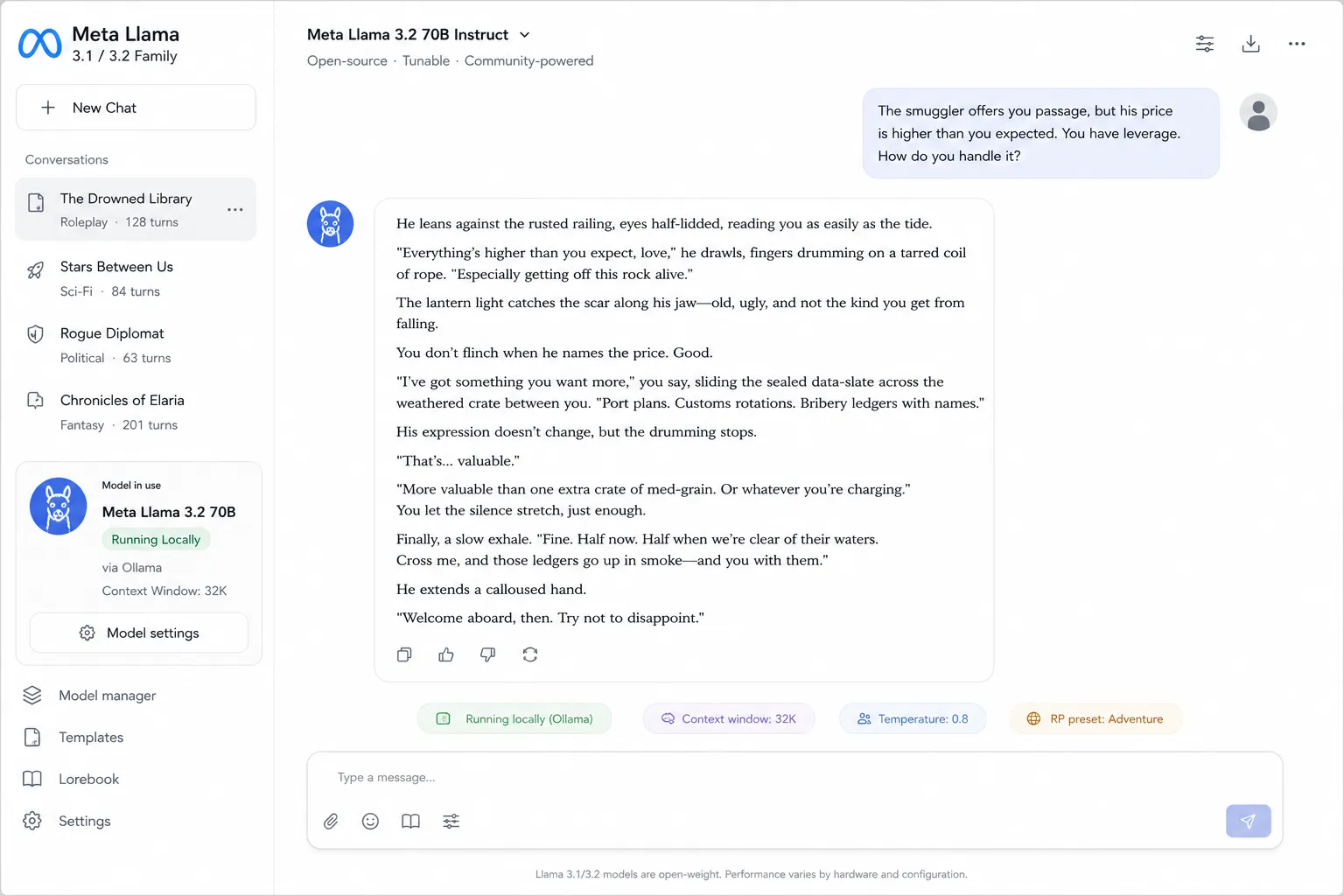
The Llama family is where open-source roleplay really comes into its own. The base models from Meta are strong, but what makes Llama the best open-weight option for RP is the ecosystem around it: hundreds of community fine-tunes specifically optimized for roleplay, uncensored creative writing, and character consistency. Models like MythoMax L2 (built on Llama 2), Psyfighter, and numerous SillyTavern-optimized variants all trace their lineage here.
- Rich ecosystem of RP-specific fine-tunes (MythoMax, Psyfighter, Chronos Hermes)
- Full control over content filters when run locally via Ollama or KoboldCPP
- 32K+ context windows on modern variants, good for sustained narratives
Qwen 3 Family (7B–72B)
Best multilingual roleplay · Creative improvisation · Flexible persona chat
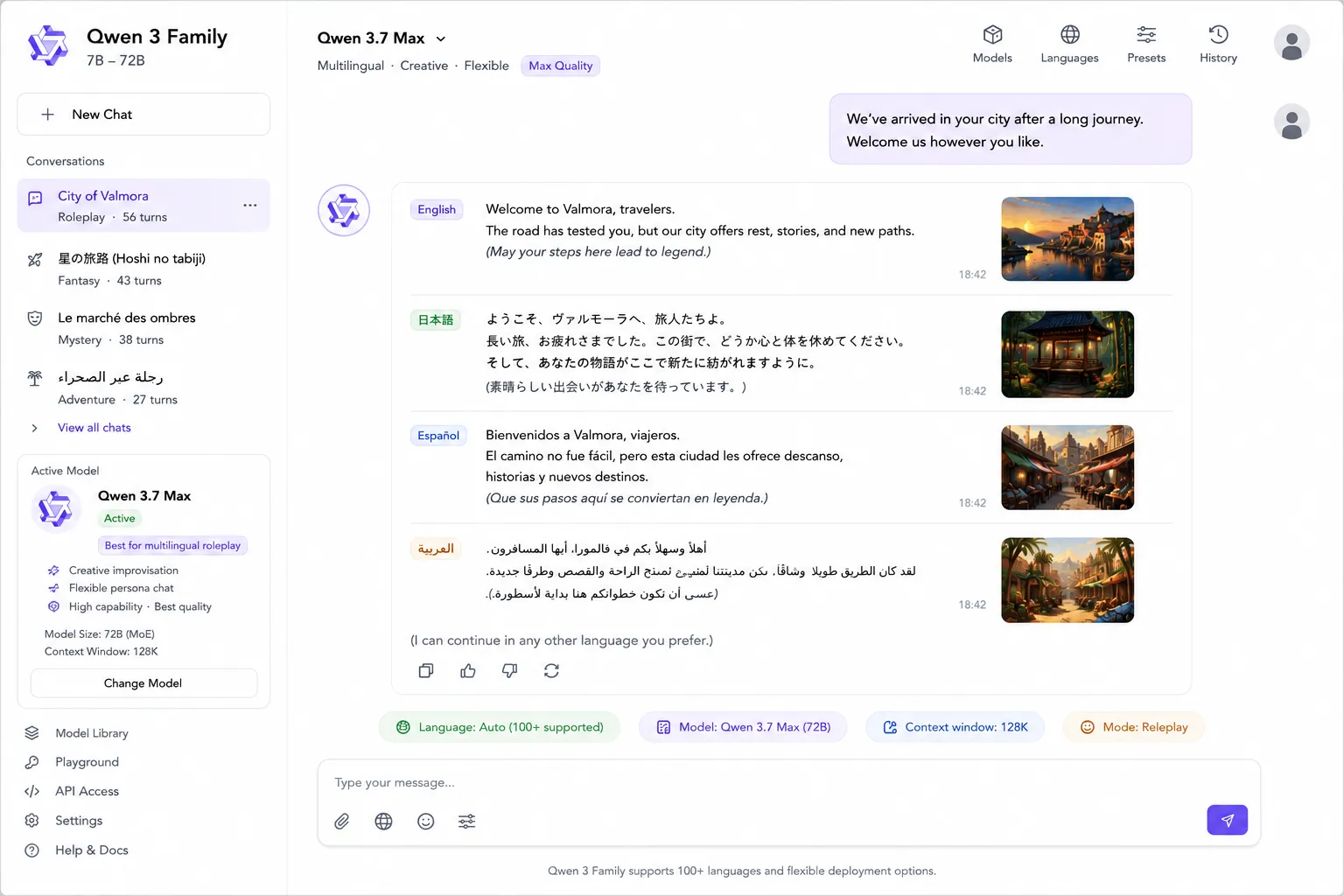
Qwen 3's biggest roleplay advantage is one that gets overlooked in English-language discussions: it performs genuinely well across dozens of languages, not just passably. If you're running multilingual sessions, playing characters from non-English-speaking cultures, or want your RP world to feel linguistically authentic, Qwen has no real competition at this price point.
Beyond multilingual capability, Qwen 3 is a strong creative improviser, it leans into unexpected turns rather than deflecting them, which is one of the most important traits in a roleplay partner. AI/ML API supports the full range from Qwen3.5 through Qwen3.6 and the Max/Plus/Turbo variants of Qwen 3.7, giving you cost-efficient scaling across session complexity.
- Strongest multilingual RP performance of any model in this guide
- Good creative improvisation — adapts to plot twists rather than stalling
- Wide model size range allows budget optimization for different session lengths
DeepSeek V3 / V4
Best for dungeon master logic · Structured scenes · Value-focused API pricing
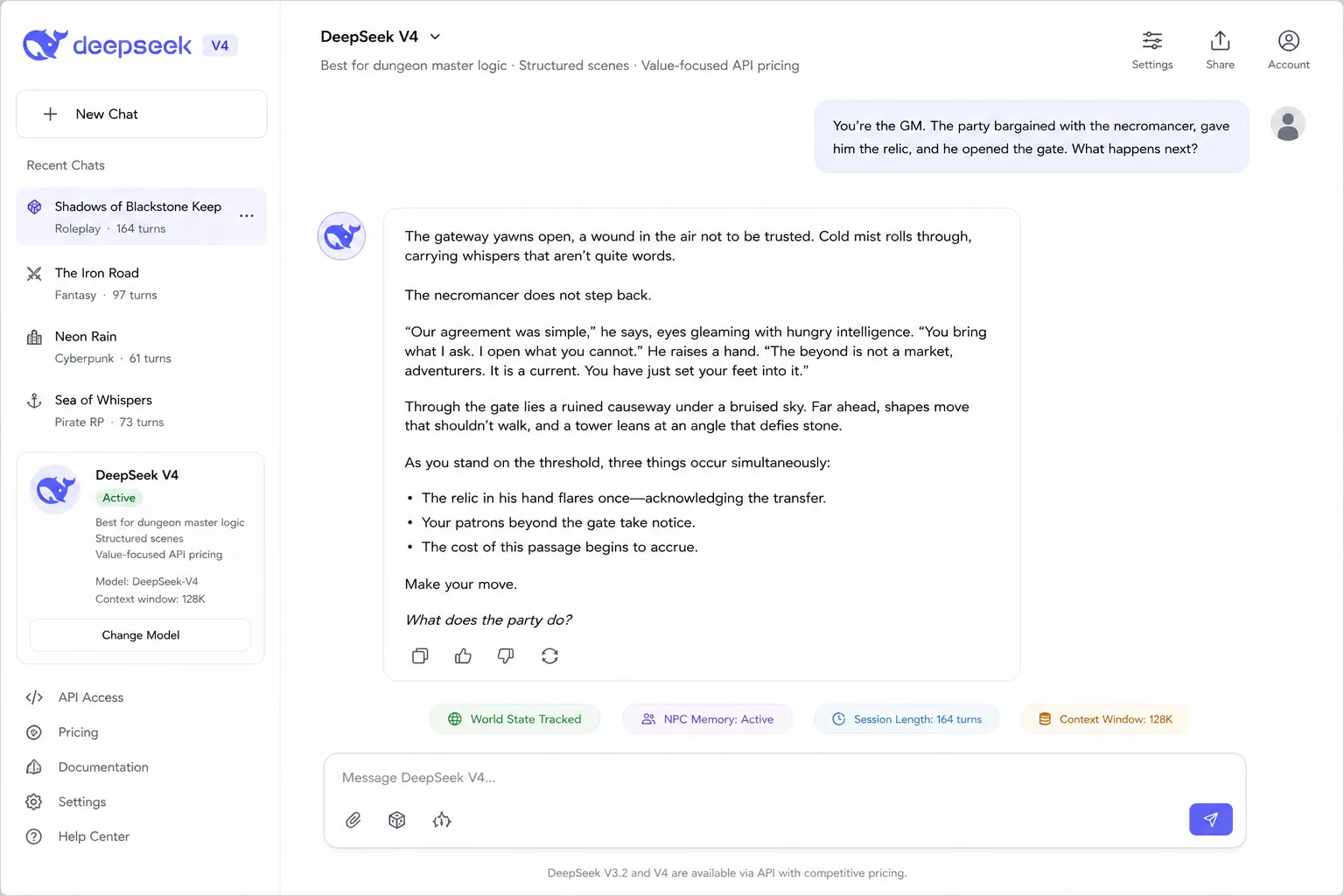
DeepSeek earns its place in this guide through a particular kind of roleplay excellence: internally consistent world logic. When you're running a complex tabletop-adjacent session where cause and effect need to track, where NPC motivations need to hold up under scrutiny, and where player choices should have real downstream consequences, DeepSeek's reasoning architecture shines. It's less about emotional depth and more about the structural integrity of the fictional world you're building together.
DeepSeek V3.2 and V4 are both available through AI/ML API at pricing that makes extended multi-session campaigns economically viable. If you're building a roleplay application on top of an API, DeepSeek often provides the best quality-per-token trade-off for logic-heavy interactions.
- Strong at tracking complex world-state across long sessions
- Excellent for game master / dungeon master style structured roleplay
- Competitive pricing for high-volume or long-running sessions
MythoMax L2 13B
Best for uncensored RP · Exceptional local performance · Long context memory
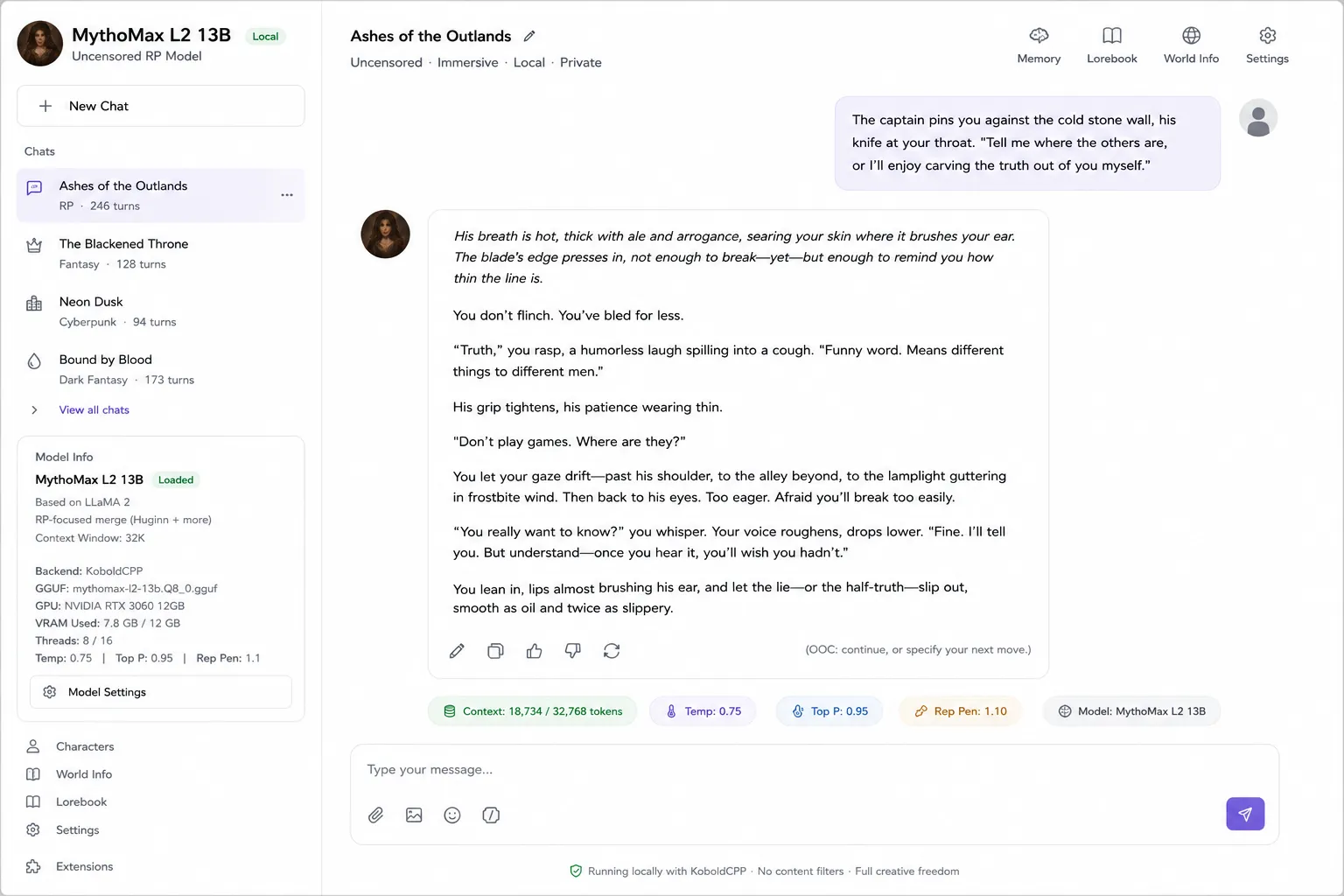
For users who want full creative freedom with zero content moderation, MythoMax L2 13B remains a community benchmark. Built from a merge of LLaMA 2 with Huginn and other RP-focused fine-tunes, it was designed from the ground up for immersive storytelling without restrictions. The 32K context window means it holds detailed character histories and ongoing plot threads without losing the thread, and it handles emotionally complex, dark, or adult themes without the deflections that frustrate serious collaborative fiction writers.
Running it locally via KoboldCPP or SillyTavern gives you complete session privacy and no API costs. A mid-range gaming GPU handles it comfortably, most users with 12GB VRAM report smooth performance.
- No content filters — full creative latitude for mature and complex themes
- 32K context keeps long narratives coherent without manual memory management
- Strong community fine-tune ecosystem for additional specialization
- Runs on consumer hardware; widely available on Hugging Face in GGUF format
Quick Comparison: Best Models on AI/ML API for Roleplay
If you're accessing these through AI/ML API's unified endpoint, here's how they map to specific roleplay scenarios.
Best AI by Roleplay Style
Different roleplay formats demand different model strengths. Here's how to match your use case to the right tool.
Prompt Tips for Better AI Roleplay
The model matters, but how you set it up matters just as much. These techniques will improve character consistency and narrative quality regardless of which model you're using.
- Write a real character sheet, not a one-liner. Include physical description, speech patterns, core motivations, known history, and — crucially — what the character wants in the current scene. The more behavioral detail you give upfront, the longer the model holds the persona without drift.
- Set the stakes in your first message. Don't just describe the setting — establish the tension. What does your character stand to gain or lose? Models with strong narrative judgment will track those stakes across the session if you establish them early.
- Reinforce memory every 15–20 turns. Even models with large context windows benefit from periodic anchoring. A one-sentence recap — "Remember, Aria doesn't know Marcus is dead yet" — costs you nothing and prevents the most common form of persona drift.
- Keep your system prompt lean and specific. A 200-word focused character brief outperforms a 2,000-word sprawl. Prioritize behavioral rules over backstory — tell the model how the character acts, not just who they are.
- For multi-character scenes, assign distinct speech styles. Give each character a verbal tic, a sentence structure preference, or a vocabulary range that's theirs alone. "Vex speaks in clipped sentences and never uses contractions" is more useful than a paragraph of backstory when it comes to keeping voices distinct.
- Use larger context windows when they're available. If your model supports 128K tokens, use it. Copy your character sheets and key plot notes into the system prompt at the start of each session. Session continuity is far better than relying on the model to remember across API calls.
Frequently Asked Questions
What is the best AI for roleplay in 2026?
For most users, MiniMax M2 (Her) leads the field on sustained character consistency and narrative quality across long sessions. Claude Sonnet 4.6 is the better choice if prose quality and psychological depth are your priorities. For uncensored roleplay with full creative control, locally-run open-weight models like MythoMax L2 13B on the Llama lineage offer the most freedom.
Which LLM is best for character chat and companion roleplay?
MiniMax M2, Claude Sonnet 4.6, and GPT-5.5 all perform strongly in one-on-one character chat. MiniMax M2 leads on long-term persona retention. Claude leads on emotional nuance and naturalistic dialogue. GPT-5.5 is the most reliable at honoring a specific character brief you've written out in detail.
What is the best uncensored AI for roleplay?
Open-weight models run locally are the clearest path to genuinely uncensored roleplay. MythoMax L2 13B, Psyfighter 13B, and uncensored Llama 3 variants on Hugging Face are the community standards. Commercial APIs apply content policies from the underlying model providers — the degree of flexibility varies by model, but none will match a locally-run, unfiltered open-weight model.
Which AI is best for fantasy and adventure storytelling?
For fantasy world-building and long-form adventure, the strongest combination is a large context window plus good improvisation. Llama 3.1 405B Turbo (via AIMLAPI or locally), Qwen 3.7, and MiniMax M2 all perform well here. If you want a dungeon master-style experience with logical world consequences, DeepSeek V4 is worth considering specifically for its structured reasoning.
What is the best open-source model for roleplay?
Within the open-weight ecosystem, MythoMax L2 13B has the best community reputation for general RP quality, MN Violet Lotus 12B leads on emotional depth with its 131K context window, and Chronos Hermes 13B is the go-to for long fantasy and sci-fi narratives. All are available as GGUF files on Hugging Face and run on consumer gaming hardware.
Do these AI models remember previous roleplay sessions?
By default, most LLMs don't retain memory across separate API calls or sessions — each new conversation starts fresh. You can work around this by including a summary of previous sessions in your system prompt, using tools with built-in persistent memory features, or choosing platforms that offer session continuity. Within a single session, models with large context windows handle long conversations very well.