
Gemini 3.5 Pro: Everything You Need to Know
Release Status: Coming June 2026
Gemini 3.5 Flash launched at Google I/O on May 19, 2026 and is already live. Sundar Pichai confirmed on stage that Gemini 3.5 Pro is currently in internal use at Google and will roll out to the public next month. The audience was audibly disappointed, but the wait signals that Pro is being polished to address specific reasoning gaps that Flash left open.
What Is Gemini 3.5 Pro?
Gemini 3.5 Pro is the flagship model in Google DeepMind's next generation of AI — a step above 3.5 Flash on raw reasoning depth and long-context recall, while sharing the same agentic foundation that made Flash the surprise story of Google I/O 2026. Think of Flash as the turbocharged sprint runner; Pro is the ultra-marathoner that also happens to sprint pretty well.
The Gemini 3.5 series was built around one central thesis: frontier intelligence isn't useful if it can't act. Every architectural decision prioritizes agentic execution — the ability to plan, iterate, use tools, coordinate subagents, and complete multi-step tasks without constant human guidance. Pro inherits that orientation but adds heavier reasoning capacity on top.
How It Fits Into Google's Model Lineup
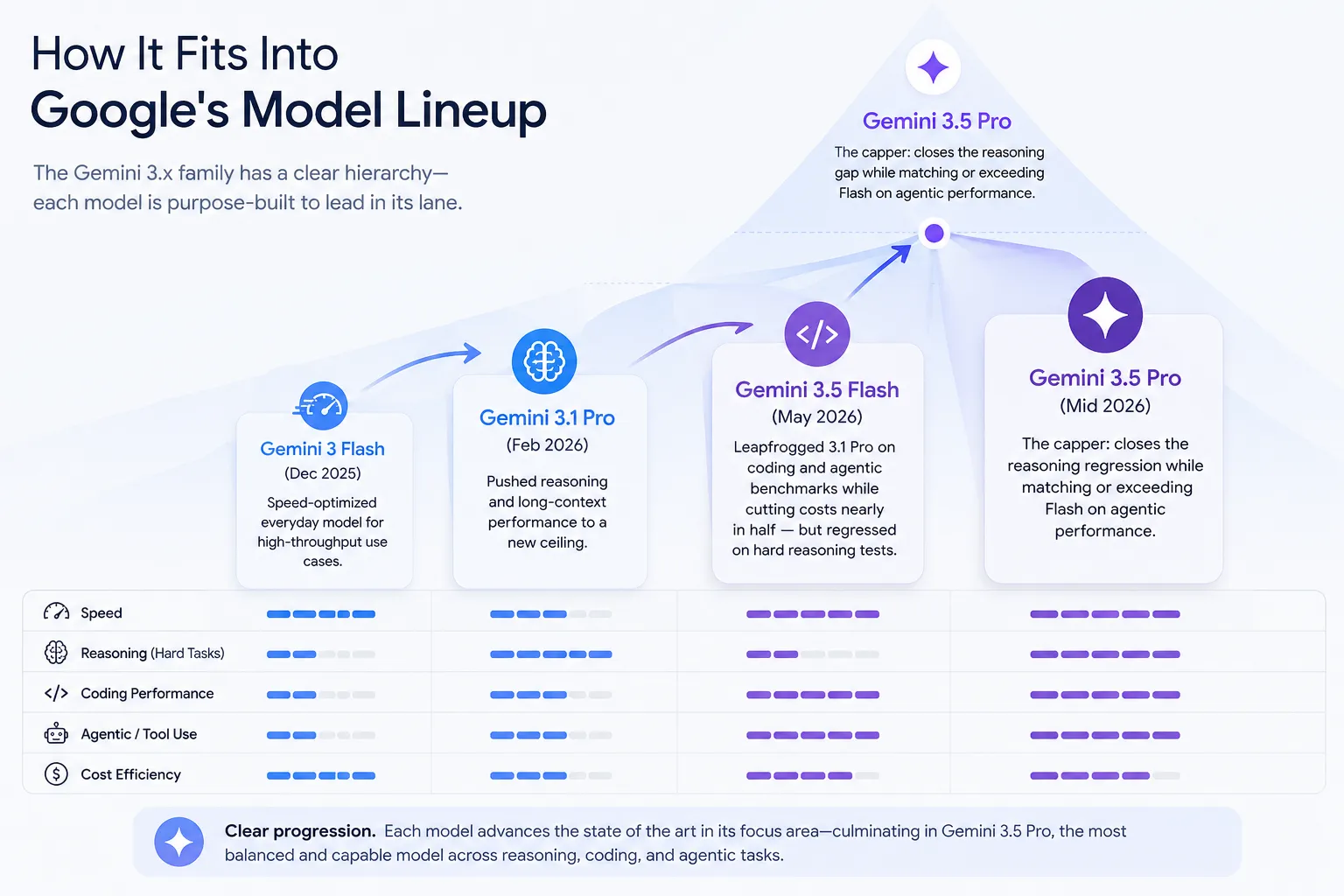
The Gemini 3.x family now has a clear hierarchy. Gemini 3 Flash (released December 2025) was Google's speed-optimized everyday model. Gemini 3.1 Pro (February 2026) pushed reasoning and long-context performance to a new ceiling. Gemini 3.5 Flash then leapfrogged 3.1 Pro on coding and agentic benchmarks while cutting costs nearly in half — but regressed on hard reasoning tests. Gemini 3.5 Pro is the capper: designed to close that regression while matching or exceeding Flash on agentic performance.
Core Features & What to Expect
Google has been deliberately tight-lipped about Pro's specifics — no model card, no API pricing, no benchmarks as of May 27, 2026. But the 3.5 Flash launch was unusually transparent about the architecture, and the regression data makes it clear what Pro was built to fix.
The Antigravity Connection
One of the underappreciated aspects of the 3.5 series is how tightly it's integrated with Google Antigravity — the agentic development platform Google released alongside Gemini 3. With Antigravity, Pro won't just write code: it can deploy subagents that operate in parallel, iterate across multiple reasoning passes, and maintain context across genuinely long-horizon tasks. Think weeks-long autonomous workflows, not just single-session help.
For teams already on Antigravity, Pro represents a significant capability jump — the same platform, with a model that can handle the reasoning complexity that Flash occasionally stumbles on.
Thinking Mode: The Open Question
One of the most watched unknowns going into the June launch is whether Gemini 3.5 Pro will ship with a dedicated "thinking" mode — an optional deep-reasoning pass that trades latency for accuracy. Google's recent models (notably Gemini 3 Deep Think) have offered this, and Pro would be a natural fit. Per-request thinking control would make Pro significantly more versatile: fast for routine tasks, deep when the problem demands it.
Benchmark Data: What We Know Now
Official Pro benchmarks aren't public yet, but the 3.5 Flash data tells a clear story. The table below shows where Flash landed and where Pro needs to improve to justify its premium tier.
If Pro matches Flash on the top four benchmarks AND closes the gap on the bottom three, it becomes the strongest all-around frontier model in production, better than Claude Opus 4.6 on agents, better than GPT-5.5 on long-context recall. That's the scenario Google is building toward.
Gemini 3.5 Pro vs GPT-5.5 vs Claude
Until Pro ships with a model card, any direct comparison is partly speculative, but based on Flash's launch data and what we know about the competitor landscape in May 2026, here's a realistic picture.
Gemini 3.5 Pro vs GPT-5.5
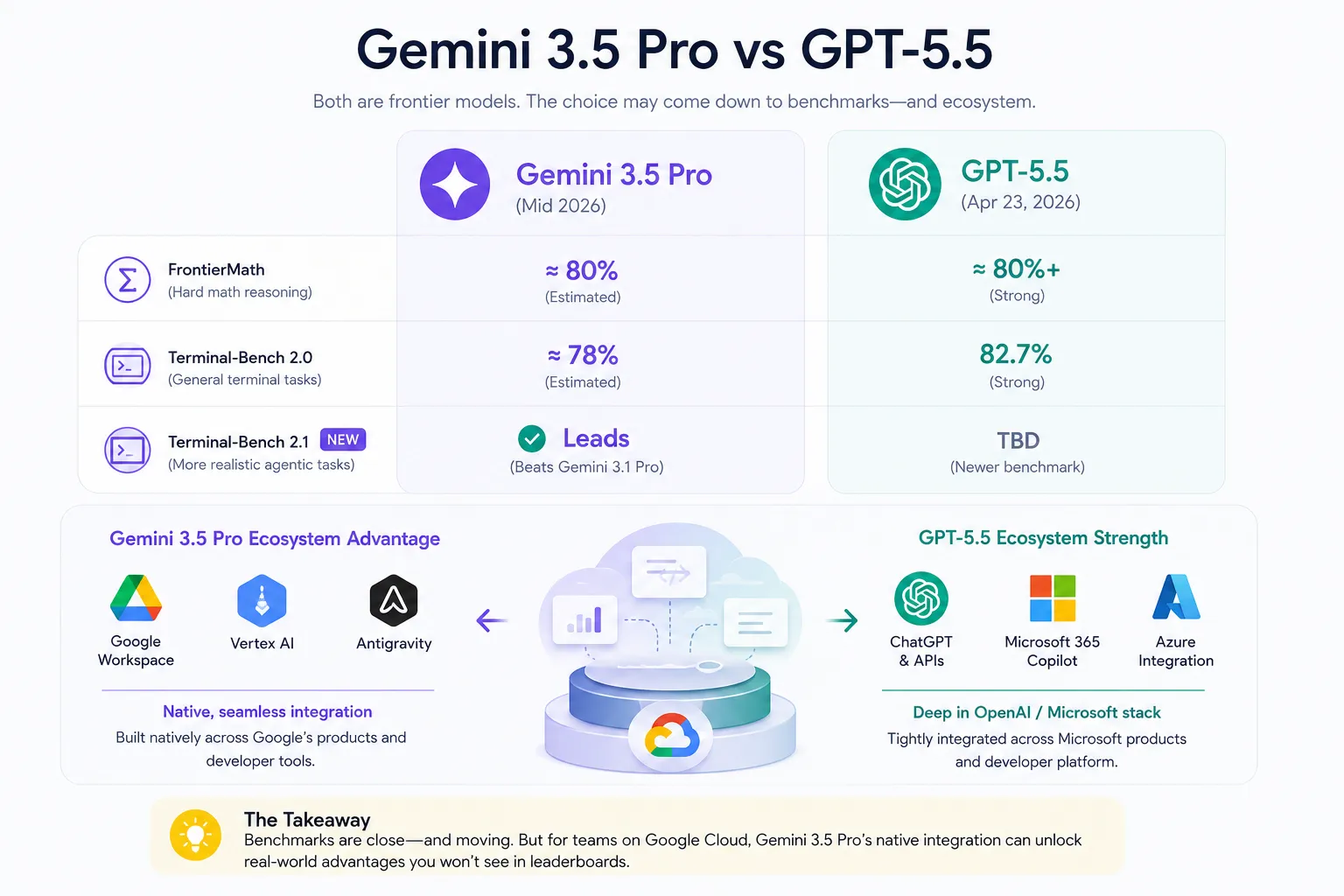
OpenAI's GPT-5.5 (released April 23, 2026) posts strong numbers on FrontierMath and Terminal-Bench 2.0 (82.7%). However, Flash already beats Gemini 3.1 Pro on the newer Terminal-Bench 2.1 metric. If Pro improves further, it's a genuine contest. The more important distinction may be ecosystem: GPT-5.5 is deep in the OpenAI/Microsoft stack, while Gemini 3.5 Pro is native to Google Workspace, Vertex AI, and Antigravity. For teams already building on Google Cloud, Pro's integration advantages are real and not benchmark-visible.
Gemini 3.5 Pro vs Claude Opus 4.6
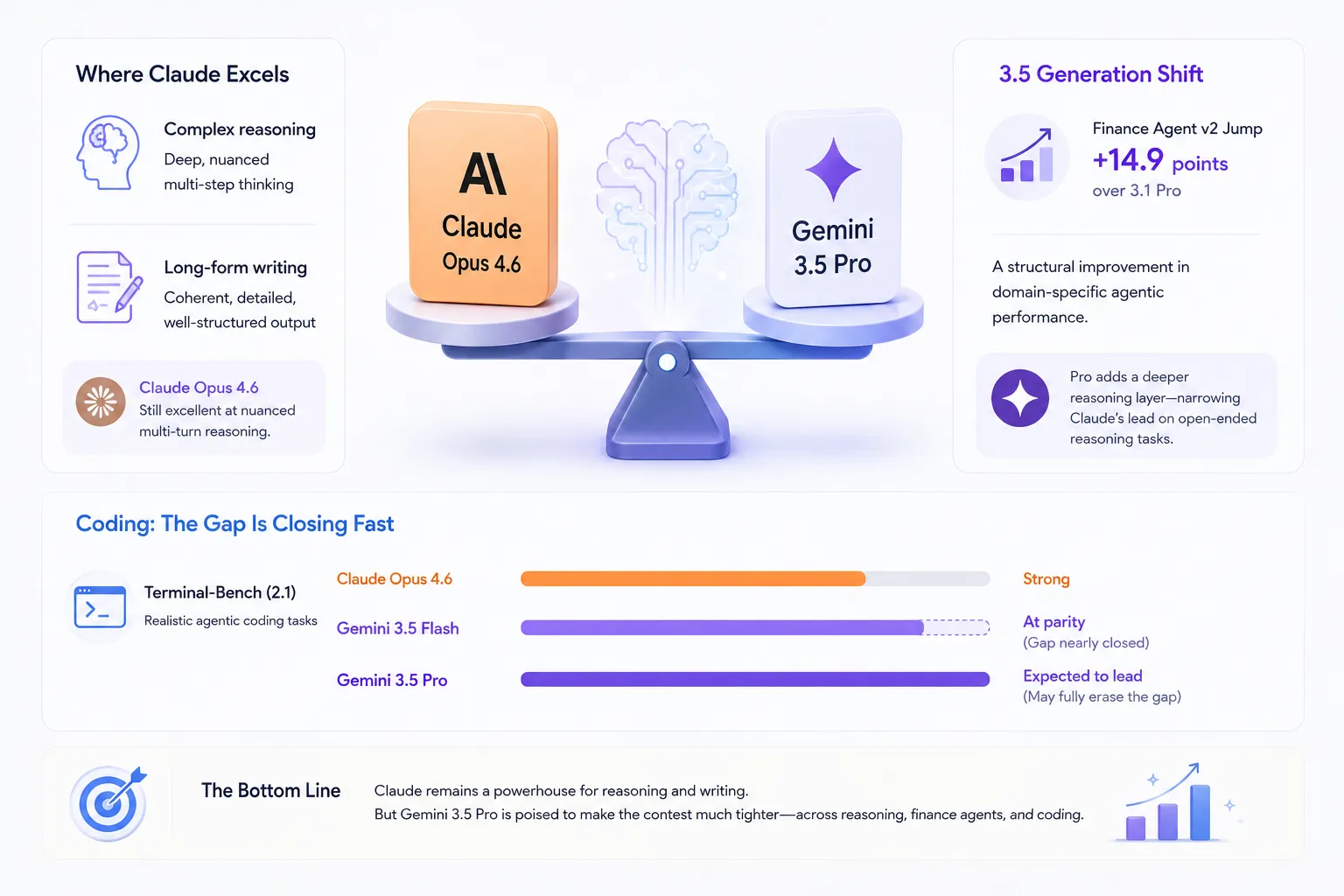
Anthropic's Claude series has been the developer default for complex reasoning and long-form writing tasks. Claude Opus 4.6 remains excellent at nuanced multi-turn reasoning. But Flash's Finance Agent v2 jump (+14.9 points over 3.1 Pro) suggests that the 3.5 generation has made a structural improvement in domain-specific agentic performance. Pro, with its deeper reasoning layer, could make Claude's lead on open-ended reasoning tasks much narrower. For coding specifically, the Terminal-Bench data already suggests 3.5 Flash has closed the gap — Pro may fully erase it.
Gemini 3.5 Pro vs Gemini 3.5 Flash
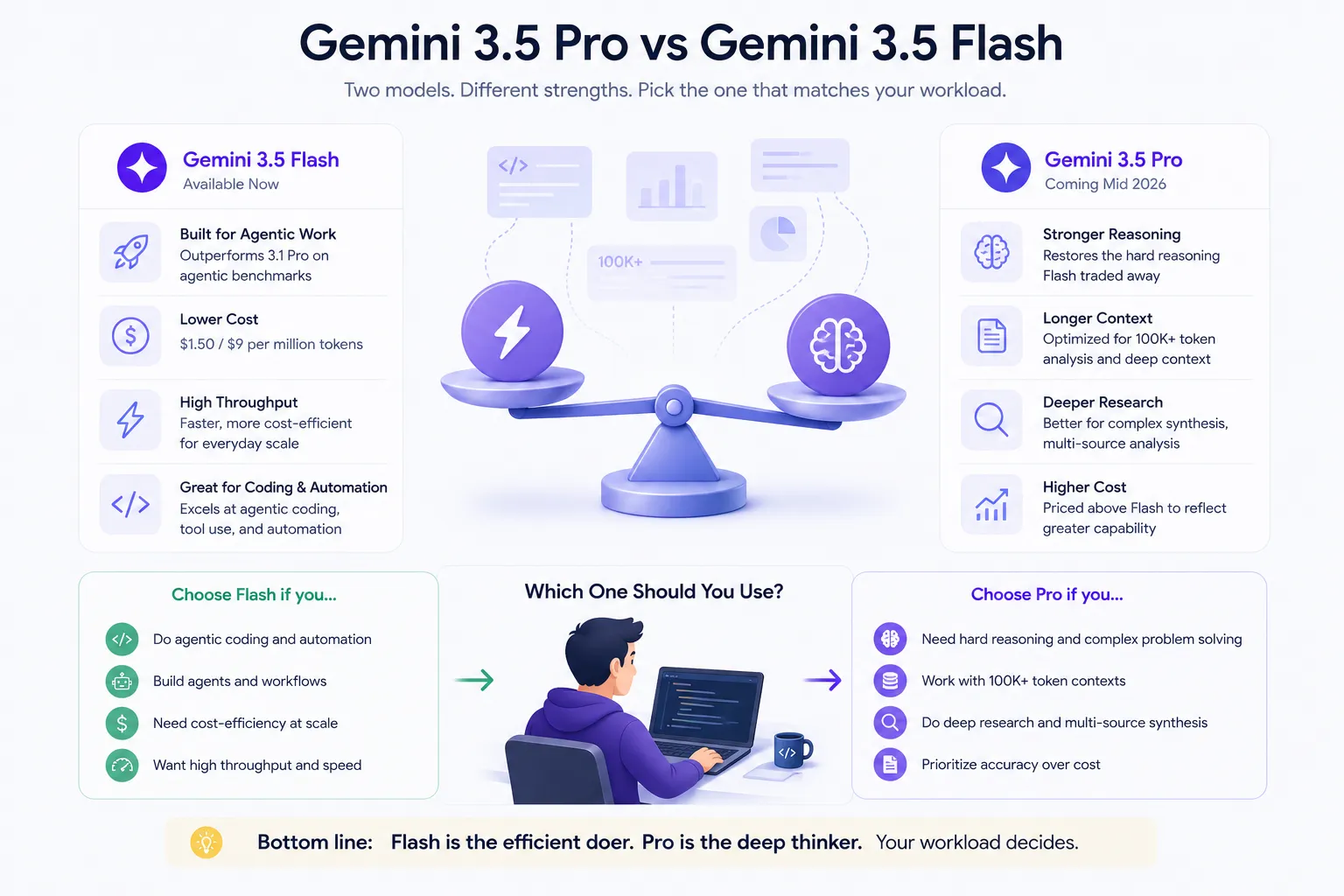
This is the most practically useful comparison for most developers. Flash is already available, costs $1.50/$9 per million tokens, and outperforms 3.1 Pro on everything agentic. Pro will cost more but should restore the reasoning and long-context performance that Flash traded away. The right choice depends entirely on your workload: if you're doing agentic coding and financial automation, Flash may genuinely be enough. If you need hard reasoning, 100K+ token analysis, or deep research synthesis, wait for Pro.
Gemini 3.5 Pro Pricing: What to Expect
No official pricing has been announced. But the Flash launch at $1.50/$9 per million tokens (40% cheaper than 3.1 Pro on both axes) gives a useful baseline. Three plausible scenarios:
Gemini 3.5 Pro Use Cases & Workflows
While Flash covers a huge range of tasks, Pro's deeper reasoning and stronger long-context handling opens specific workflows that have been genuinely difficult for current models.
01 Complex Document Analysis for Legal & Finance
Macquarie Bank is already piloting Flash for 100+ page document reasoning. Pro's restored long-context accuracy makes it even better suited for legal due diligence, regulatory filings, multi-contract comparison, and multi-week financial workflow automation — exactly the kind of task where a 7-point accuracy regression matters enormously.
02 Gemini 3.5 Pro for Coding & Software Development
Flash already beats previous-generation Pro on coding benchmarks. Pro should be a strict superset — matching Flash's Terminal-Bench and MCP Atlas scores while adding the reasoning depth needed for legacy codebase refactors, architectural planning, and complex debugging sessions. Paired with Antigravity, this becomes a full autonomous coding pipeline.
03 Gemini 3.5 Pro for Content Creation
Long-context recall is the backbone of serious content work — synthesizing research across dozens of sources, maintaining topical consistency across a 10,000-word piece, and generating structured output without losing thread. Pro's expected improvement here makes it the better choice for long-form content marketing, technical writing, and content operations at scale.
04 Enterprise Agentic Automation
Companies like Xero and Salesforce are already deploying Flash-based agents for multi-week autonomous workflows — supplier identification, CRM automation, tax form management. Pro's deeper reasoning layer will handle the exception cases and ambiguous judgment calls that require more than pattern matching: the decisions where getting it wrong is expensive.
05 Research Synthesis & Data Science
Databricks is using 3.5 Flash agents for real-time data diagnostics. Pro's restored long-context and reasoning scores make it better suited for deep research synthesis — reading across large datasets, identifying cross-source patterns, and producing analyses that hold up under scrutiny rather than just looking plausible.
06 Gemini 3.5 Pro for Business Productivity
For knowledge workers using Google Workspace, Pro as the Gemini app's backend model (once it replaces Flash there) means smarter email drafts, better meeting summaries, more accurate spreadsheet reasoning, and document analysis that doesn't truncate at 32K tokens. The Gemini Spark personal agent, currently running on Flash, will likely upgrade to Pro for complex task delegation.
Prompt Tips for Getting the Most Out of Gemini 3.5 Pro
Pro's architecture emphasizes agentic capability and deep reasoning, which means the prompting patterns that worked for purely conversational models need updating. These principles apply to Flash today and will apply to Pro at launch.
The best way to know if Gemini 3.5 Pro is worth switching to is running it against your actual workload. AI/ML API lets you do exactly that: Gemini 3.5 Flash and 3.1 Pro are available now, GPT-5.5 and Claude are right alongside them, and 3.5 Pro will be added at launch.
Frequently Asked Questions
Is Gemini 3.5 Pro available now?
No. As of May 27, 2026, Gemini 3.5 Pro is only available internally at Google. Gemini 3.5 Flash is live and available to everyone via the Gemini app, Google AI Studio, Vertex AI, Antigravity, and the Gemini API. Flash already exceeds Gemini 3.1 Pro on most coding and agentic benchmarks, making it worth using today.
Is Gemini 3.5 Pro good for coding?
The evidence strongly suggests yes. Even 3.5 Flash — the lighter-weight model — already outperforms the previous-generation 3.1 Pro on Terminal-Bench 2.1 (76.2% vs 70.3%) and MCP Atlas (83.6% vs 78.2%). Pro is expected to match or exceed those scores while also improving on the complex reasoning tasks where Flash regressed. For autonomous coding with Antigravity, it should be the strongest available option at launch.
How does Gemini 3.5 Pro compare to ChatGPT for writing?
GPT-5.5 is genuinely strong at long-form writing tasks. Gemini 3.5 Pro's advantage will likely come from long-context accuracy — if you're writing content that requires synthesizing large research corpora, Pro's restored 128K+ recall should produce more accurate, less hallucinated output. For style and tone, both models are competitive. Flash's current regression on long-context tasks means this comparison will be clearer after Pro launches with its full model card.
What's the Gemini 3.5 Pro context window?
Not officially confirmed. Gemini 3.5 Flash ships with a 1M-token input context window. Pro is expected to match or exceed this. The key difference isn't window size — it's accuracy within that window. Flash dropped significantly on 128K benchmark recall tests vs 3.1 Pro. Restoring that accuracy at scale is one of Pro's primary design goals.
Should I use Gemini 3.5 Flash now or wait for Pro?
Use Flash now if your workload is primarily agentic coding, financial automation, or multimodal tasks. Flash already beats 3.1 Pro on those benchmarks at lower cost and higher speed. Wait for Pro if your work involves hard reasoning tasks (math, logic, abstract problem-solving), long document analysis at 128K+ tokens, or research synthesis where accuracy is non-negotiable. Run your actual evals against Flash this week — if Flash passes them, you may not need Pro at all.