
Meet Grok Build 0.1 The Model That Codes Like an Agent
What Is Grok Build 0.1?
Released by xAI on May 29, 2026 in public beta, Grok Build 0.1 is a coding model with a specific and deliberate purpose: to function as an autonomous software engineering agent, not just a code-completion helper. While most language models can answer programming questions or fill in a function body, Grok Build 0.1 is trained from the ground up to handle end-to-end development tasks — planning what needs to be done, executing the work step by step, debugging failures along the way, and integrating cleanly with the tools developers already rely on.
The model is the exact same one powering the Grok Build CLI, xAI's agentic command-line tool that was introduced in early beta for SuperGrok Heavy subscribers. When xAI decided to make that underlying model available directly through their API, grok-build-0.1 became accessible to any developer who wants to embed similar capabilities inside their own products, scripts, or multi-agent pipelines.
To be clear about what sets it apart: this is not the same architecture as Grok 4 or its predecessors. The underlying weights were trained from scratch on a corpus heavily weighted toward real programming content — pull requests, open-source repositories, debugging sessions, and documentation. The result is a model whose instincts are genuinely oriented toward code, not adapted from a general-purpose foundation.
- Quick context: The model was previously known under the aliases
grok-code-fast-1,grok-code-fast, andgrok-code-fast-1-0825. If you were already using any of those identifiers,grok-build-0.1is the same model under its official, versioned name.
Model Specifications at a Glance
Here's the full technical picture for grok-build-0.1, pulled from the official xAI documentation and API console.
What Grok Build 0.1 Is Designed to Do
Grok Build 0.1 doesn't try to be everything, it's deliberately scoped for the kinds of tasks where speed, precision, and tool-awareness matter most. That focus shows up clearly in how it performs in practice.
The Grok Build CLI — Where This Model Lives Natively
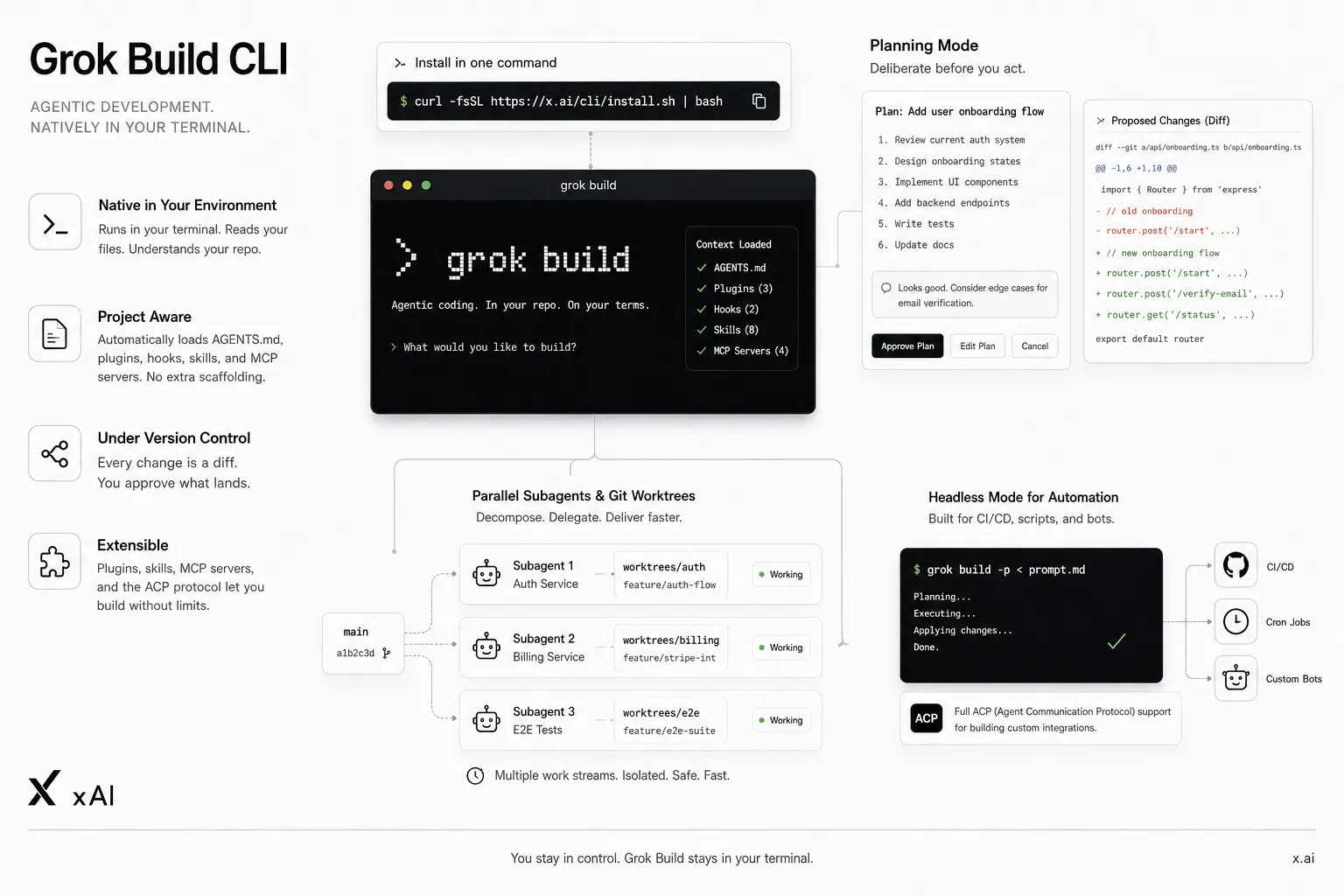
To understand Grok Build 0.1 properly, it helps to understand the CLI it powers. Grok Build is xAI's answer to the agentic developer tool trend — a command-line agent that you install once and run directly inside your terminal, alongside your actual codebase. Unlike browser-based tools that operate at a distance, it runs in your environment, reads your files, and interacts with your repository state directly.
Installing it takes one command:
curl -fsSL https://x.ai/cli/install.sh | bash
Once installed, the CLI automatically picks up your repository's configuration — AGENTS.md files, registered plugins, lifecycle hooks, skills, and any connected MCP servers. There's no additional scaffolding required. The agent reads your project context and gets to work.
Planning Mode — Deliberate Before Acting
For non-trivial tasks, Grok Build offers a structured planning mode. Before touching a single file, the agent drafts a step-by-step plan describing what it intends to do and why. You can review that plan, leave comments, approve it as-is, or rewrite it entirely before execution begins. Once approved, every change is shown as a diff, so you remain in control of exactly what lands in your codebase.
Parallel Subagents and Git Worktrees
Large tasks can be decomposed and delegated. The CLI supports spinning up parallel subagents, each working on a separate branch via git worktree — a technique that allows multiple work streams to operate simultaneously without interfering with each other. For projects with clearly separable concerns (separate services, different feature areas, independent test suites), this can meaningfully compress the time to completion.
Headless Mode for Automation
Developers who want to embed Grok Build in CI/CD pipelines, scheduled scripts, or other automated workflows can use the -p (headless) flag. In this mode, the agent runs non-interactively, consuming a prompt from stdin or a file and producing output that can be piped into downstream tooling. Full ACP (Agent Communication Protocol) support is also available for anyone building custom bots or orchestration layers on top.
Cost Structure and Rate Limits
The pricing for Grok Build 0.1 is straightforward and positioned competitively for high-throughput agentic use cases. At a token-per-second speed that rivals or exceeds most models in its class, the economics become particularly favorable for long-running agent sessions where total cost per task is what matters.
- Input Tokens: $1.00 per 1 million tokens
- Cached Input Tokens: $0.20 per 1 million tokens. 80% savings on cache hits
- Output Tokens: $2.00 per 1 million tokens
One nuance worth knowing: requests that exceed the 200K token mark within the 256K context window are charged at a higher rate. For most coding tasks this threshold is unlikely to be hit, but for workflows that pass in large codebases or extensive conversation history, it's worth keeping in mind.
Prompt caching is supported and can dramatically reduce costs in scenarios where the same large system prompt or file context is reused across many calls — common in agentic pipelines that operate over the same repository across a session.
Rate Limits
The model supports up to 1,800 requests per minute and 10 million tokens per minute, which is generous enough for most production agentic workloads. For teams that need higher capacity, xAI offers provisioned throughput options and an official form to request increased limits.
Where Grok Build 0.1 Works Right Now
Beyond the native CLI and direct API access, grok-build-0.1 is already integrated into a growing number of third-party developer tools. xAI has been deliberate about expanding the model's reach quickly, and the result is that many developers can start using it inside tools they already have installed.
Grok Build 0.1 vs. Other Agentic Coding Models
The agentic coding model space in 2026 has consolidated into a genuine competition. Anthropic's Claude Code and OpenAI's Codex CLI both have significant market traction — Claude Code alone has been cited as a primary driver behind Anthropic's growth trajectory, and Codex CLI reportedly crossed one million developers in its first month. Grok Build 0.1 enters this environment with some clear differentiators and a few areas where it's still establishing its track record.
Real-World Use Cases Where Grok Build 0.1 Excels
Knowing a model's stated capabilities is useful; knowing where it genuinely adds value is more useful. Here are the scenarios where grok-build-0.1 tends to shine, based on its design characteristics and the workflows it was trained on.
Access Grok Build 0.1 alongside 400+ other leading AI models through a single unified API — no juggling multiple keys, no switching SDKs.
Common Questions About Grok Build 0.1
Is this the same as Grok 4?
No. Grok Build 0.1 was built from scratch separately from the Grok 4 lineage, with a training approach focused specifically on programming content and agentic task execution. It's a different model serving a different purpose.
Can it handle non-coding tasks?
Yes, xAI notes it works well for general-purpose agentic and tool-calling tasks even outside of software development. The reasoning capabilities and structured output support transfer broadly. That said, its training is most densely focused on coding workflows.
What image inputs does it accept?
The model supports standard image formats (PNG, JPEG, WEBP) passed as base64 or URL references. This is particularly useful for passing in UI mockups, architecture diagrams, or visual specifications alongside text prompts.
Is the output length actually unlimited?
There's no hard output cap enforced by the model itself, though very long outputs will naturally accrue token costs at the standard output rate. In practice, extremely long generations may be limited by API timeout configurations on the client side.
How does prompt caching work?
Cached input tokens are billed at $0.20/M — an 80% discount off the standard $1.00/M rate. Caching activates automatically for repeated identical system prompt prefixes, making it most valuable when you reuse the same large context (like a full repository or lengthy spec doc) across many API calls.