


1M

3.9

19.5


Chat

Active
Claude Sonnet 4.6
Positioned as the core workhorse in the Claude 4.6 family, it powers everything from autonomous agents to enterprise document workflows.



Claude Sonnet 4.6 is a versatile frontier‑class AI model built for real‑world use: it combines strong reasoning and coding performance with responsive latency and practical features for production deployment.
Claude Sonnet 4.6 is a high-performance AI model built for developers who need reliable reasoning, fast response times, and predictable costs at scale. It sits in a sweet spot between lightweight models that struggle with complex tasks and heavyweight systems that are too slow or expensive for real-world use.
From the very first integration, it feels less like an experimental tool and more like infrastructure you can depend on. If your goal is to ship AI features that users actually interact with daily, Claude Sonnet 4.6 is designed with that reality in mind.
Most models force a compromise. You either get strong reasoning with high latency, or fast responses with shallow outputs. Claude Sonnet 4.6 is engineered to reduce that gap. It delivers consistent performance across typical production workloads: user queries, document processing, automation pipelines. Instead of optimizing purely for benchmarks, it focuses on stability under real conditions, something that becomes critical once you move beyond prototypes.
The result is a model that behaves predictably, even as usage scales.
Claude Sonnet 4.6 is clearly designed with production environments in mind. Every part of its behavior, from latency to output structure, reflects that.
Speed is not just a technical metric; it directly impacts user experience. Delays break conversations, slow down workflows, and reduce engagement.
Claude Sonnet 4.6 responds quickly enough to feel interactive, even in applications that rely on continuous back-and-forth communication. Whether it’s a support assistant, a writing tool, or an internal chatbot, the model maintains responsiveness without sacrificing clarity or structure.
Scaling AI is expensive, and cost becomes a limiting factor faster than most teams expect. Claude Sonnet 4.6 addresses this by offering a strong cost-to-performance ratio.
Instead of paying premium pricing for marginal gains, you get a model that handles the majority of real-world tasks efficiently. This makes it easier to expand usage, test new features, and support more users without constantly worrying about budget constraints.
One of the most common bottlenecks in production AI systems is throughput. As soon as usage grows, rate limits and delays start to appear.
Claude Sonnet 4.6 is built to handle higher volumes of requests, making it suitable for live products with active users. It performs reliably even when multiple requests are processed in parallel, which is essential for SaaS platforms and backend automation systems.
Claude Sonnet 4.6 is versatile enough to cover a wide range of tasks without constant model switching.
The model produces structured, readable, and context-aware text across different formats. It adapts well to both conversational and formal outputs, which makes it suitable for everything from chat interfaces to long-form content generation.
Unlike smaller models, it maintains coherence over extended responses. This reduces the need for heavy prompt engineering or post-editing, especially in professional workflows.
Claude Sonnet 4.6 handles multi-step reasoning with a level of consistency that is difficult to achieve with lightweight models.
It can break down problems, follow instructions precisely, and generate logical explanations that are easy to follow. This makes it particularly useful for developer tools, analytical workflows, and structured decision-making tasks.
In real-world applications, inputs are rarely short. Documents, conversations, and datasets require models that can retain context over time.
Claude Sonnet 4.6 processes longer inputs without losing coherence. This enables use cases like document summarization, internal knowledge assistants, and multi-turn conversations that feel continuous rather than fragmented.
Modern applications increasingly rely on more than just text. Claude Sonnet 4.6 can process both text and images, which expands the types of products you can build.
From analyzing screenshots to extracting information from visual documents, the model allows developers to create richer, more interactive experiences without stitching together multiple systems.
In internal and external evaluations, Sonnet 4.6 demonstrates strong agentic coding and tool‑using abilities across long‑context scenarios. It is noticeably stronger on difficult problems where Sonnet 4.5 struggled, especially in complex debugging, planning, and multi‑document reasoning. On enterprise document comprehension, OfficeQA results indicate that it can match Opus 4.6, underscoring its suitability for high‑stakes business workflows.
Building on being one of the first frontier models with robust computer‑use abilities, Sonnet 4.6 significantly improves navigation and reliability in digital environments. This unlocks more complex browser‑ and desktop‑based automations that previously required human operators.
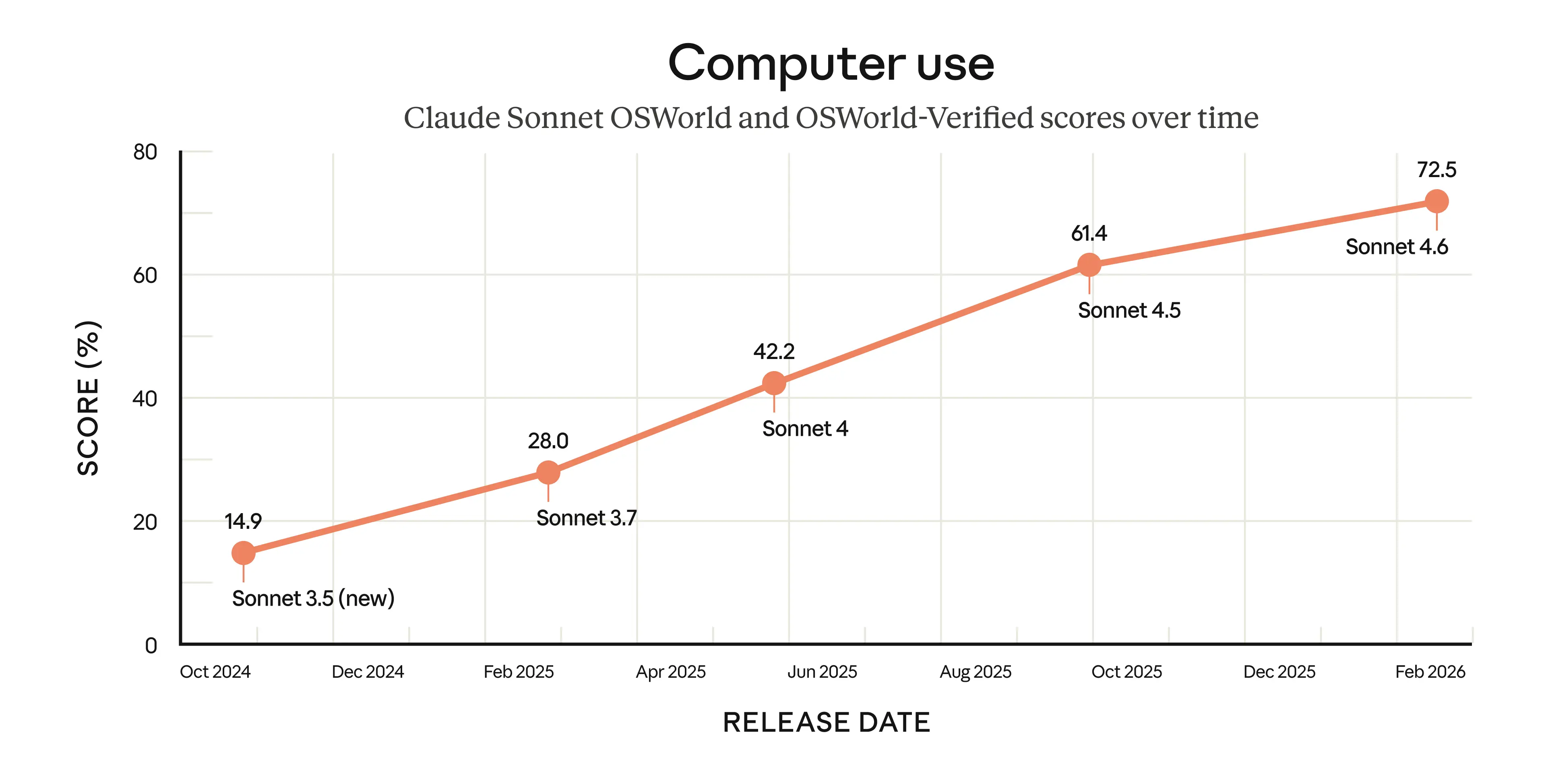
Claude Sonnet 4.6 is not built for demos, it is designed for deployment in real products.
Support teams often deal with repetitive queries that still require accurate and context-aware responses. Claude Sonnet 4.6 can handle these interactions in a way that feels natural and consistent.
It helps reduce workload while maintaining response quality, which improves both efficiency and user satisfaction.
For teams building content platforms, the model provides a strong foundation for writing assistants, editing tools, and SEO workflows.
It generates structured content, adapts tone when needed, and follows detailed instructions reliably. This makes it suitable for professional environments where quality matters.
Claude Sonnet 4.6 supports coding workflows by assisting with generation, debugging, and documentation.
It is fast enough to be used interactively and reliable enough to reduce friction during development. While it may not replace highly specialized models, it offers a practical balance for everyday engineering tasks.
Organizations often need to extract meaning from large volumes of unstructured data. Claude Sonnet 4.6 helps transform that data into structured insights.
It can summarize reports, extract key information, and support internal analytics workflows without requiring complex pipelines.
Many of the most valuable AI applications are internal. Claude Sonnet 4.6 is well-suited for building knowledge assistants, workflow automation tools, and decision-support systems.
Its ability to handle long context makes it particularly effective in environments where information is spread across multiple sources.
Gemini 3.1 is Google’s latest serious competitor, optimized for scale, cost, and speed.
Where Gemini 3.1 wins:
Where Claude Sonnet 4.6 wins:
GPT-5.3 Codex is designed specifically for coding workflows and agent-style development.
Where GPT-5.3 Codex wins:
Where Claude Sonnet 4.6 wins:
Many teams use Codex for execution-heavy tasks, but rely on Sonnet for planning, reasoning, and writing.
Integration should not slow down development. Claude Sonnet 4.6 is accessible through a straightforward API that fits naturally into modern stacks.
Whether you are building a new product or enhancing an existing one, the model can be integrated quickly and adapted to different environments without friction.
Teams consistently choose this model because it works well in production. It is fast enough for real-time applications, stable enough for continuous workloads, and cost-efficient enough to scale. Integration is straightforward, and maintenance overhead is minimal.
Over time, these factors compound into a smoother development experience and a more reliable product.
Claude Sonnet 4.6 is a high-performance AI model built for developers who need reliable reasoning, fast response times, and predictable costs at scale. It sits in a sweet spot between lightweight models that struggle with complex tasks and heavyweight systems that are too slow or expensive for real-world use.
From the very first integration, it feels less like an experimental tool and more like infrastructure you can depend on. If your goal is to ship AI features that users actually interact with daily, Claude Sonnet 4.6 is designed with that reality in mind.
Most models force a compromise. You either get strong reasoning with high latency, or fast responses with shallow outputs. Claude Sonnet 4.6 is engineered to reduce that gap. It delivers consistent performance across typical production workloads: user queries, document processing, automation pipelines. Instead of optimizing purely for benchmarks, it focuses on stability under real conditions, something that becomes critical once you move beyond prototypes.
The result is a model that behaves predictably, even as usage scales.
Claude Sonnet 4.6 is clearly designed with production environments in mind. Every part of its behavior, from latency to output structure, reflects that.
Speed is not just a technical metric; it directly impacts user experience. Delays break conversations, slow down workflows, and reduce engagement.
Claude Sonnet 4.6 responds quickly enough to feel interactive, even in applications that rely on continuous back-and-forth communication. Whether it’s a support assistant, a writing tool, or an internal chatbot, the model maintains responsiveness without sacrificing clarity or structure.
Scaling AI is expensive, and cost becomes a limiting factor faster than most teams expect. Claude Sonnet 4.6 addresses this by offering a strong cost-to-performance ratio.
Instead of paying premium pricing for marginal gains, you get a model that handles the majority of real-world tasks efficiently. This makes it easier to expand usage, test new features, and support more users without constantly worrying about budget constraints.
One of the most common bottlenecks in production AI systems is throughput. As soon as usage grows, rate limits and delays start to appear.
Claude Sonnet 4.6 is built to handle higher volumes of requests, making it suitable for live products with active users. It performs reliably even when multiple requests are processed in parallel, which is essential for SaaS platforms and backend automation systems.
Claude Sonnet 4.6 is versatile enough to cover a wide range of tasks without constant model switching.
The model produces structured, readable, and context-aware text across different formats. It adapts well to both conversational and formal outputs, which makes it suitable for everything from chat interfaces to long-form content generation.
Unlike smaller models, it maintains coherence over extended responses. This reduces the need for heavy prompt engineering or post-editing, especially in professional workflows.
Claude Sonnet 4.6 handles multi-step reasoning with a level of consistency that is difficult to achieve with lightweight models.
It can break down problems, follow instructions precisely, and generate logical explanations that are easy to follow. This makes it particularly useful for developer tools, analytical workflows, and structured decision-making tasks.
In real-world applications, inputs are rarely short. Documents, conversations, and datasets require models that can retain context over time.
Claude Sonnet 4.6 processes longer inputs without losing coherence. This enables use cases like document summarization, internal knowledge assistants, and multi-turn conversations that feel continuous rather than fragmented.
Modern applications increasingly rely on more than just text. Claude Sonnet 4.6 can process both text and images, which expands the types of products you can build.
From analyzing screenshots to extracting information from visual documents, the model allows developers to create richer, more interactive experiences without stitching together multiple systems.
In internal and external evaluations, Sonnet 4.6 demonstrates strong agentic coding and tool‑using abilities across long‑context scenarios. It is noticeably stronger on difficult problems where Sonnet 4.5 struggled, especially in complex debugging, planning, and multi‑document reasoning. On enterprise document comprehension, OfficeQA results indicate that it can match Opus 4.6, underscoring its suitability for high‑stakes business workflows.
Building on being one of the first frontier models with robust computer‑use abilities, Sonnet 4.6 significantly improves navigation and reliability in digital environments. This unlocks more complex browser‑ and desktop‑based automations that previously required human operators.
Claude Sonnet 4.6 is not built for demos, it is designed for deployment in real products.
Support teams often deal with repetitive queries that still require accurate and context-aware responses. Claude Sonnet 4.6 can handle these interactions in a way that feels natural and consistent.
It helps reduce workload while maintaining response quality, which improves both efficiency and user satisfaction.
For teams building content platforms, the model provides a strong foundation for writing assistants, editing tools, and SEO workflows.
It generates structured content, adapts tone when needed, and follows detailed instructions reliably. This makes it suitable for professional environments where quality matters.
Claude Sonnet 4.6 supports coding workflows by assisting with generation, debugging, and documentation.
It is fast enough to be used interactively and reliable enough to reduce friction during development. While it may not replace highly specialized models, it offers a practical balance for everyday engineering tasks.
Organizations often need to extract meaning from large volumes of unstructured data. Claude Sonnet 4.6 helps transform that data into structured insights.
It can summarize reports, extract key information, and support internal analytics workflows without requiring complex pipelines.
Many of the most valuable AI applications are internal. Claude Sonnet 4.6 is well-suited for building knowledge assistants, workflow automation tools, and decision-support systems.
Its ability to handle long context makes it particularly effective in environments where information is spread across multiple sources.
Gemini 3.1 is Google’s latest serious competitor, optimized for scale, cost, and speed.
Where Gemini 3.1 wins:
Where Claude Sonnet 4.6 wins:
GPT-5.3 Codex is designed specifically for coding workflows and agent-style development.
Where GPT-5.3 Codex wins:
Where Claude Sonnet 4.6 wins:
Many teams use Codex for execution-heavy tasks, but rely on Sonnet for planning, reasoning, and writing.
Integration should not slow down development. Claude Sonnet 4.6 is accessible through a straightforward API that fits naturally into modern stacks.
Whether you are building a new product or enhancing an existing one, the model can be integrated quickly and adapted to different environments without friction.
Teams consistently choose this model because it works well in production. It is fast enough for real-time applications, stable enough for continuous workloads, and cost-efficient enough to scale. Integration is straightforward, and maintenance overhead is minimal.
Over time, these factors compound into a smoother development experience and a more reliable product.


.webp)
.webp)






.png)

.png)
