Inworld TTS-1-Max is a cutting-edge Transformer-based autoregressive text-to-speech (TTS) model developed to deliver unparalleled speech quality and expressiveness. With 8.8 billion parameters, it targets demanding professional and commercial applications requiring high-resolution, nuanced speech synthesis.
The TTS-1-Max model is currently ranked as a top performer on independent quality leaderboards.
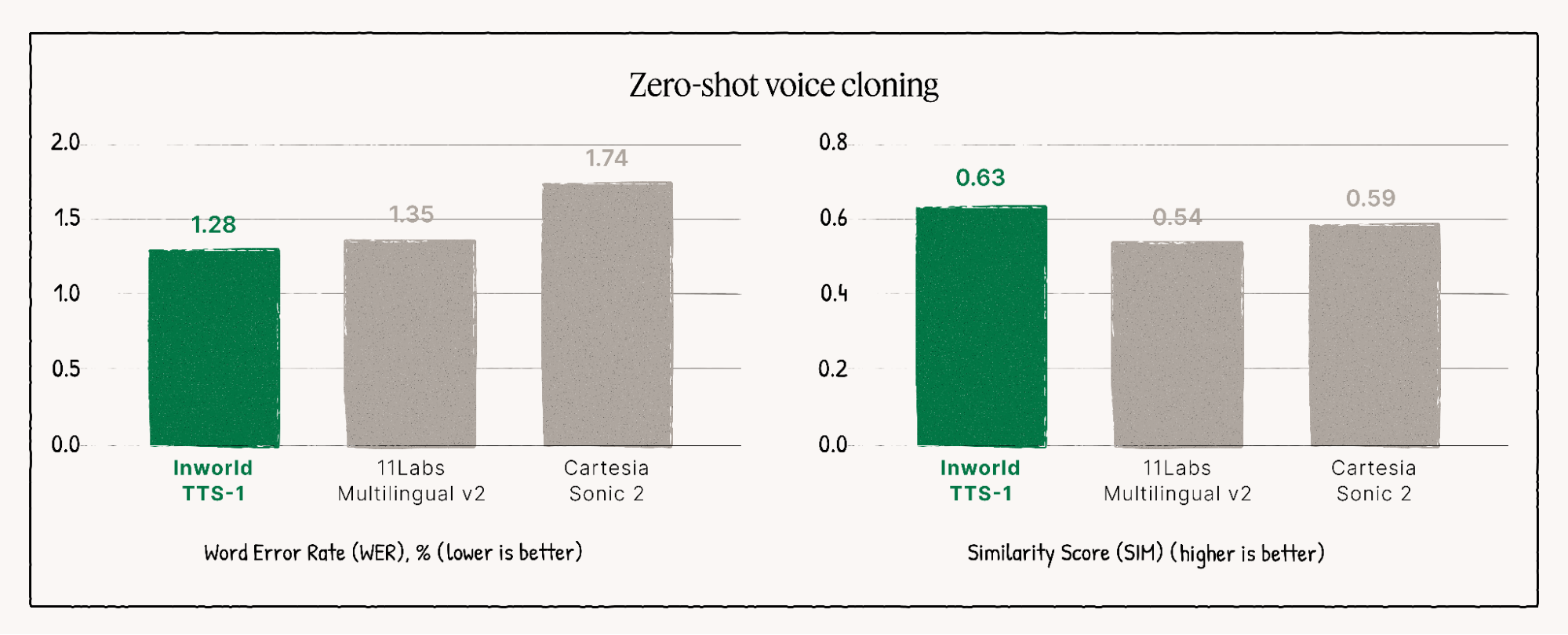
vs Inworld TTS-1: TTS-1-Max delivers superior expressiveness and naturalness thanks to its larger 8.8B parameter scale compared to TTS-1's 1.6B, ideal for premium content like audiobooks. However, TTS-1 prioritizes real-time speed at ~153 characters/second versus TTS-1-Max's ~69 characters/second, making it better for interactive apps.
vs ElevenLabs Multilingual V2: TTS-1-Max edges out with 59.1% head-to-head win rates in quality tests, offering finer emotional granularity and non-verbal sounds via markups. ElevenLabs provides strong multilingual cloning but lags in raw audio resolution and in-context learning purity.
vs MiniMax-Speech: TTS-1-Max prioritizes peak voice quality and 11-language fidelity over MiniMax's broader 32-language zero-shot cloning emphasis. While MiniMax shines in rapid one-shot replication, TTS-1-Max leads in benchmarked naturalness and emotional prosody control.
Measured on the AI/ML API gateway across live traffic. Figures are medians unless stated. Last updated 2026-10-12.
import requests

r = requests.post(
    "https://api.aimlapi.com/v1/tts",
    headers={"Authorization": "Bearer " + AIMLAPI_KEY},
    json={
      "model": "inworld/tts-1-max",
      "text": "Hello from AI/ML API",
      "voice": "alloy"
    },
)
print(r.json()["audio"])  # URL to the generated audio
const r = await fetch("https://api.aimlapi.com/v1/tts", {
  method: "POST",
  headers: {
    Authorization: `Bearer ${process.env.AIMLAPI_KEY}`,
    "Content-Type": "application/json",
  },
  body: JSON.stringify({
    "model": "inworld/tts-1-max",
    "text": "Hello from AI/ML API",
    "voice": "alloy"
  }),
});
const { audio } = await r.json();
console.log(audio); // URL to the generated audio
curl -X POST https://api.aimlapi.com/v1/tts \
  -H "Authorization: Bearer $AIMLAPI_KEY" \
  -H "Content-Type: application/json" \
  -d '{"model":"inworld/tts-1-max","text":"Hello from AI/ML API","voice":"alloy"}'

# the JSON response contains "audio" — a URL to the generated speech
OpenAI-compatible — swap the base URL and it works with your existing SDK.
| Type | Price |
|---|---|
| Input | |
| Output | |
| Model | Input | Output | Context | Best for |
|---|---|---|---|---|
Inworld TTS-1-Max This page | Speech synthesis | |||
| Speech synthesis | ||||
| Speech synthesis | ||||
| Speech synthesis | ||||
| Speech synthesis |
Inworld TTS-1-Max takes text as input and returns audio.
Inworld TTS-1-Max is priced at $0.013 / 1M tokens.
Inworld TTS-1-Max is billed per generation — a fixed charge per output rather than by prompt length.
Inworld TTS-1-Max was built by Inworld AI.
Send a request to https://api.aimlapi.com/v1/tts with inworld/tts-1-max as the model id.
Yes. Inworld TTS-1-Max is served through AI/ML API, so the same key and endpoint format used for other models applies.