
The Suno API Reality: Unofficial Tools & Legal Risks
What Suno Actually Is (and What Makes It Different)
Suno entered the public conversation quietly and then all at once. Feed it a sentence, something like "melancholic acoustic blues sung by an AI with existential dread" and within seconds you get a full song: vocals, instrumentation, dynamics, and all. For a lot of developers, that first generation moment lands somewhere between impressive and genuinely unsettling.
What separates Suno from earlier music AI tools isn't just audio quality. It's the completeness of the output. Most AI music generators up to this point produced loops, stems, or instrumentals. Suno produces a song, the kind of thing you'd expect to hear on a streaming platform, not just in a tech demo.
Core Premise
Suno is a text-to-music platform that generates complete, vocal-inclusive songs from natural language prompts. It's effectively the ChatGPT moment for audio creation.
The Model Evolution: v3.5 Through v5
Understanding Suno's development trajectory matters if you're building with it, because capability gaps between versions are significant enough to affect product decisions.
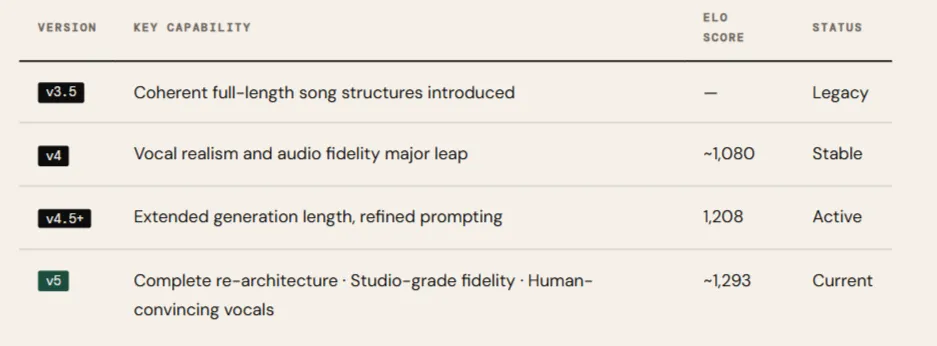
The jump from v4.5+ to v5 isn't incremental refinement, it's described internally as a complete re-architecture. The ELO score gap (85 points) reflects a material improvement in how listeners actually perceive the output, not just on paper benchmarks.
Multimodal Expansion: Suno Scenes
Suno Scenes, available on iOS, takes music generation a step further by accepting images or videos as input, producing a personalized soundtrack derived from visual context rather than text. This signals where the platform is heading: away from the text box as the only creative entry point, toward richer, more intuitive forms of input.
The Unofficial API Ecosystem: A Realistic Picture
If you've searched for "Suno API" in the past year, you'll have found a mix of GitHub repositories, third-party services, and some pretty confident blog posts that don't quite agree with each other. Here's the straight version: Suno does not offer an official public API. What exists in the developer ecosystem is entirely unofficial, reverse-engineered, and carries real risk.
Fundamental Truth
As of late 2025, there is no sanctioned developer API from Suno. Every "Suno API" you encounter in third-party documentation is a reverse-engineered workaround, not a product Suno ships or supports.
How the Third-Party Services Work
Ingenious developers have studied the private API calls that Suno's own web application makes, then packaged those endpoints into developer-friendly wrappers. Services like SunoAPI offer this as a subscription product with added infrastructure: scalable concurrency, caching, commercial licensing claims (which carry their own legal complexity), and rapid audio streaming that often delivers the first audio chunks in under 20 seconds.
The pitch is reasonable for prototyping: you get a familiar REST-style interface, reasonable pricing, and decent documentation. For production use, the picture is less clean.
The Open-Source Self-Hosted Route
Projects like gcui-art/suno-api on GitHub take a different approach. Rather than proxying through a third-party service, they automate browser interaction directly, using CAPTCHA-solving services to authenticate on your behalf, effectively turning your own Suno account into a local API server. This includes an OpenAI-compatible response format, which makes it easier to slot into existing agent workflows.
The transparency here is genuine, but the fragility is real. Any change Suno makes to its web interface can break these tools overnight, with no notice and no recourse.
Hands-On Integration: Code Walkthrough
Despite the caveats above, understanding how these unofficial integrations work is valuable for prototyping, personal projects, or simply forming a clear mental model of what's involved. The workflow across most third-party providers follows a consistent pattern.
Step 1: Credential Setup
Sign up with your provider of choice and generate an API key from their dashboard. Store it as an environment variable. Hardcoding API keys into source files is a beginner mistake that has ended careers — don't do it.
Step 2: Initiating a Generation Request
Trigger generation via a POST request to an endpoint like /api/generate. The model version field, typically labeled mv, accepts version strings like chirp-crow for v5.
Python Example:
import requests
import os

API_KEY = os.getenv("SUNO_API_KEY")
BASE_URL = "https://api.example.com"  # Your provider's URL

headers = {"Authorization": f"Bearer {API_KEY}", "Content-Type": "application/json"}
payload = {
    "prompt": "Dark synthwave, driving bassline, retro 80s drums, melancholic melody",
    "mv": "chirp-crow",
    "wait_audio": False  # Enables asynchronous polling
}

response = requests.post(f"{BASE_URL}/api/generate", json=payload, headers=headers)
task_data = response.json()
print(f"Generation Task ID: {task_data['id']}")
cURL Example:
curl -X POST 'https://api.example.com/api/generate' \
  -H 'Authorization: Bearer YOUR_API_KEY_HERE' \
  -H 'Content-Type: application/json' \
  -d '{
    "prompt": "Jazz trio, piano, upright bass, brushed drums, cozy coffee shop vibe",
    "mv": "chirp-crow"
  }'
Step 3: Polling for Completion
Music generation is asynchronous. The initial call gives you a task ID, not audio. Your application then needs to poll a status endpoint — something like GET /api/get/{id} — on a loop until the status field transitions from processing to complete. At that point, the response payload will include an audio_url you can download or stream from.
Engineering Note
Build in exponential backoff when polling, hitting a status endpoint in a tight loop will get you rate-limited quickly and makes you a bad API citizen regardless of the service.
Suno Studio: The Official Professional Frontier
While developers were building workarounds, Suno was building something more significant internally. Suno Studio, positioned as the world's first "Generative Audio Workstation" (GAW), isn't just an improved version of the main product. It's a different proposition entirely: a shift from single-prompt generation toward iterative, multi-track composition.
The distinction matters. The main Suno product is fundamentally a vending machine: put in a prompt, get out a song. Studio changes the relationship between creator and output, allowing for ongoing refinement and layering in a way that maps more naturally to how working musicians actually build tracks.
Generative Stems
This is the feature that makes Studio genuinely novel. Select any generated element, say, a synth pad layer you liked, and instruct the AI to generate a complementary bassline or drum pattern that responds to the musical context of that original piece. The AI isn't generating in isolation; it's composing in relation to something that already exists.
Stem Separation and MIDI Export
Any full Suno-generated track can be deconstructed into its component stems: vocals, drums, bass, synths, and more. More critically, these can be exported as standard MIDI files, which means you can take them into Ableton, Logic Pro, or any other DAW and manipulate them with complete freedom. The AI becomes a starting point for human production work, not a black box end product.
Sample-to-Song Expansion
Have a short melodic hook, something you hummed, recorded, or imported? Upload it, and Studio will build a fully arranged composition around it. For songwriters who think in fragments rather than full compositions, this is a meaningful workflow addition.
The Legal Thunderclouds: Copyright and Commercial Use
This is the section you need to read carefully if you're building anything commercial with AI-generated music. The legal landscape is not stable, and the stakes are high enough that optimism is not a strategy.
The RIAA Lawsuit
In June 2024, Sony Music Entertainment, Universal Music Group, and Warner Records jointly filed a copyright infringement lawsuit against both Suno and Udio. The core allegation: both platforms trained their models on vast quantities of copyrighted recorded music without obtaining licenses or compensating rights holders. The damages sought are substantial, large enough that the outcome could meaningfully shape the AI music industry's structure.
Suno's defense centers on the argument that its outputs are genuinely new creations, not reproductions of training data. Whether that argument prevails in court remains unresolved. What's already resolved is that the lawsuit exists, is being actively litigated, and creates real uncertainty for anyone building a business on top of Suno-generated content.
The Third-Party API Legal Stack
If you're using an unofficial API service, you're operating in a layered legal situation. First, you're likely in violation of Suno's Terms of Service, which prohibits automated access to the platform without authorization. Second, any "commercial licensing" claims made by unofficial API providers are promises those providers cannot legally guarantee, because they themselves are operating outside Suno's sanctioned ecosystem. Third, the underlying copyright questions from the RIAA lawsuit apply to all content generated by the platform, regardless of access method.
Market Growth vs. Legal Risk
None of this has slowed market growth. The global AI-in-music sector is growing at a compound annual rate exceeding 23%, driven by real demand from content creators, game developers, advertising agencies, and streaming platforms looking for cost-effective original music. The legal uncertainty is a headwind, not a wall. But it's a headwind worth understanding clearly before committing to it as infrastructure.
FAQ
Is there actually an official Suno API coming?
Nothing confirmed as of late 2025. Suno has maintained a consumer-first focus, investing in Suno Studio as its professional offering rather than a developer API. If one launches, it will likely follow the Studio's maturation and could come with usage policies shaped by the ongoing copyright litigation.
Can I use unofficial API output commercially?
Not without significant legal exposure. Unofficial API access violates Suno's ToS regardless of the commercial rights situation. Even via Suno's own paid tiers, those commercial rights exist under active federal litigation.
How does Suno Studio differ from the main Suno product?
The main Suno product is prompt-in, song-out — single generation workflow. Studio is iterative: you generate stems, build on them, export MIDI, separate tracks, and expand samples into full compositions. It's a fundamentally different creative relationship, oriented toward working musicians and producers rather than people who want a finished track in 30 seconds.