GPT-5 Chat delivers enhanced accuracy, lower latency, and superior factual reliability, powered by cutting-edge transformer architectures and real-time routing.
GPT-5 Chat represents the latest generation of OpenAI’s conversational models, designed for sophisticated interaction.
GPT-5 Chat is OpenAI’s latest conversational large language model offering a unified system combining a smart, fast base model with deeper reasoning variants, optimized for efficient multimodal understanding and extended context. It supports input contexts up to 400,000 tokens, enabling sophisticated handling of lengthy and complex conversations.
Technical Specifications
Context Management
400,000-token input window
Long context handling with recursive attention and dynamic focus on salient information
Supports multimodal inputs
Unified System Architecture
Smart, fast base model for general queries
Deeper "thinking" model variants for complex reasoning
Mini and nano compressed models for cost-efficient usage
Real-time routing system to select optimal model based on task complexity and user cues
Unified System Architecture
Technical Innovations
Mixture of Experts (MoE) layers for efficiency and scale
Enhanced transformer attention mechanisms
Recursive training techniques enhance contextual comprehension and iterative problem solving
API Pricing
Input: $1.625
Output: $13
Code Sample
Use Cases
Advanced conversational AI and chatbots
Software engineering and code generation
Large-scale document and multimodal content analysis
Creative writing, research, and education assistance
vs GPT-4: GPT-5 Chat delivers faster performance, superior logical reasoning, and an expanded 400,000-token context window, enabling deeper understanding of complex inputs compared to GPT-4, which is strong in general purpose language tasks but limited by smaller context and less advanced reasoning.
vs Claude 4: While Claude 4 excels in stable, high-precision coding tasks, GPT-5 offers more advanced multimodal understanding and faster dynamic reasoning modes, making it more versatile in vision-language workflows and complex multi-step reasoning.
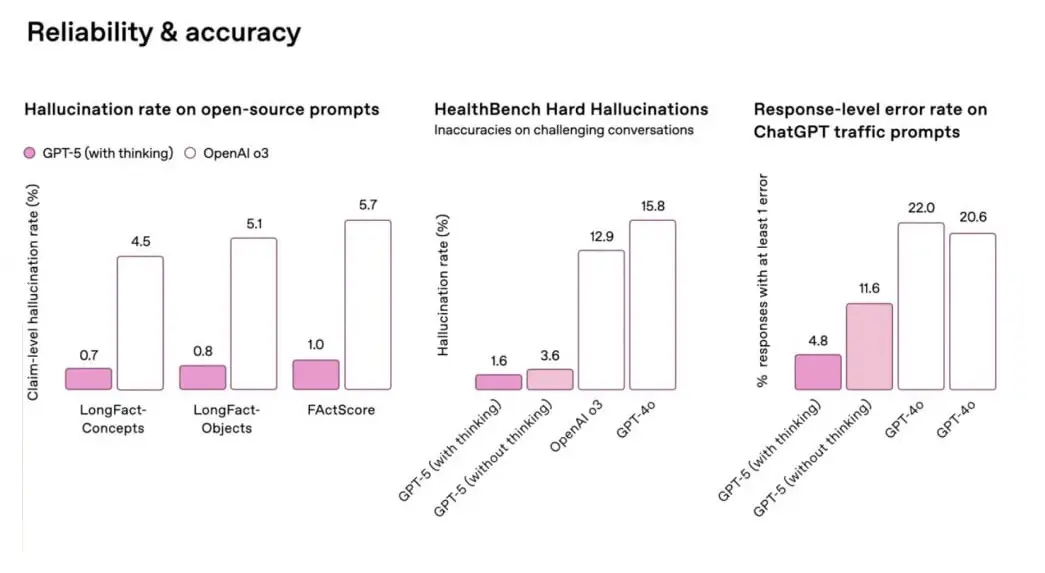
vs OpenAI o3: GPT-5 achieves substantially lower hallucination rates (9%) compared to OpenAI o3 (86.7%), reflecting a major improvement in factual accuracy and trustworthiness in complex reasoning and knowledge tasks.
{
"@context": "https://schema.org",
"@type": "FAQPage",
"mainEntity": [
{
"@type": "Question",
"name": "What conversational architecture enables GPT-5 Chat's human-like dialogue capabilities?",
"acceptedAnswer": {
"@type": "Answer",
"text": "GPT-5 Chat employs a sophisticated multi-scale dialogue transformer architecture with dynamic context management that maintains conversation state across extended interactions. The model features hierarchical attention mechanisms that distinguish between different conversation elements—factual content, emotional tone, user preferences, and interaction history—while adaptive response generation tailors output based on conversation context and relationship dynamics. Advanced personality modeling ensures consistent character throughout conversations, while sophisticated social intelligence allows the model to navigate complex interpersonal dynamics, understand nuanced social cues, and maintain appropriate conversational boundaries across diverse contexts and cultures."
}
},
{
"@type": "Question",
"name": "How does GPT-5 Chat achieve breakthrough performance in emotional intelligence and social understanding?",
"acceptedAnswer": {
"@type": "Answer",
"text": "The architecture incorporates advanced affective computing capabilities through emotion-aware attention mechanisms, sentiment-adaptive response generation, and sophisticated theory of mind modeling that understands user knowledge states and emotional perspectives. It employs cross-cultural communication patterns that adapt conversational style to different social contexts, nuanced empathy modeling that provides appropriate emotional support, and sophisticated social dynamics understanding that navigates complex interpersonal situations. These capabilities enable the model to engage in conversations that feel genuinely understanding, emotionally appropriate, and socially intelligent across diverse scenarios and user backgrounds."
}
},
{
"@type": "Question",
"name": "What memory and context management innovations distinguish GPT-5 Chat's extended conversations?",
"acceptedAnswer": {
"@type": "Answer",
"text": "GPT-5 Chat implements revolutionary conversation memory systems with multi-tiered context storage that maintains relevant information across conversations spanning days or weeks. The architecture features intelligent memory compression that preserves essential conversation elements while eliminating redundancy, dynamic context retrieval that recalls relevant previous discussions based on current topics, and relationship modeling that tracks evolving user preferences and interaction patterns. Advanced forgetting mechanisms ensure privacy by automatically discarding sensitive information while maintaining conversational coherence, creating interactions that feel continuous and personally relevant over extended periods."
}
},
{
"@type": "Question",
"name": "How does the model handle complex multi-modal conversations integrating text, voice, and eventually visual elements?",
"acceptedAnswer": {
"@type": "Answer",
"text": "The architecture supports seamless multi-modal integration through unified representation learning that processes text, audio cues, and visual context in a shared semantic space. It employs cross-modal attention mechanisms that align information from different sources, adaptive modality weighting that prioritizes the most relevant input types, and coherent multi-modal response generation that maintains consistency across different communication channels. This enables the model to engage in rich, multi-sensory conversations that understand tone of voice, visual context, and textual content as integrated elements of human communication."
}
},
{
"@type": "Question",
"name": "What safety and alignment features ensure GPT-5 Chat remains helpful and appropriate in all conversational contexts?",
"acceptedAnswer": {
"@type": "Answer",
"text": "GPT-5 Chat incorporates comprehensive conversation safety measures including real-time content evaluation with contextual understanding, sophisticated boundary detection that maintains appropriate conversational limits, and value-aligned response generation that respects diverse cultural and personal perspectives. The model features transparent reasoning about safety decisions, graceful redirection mechanisms for inappropriate topics, and consistent adherence to ethical guidelines across all interaction types. Advanced user intent understanding helps distinguish between genuine queries and potentially harmful requests, ensuring conversations remain constructive, respectful, and beneficial regardless of context or user background."
}
}
]
}
GPT-5 Chat is OpenAI’s latest conversational large language model offering a unified system combining a smart, fast base model with deeper reasoning variants, optimized for efficient multimodal understanding and extended context. It supports input contexts up to 400,000 tokens, enabling sophisticated handling of lengthy and complex conversations.
Technical Specifications
Context Management
400,000-token input window
Long context handling with recursive attention and dynamic focus on salient information
Supports multimodal inputs
Unified System Architecture
Smart, fast base model for general queries
Deeper "thinking" model variants for complex reasoning
Mini and nano compressed models for cost-efficient usage
Real-time routing system to select optimal model based on task complexity and user cues
Unified System Architecture
Technical Innovations
Mixture of Experts (MoE) layers for efficiency and scale
Enhanced transformer attention mechanisms
Recursive training techniques enhance contextual comprehension and iterative problem solving
API Pricing
Input: $1.625
Output: $13
Code Sample
Use Cases
Advanced conversational AI and chatbots
Software engineering and code generation
Large-scale document and multimodal content analysis
Creative writing, research, and education assistance
vs GPT-4: GPT-5 Chat delivers faster performance, superior logical reasoning, and an expanded 400,000-token context window, enabling deeper understanding of complex inputs compared to GPT-4, which is strong in general purpose language tasks but limited by smaller context and less advanced reasoning.
vs Claude 4: While Claude 4 excels in stable, high-precision coding tasks, GPT-5 offers more advanced multimodal understanding and faster dynamic reasoning modes, making it more versatile in vision-language workflows and complex multi-step reasoning.
vs OpenAI o3: GPT-5 achieves substantially lower hallucination rates (9%) compared to OpenAI o3 (86.7%), reflecting a major improvement in factual accuracy and trustworthiness in complex reasoning and knowledge tasks.
{
"@context": "https://schema.org",
"@type": "FAQPage",
"mainEntity": [
{
"@type": "Question",
"name": "What conversational architecture enables GPT-5 Chat's human-like dialogue capabilities?",
"acceptedAnswer": {
"@type": "Answer",
"text": "GPT-5 Chat employs a sophisticated multi-scale dialogue transformer architecture with dynamic context management that maintains conversation state across extended interactions. The model features hierarchical attention mechanisms that distinguish between different conversation elements—factual content, emotional tone, user preferences, and interaction history—while adaptive response generation tailors output based on conversation context and relationship dynamics. Advanced personality modeling ensures consistent character throughout conversations, while sophisticated social intelligence allows the model to navigate complex interpersonal dynamics, understand nuanced social cues, and maintain appropriate conversational boundaries across diverse contexts and cultures."
}
},
{
"@type": "Question",
"name": "How does GPT-5 Chat achieve breakthrough performance in emotional intelligence and social understanding?",
"acceptedAnswer": {
"@type": "Answer",
"text": "The architecture incorporates advanced affective computing capabilities through emotion-aware attention mechanisms, sentiment-adaptive response generation, and sophisticated theory of mind modeling that understands user knowledge states and emotional perspectives. It employs cross-cultural communication patterns that adapt conversational style to different social contexts, nuanced empathy modeling that provides appropriate emotional support, and sophisticated social dynamics understanding that navigates complex interpersonal situations. These capabilities enable the model to engage in conversations that feel genuinely understanding, emotionally appropriate, and socially intelligent across diverse scenarios and user backgrounds."
}
},
{
"@type": "Question",
"name": "What memory and context management innovations distinguish GPT-5 Chat's extended conversations?",
"acceptedAnswer": {
"@type": "Answer",
"text": "GPT-5 Chat implements revolutionary conversation memory systems with multi-tiered context storage that maintains relevant information across conversations spanning days or weeks. The architecture features intelligent memory compression that preserves essential conversation elements while eliminating redundancy, dynamic context retrieval that recalls relevant previous discussions based on current topics, and relationship modeling that tracks evolving user preferences and interaction patterns. Advanced forgetting mechanisms ensure privacy by automatically discarding sensitive information while maintaining conversational coherence, creating interactions that feel continuous and personally relevant over extended periods."
}
},
{
"@type": "Question",
"name": "How does the model handle complex multi-modal conversations integrating text, voice, and eventually visual elements?",
"acceptedAnswer": {
"@type": "Answer",
"text": "The architecture supports seamless multi-modal integration through unified representation learning that processes text, audio cues, and visual context in a shared semantic space. It employs cross-modal attention mechanisms that align information from different sources, adaptive modality weighting that prioritizes the most relevant input types, and coherent multi-modal response generation that maintains consistency across different communication channels. This enables the model to engage in rich, multi-sensory conversations that understand tone of voice, visual context, and textual content as integrated elements of human communication."
}
},
{
"@type": "Question",
"name": "What safety and alignment features ensure GPT-5 Chat remains helpful and appropriate in all conversational contexts?",
"acceptedAnswer": {
"@type": "Answer",
"text": "GPT-5 Chat incorporates comprehensive conversation safety measures including real-time content evaluation with contextual understanding, sophisticated boundary detection that maintains appropriate conversational limits, and value-aligned response generation that respects diverse cultural and personal perspectives. The model features transparent reasoning about safety decisions, graceful redirection mechanisms for inappropriate topics, and consistent adherence to ethical guidelines across all interaction types. Advanced user intent understanding helps distinguish between genuine queries and potentially harmful requests, ensuring conversations remain constructive, respectful, and beneficial regardless of context or user background."
}
}
]
}



.avif)



-p-130x130q80.png)











.png)

.png)
