8 Best MiniMax M3.1 Flash Alternatives with Benchmarks
MiniMax M3.1 Flash is a new low-cost reasoning model built for coding and AI agents, but it's not necessarily the best fit for every task. Depending on your workload, other models may offer faster responses, lower costs, or more reliable results.
To see how they compare, we tested eight MiniMax M3.1 Flash alternatives across 10 coding, agent, and vision tasks, measuring accuracy, response speed, and cost. Here's how each model performed and where it makes sense to use one over MiniMax.
Prices, model specs and test results are as of October 23, 2026.
What is MiniMax M3.1 Flash?
MiniMax M3.1 Flash is a new LLM released on October 19, 2026, with a focus on coding and agentic tasks. It supports text, images, and video, and has a 1M-token context window.
Why look for a MiniMax M3.1 Flash alternative?
While MiniMax M3.1 Flash is a new model, new isn't always better. The main limitation of this model is its reasoning overhead, unlike models that can answer without reasoning, M3.1 Flash always generates reasoning tokens, even at its lowest reasoning_effort setting. This makes it less practical for simple requests where speed matters more than extensive reasoning.
Factual accuracy is another concern. On Artificial Analysis's AA-Omniscience benchmark, M3.1 Flash recorded a 92.8% hallucination rate, compared with 27.6% for GLM 5.3 Flash, for example.
How we picked these alternatives
We focused on models that could realistically replace MiniMax M3.1 Flash. To make the comparison useful, each alternative had to meet four criteria:
- Similar pricing. We selected models with input prices below $1 per million tokens.
- Long context window. Every model had to support at least 524K tokens.
- Agent capabilities. Since coding and AI agents are two of M3.1 Flash's primary use cases, tool calling was a requirement.
- Multimodal input. We included only models that support both text and images.
MiniMax M3.1 Flash alternatives at a glance
The table below compares all eight alternatives with MiniMax M3.1 Flash:
Below we break down each model we'd suggest to use instead of MiniMax M3.1 Flash in more detail, including when it might be a better choice.
1. DeepSeek V4.1 Flash
Best for: High-throughput generation and long-context tasks.
DeepSeek V4.1 Flash is a multimodal reasoning model built for coding, tool use, and working with long documents. One of its main advantages is inexpensive cached input, which makes it particularly useful for applications that repeatedly send the same large prompts.
DeepSeek V4.1 Flash vs MiniMax M3.1 Flash
In our MiniMax M3.1 Flash vs DeepSeek V4.1 Flash test, DeepSeek performed almost identically to MiniMax on coding and agent tasks, but was slightly less accurate at interpreting images.
When it came to vision, DeepSeek was less accurate in our tests, making a mistake in three out of three runs of a vision task that had the model add up numbers from a whiteboard with handwritten text, while MiniMax added the values up wrong in two out of three.
However, DeepSeek generated output almost twice as fast as MiniMax while using 27% fewer reasoning tokens per task.
Independent benchmarks also suggest that DeepSeek is less prone to hallucinations (66.8% vs. 92.8% on AA-Omniscience), although its overall intelligence score is only slightly higher (45 vs. 43).
Consider DeepSeek V4.1 Flash if:
Your application generates long responses or frequently reuses cached prompts.
2. GLM 5.3 Flash
Best for: Fact-sensitive tasks and image understanding.
GLM 5.3 Flash is an open-weight multimodal reasoning model from Zhipu AI, released under the MIT license and designed for coding, agent workflows, and image understanding. It uses a mixture-of-experts architecture with 320B total parameters and 18B active parameters. Like MiniMax M3.1 Flash, it always uses reasoning, even at its lowest effort setting.
GLM 5.3 Flash vs MiniMax M3.1 Flash
GLM 5.3 Flash matched MiniMax's overall accuracy in our tests, but performed better on vision tasks and slightly worse on agentic workflows.
GLM successfully handled all nine vision runs, including the handwritten whiteboard task where MiniMax twice miscalculated the total.
However, GLM made mistakes when following more complex agent instructions, twice choosing a more expensive option when a cheaper one met all the requirements.
GLM also showed better factual reliability in independent benchmarks and our previous testing. On Artificial Analysis's AA-Omniscience benchmark, it had a substantially lower hallucination rate than MiniMax: 27.6% vs. 92.8%.
In our MiniMax M3.1 Flash review, GLM correctly challenged or declined all 40 questions about nonexistent subjects, while MiniMax invented details in half of its 20 runs. These tests used different sample sizes, but the results suggest GLM is considerably more cautious when it lacks reliable information.
The main trade-off is speed. GLM was the slowest model in our tests, both in output generation (43 vs. 110 tokens per second) and in the time it took to start answering coding tasks (a median of 9.5 vs. 3.6 minutes).
Despite taking longer to respond, GLM was slightly cheaper per successful task, largely because of its lower output token price.
Consider GLM 5.3 Flash if:
Your application handles factual questions, documents, or images where incorrect information is a concern. However, its slow responses make it less suitable for latency-sensitive coding and agent workflows.
3. Qwen3.8 Flash
Best for: Reliable agent workflows and batch processing.
Qwen3.8 Flash is Alibaba's hosted multimodal model for coding, reasoning, and agentic tasks. It supports tool calling and built-in web search on AI/ML API. While it is relatively inexpensive, its extensive reasoning can result in long response times, especially on complex coding tasks.
Qwen3.8 Flash vs MiniMax M3.1 Flash
Qwen was more reliable than MiniMax in our tests, successfully completing all 30 runs across coding, agentic, and vision tasks.
Both models performed equally well on coding and agent tasks. The difference came from vision accuracy: Qwen correctly handled the handwritten whiteboard calculation in all three runs, while MiniMax miscalculated the total in two of them.
Qwen also had the lowest cost among models that passed every agent run, averaging just $0.0021 per agent task. It started answering agent requests in a median of 2.7 seconds.
However, Qwen used significantly more reasoning tokens than MiniMax and took longer to complete demanding coding tasks (a median of 9.8 vs. 3.6 minutes before the answer began).
On coding tasks specifically, Qwen generated an average of 39,356 reasoning tokens before answering. In one bug-fixing run, the model took 21 minutes to start producing its final response.
Consider Qwen3.8 Flash if:
Your application runs agent workflows or complex tasks where accuracy matters more than response time. Qwen completed every run in our tests, but its extensive reasoning makes it less suitable for interactive coding tools or other applications that need immediate responses.
4. MiMo V2.6 Flash
Best for: Low-latency requests and video input.
MiMo V2.6 Flash is Xiaomi's open-weight multimodal reasoning model, released under the MIT license. It supports text, images, and video, making it the only MiniMax alternative in this comparison with video input available through AI/ML API.
MiMo is also inexpensive to run, with an output price of just $0.385 per million tokens.
MiMo V2.6 Flash vs MiniMax M3.1 Flash
MiMo had the lowest task completion rate in our tests, passing only 10 out of 30 runs. Its biggest problems were with coding and agent workflows, where it frequently failed to follow requirements or complete all necessary steps.
For coding, MiMo failed every run on two of the four tasks. Its agent performance was similarly inconsistent. For example, it ignored scheduling conflicts and, in one run, claimed to have completed an action without calling the required tool.
The model also struggled with complex image interpretation. In two of three whiteboard runs, MiMo exhausted its entire 131,072-token output limit on reasoning without producing a final answer.
Despite these limitations, MiMo was the fastest model we tested, both in the time required to start answering (1.9 vs. 18.8 seconds) and in output generation speed (255 vs. 110 tokens per second).
MiMo was cheaper per request, but its high failure rate made it more expensive per successful task ($0.0133 vs. $0.0094).
Independent benchmarks also show MiMo trailing MiniMax on more demanding software engineering tasks: 23% vs. 26% on Terminal-Bench 4.0.
Consider MiMo V2.6 Flash if:
Your application needs fast responses for relatively simple tasks, or requires video input through AI/ML API. However, our tests suggest it is a poor replacement for MiniMax in coding and agent workflows that require reliable execution of multiple steps.
5. Claude Haiku 5.5
Best for: Fast coding and interactive chat.
Claude Haiku 5.5 is Anthropic's smallest model in the Claude 5.5 family, designed for applications that need quick responses without the cost of larger models. Unlike MiniMax M3.1 Flash, which always uses reasoning, Haiku can respond without generating reasoning tokens. In our tests through AI/ML API, it used no reasoning tokens at its default settings.
Claude Haiku 5.5 vs MiniMax M3.1 Flash
Haiku matched MiniMax's performance on coding tasks, but was less reliable on agentic workflows and image understanding.
Its mistakes were concentrated in tasks that required checking multiple conditions. In the vision tests, Haiku misread the same handwritten figure in all three runs, and in two agent runs it either duplicated an action or exceeded the budget set by the policy.
Haiku's main advantage is speed. It produced coding answers much sooner than MiniMax (a median of 11 vs. 217 seconds).
Haiku was also one of the least expensive models in our test, costing approximately 65% less per successful task than MiniMax.
Independent benchmarks show that Haiku's reasoning capabilities improve when higher effort settings are enabled, although this also changes its cost and latency characteristics. Its Intelligence Index rises from 35 at medium effort to 43 at max effort, the same score as MiniMax.
Consider Claude Haiku 5.5 if:
You need fast coding assistance, interactive chat, or other applications where response time is important. However, MiniMax was more reliable for agent tasks that required following multiple constraints.
6. GPT-6 Luna
Best for: Low-cost coding and image understanding.
GPT-6 Luna is OpenAI's smaller model in the GPT-6 family, designed for applications that need affordable text generation, coding, and multimodal input. It supports tool calling and file analysis. In our tests, it was the cheapest LLM API option overall, although its performance varied considerably between tasks.
GPT-6 Luna vs MiniMax M3.1 Flash
GPT-6 Luna performed well on coding and vision tasks, but struggled with agent workflows that required following multiple rules.
Luna completed nearly every coding run and correctly answered all questions about the images we provided. However, it failed every agent task, primarily because it overlooked conditions in the instructions.
For example, it approved refunds the policy didn't allow and scheduled meetings that conflicted with existing events or fell outside working hours. It also struggled with boundary conditions, treating "after 16:00" as "16:00 or later."
Luna was considerably cheaper than MiniMax and started answering sooner, while using far fewer reasoning tokens (720 vs. 9,583 per task).
For vision tasks specifically, Luna cost an average of just $0.0007 per request while passing all nine runs.
Independent benchmarks show a similar gap between the two models on more demanding tasks: an Intelligence Index of 38 vs. 43 and 13% vs. 26% on Terminal-Bench 4.0.
Consider GPT-6 Luna if:
You need a cheap LLM API for coding assistance, image analysis, or document processing. However, its tendency to overlook policy constraints makes it a poor choice for autonomous agents without additional validation.
7. Gemini 3.8 Flash
Best for: Complex coding and agent workflows where accuracy matters more than cost.
Gemini 3.8 Flash is Google's reasoning model for software engineering, agentic tasks, and complex problem-solving. Although it belongs to the Flash family, it is the most expensive model in this comparison, making its reliability an important factor when deciding whether to use it.
Gemini 3.8 Flash vs MiniMax M3.1 Flash
Gemini completed every task in our tests, including the vision problems that MiniMax occasionally got wrong.
Gemini also started its coding answers sooner than Qwen3.8 Flash, the other model with a perfect score (a median of 3.3 vs. 9.8 minutes). Its median response time across all tasks was higher than MiniMax's, however (43.8 vs. 18.8 seconds).
The biggest drawback is pricing. Gemini cost more than seven times as much per successful task as MiniMax. Across our 270 test runs, Gemini accounted for $2.10 of the $3.72 total cost.
Google also reports strong results on expert-level reasoning benchmarks, including a 54.9% score on Humanity's Last Exam Verified. However, these results come from Google's own evaluations and should not be treated as directly equivalent to our task-based tests.
Another limitation is output length. Gemini supports up to 65,536 output tokens, including reasoning, compared with MiniMax's 524,288. This can matter for tasks requiring extensive reasoning followed by a large generated output.
Consider Gemini 3.8 Flash if:
Your application handles complex coding or agent workflows where an incorrect result would cost more than the additional API usage. Its higher price, however, makes it difficult to justify for simpler requests.
8. MiniMax M3
Best for: Self-hosted deployments and fact-sensitive applications.
MiniMax M3 is the predecessor to M3.1 Flash and an open-weight mixture-of-experts model with approximately 428 billion parameters, 23 billion of which are active per token. It supports coding, tool use, and multimodal input, with weights available under MiniMax's community license.
MiniMax M3 vs MiniMax M3.1 Flash
M3.1 Flash performed slightly better overall, especially on coding and agent tasks, although the difference was relatively small.
Unlike M3.1 Flash, which made the same whiteboard calculation error twice, M3's four failed runs came from different tasks: two in coding, one in an agent task where it missed a time restriction, and one in a vision task where it counted a cancelled item.
M3.1 Flash was faster and more economical in our tests, despite the relatively small difference in completed tasks ($0.0094 vs. $0.0153 per solved task).
If you currently use MiniMax M3, the other models in this list work as MiniMax M3 alternatives too. For example, in a MiniMax M3 vs DeepSeek V4.1 Flash comparison, both models cost $0.39 / $1.56 per million tokens on AI/ML API, but DeepSeek passed one more run in our tests (27 vs. 26) and generated output twice as fast.
However, M3 performed considerably better on factual reliability benchmarks. Artificial Analysis measured a much lower hallucination rate for the older model: 18.4% vs. 92.8%.
This is a meaningful difference for applications that answer factual questions without external verification. It also suggests that the improvements in coding and agent performance in M3.1 Flash do not necessarily translate into better factual accuracy.
M3's open weights are another practical advantage. Developers can deploy it on their own infrastructure, although its large parameter count means substantial hardware resources are required.
Consider MiniMax M3 if:
You already use MiniMax and need a model with more reliable factual responses, or want to run it on your own hardware.
How we tested MiniMax M3.1 Flash alternatives
Each model completed 10 tasks across coding, agentic workflows, and image understanding. We ran every task three times per model, for a total of 270 runs in AI/ML API.
Test tasks
Test settings and evaluation
We used the AI/ML API chat completions endpoint with streaming enabled, temperature set to 0, each model's default reasoning effort, and its maximum output limit.
We also measured:
- Time to first answer token: Time until the final answer begins, excluding reasoning tokens but including network latency.
- Output speed: Generated tokens per second over the full request, measured for responses of at least 500 tokens.
- Reasoning tokens: Average number of reasoning tokens generated per task.
- Cost per task: Average API cost, including failed attempts.
- Cost per solved task: Total API spending divided by successful runs.
Benchmark results
Qwen3.8 Flash and Gemini 3.8 Flash were the only models to pass all 30 runs, followed by MiniMax M3.1 Flash and GLM 5.3 Flash with 28 each.
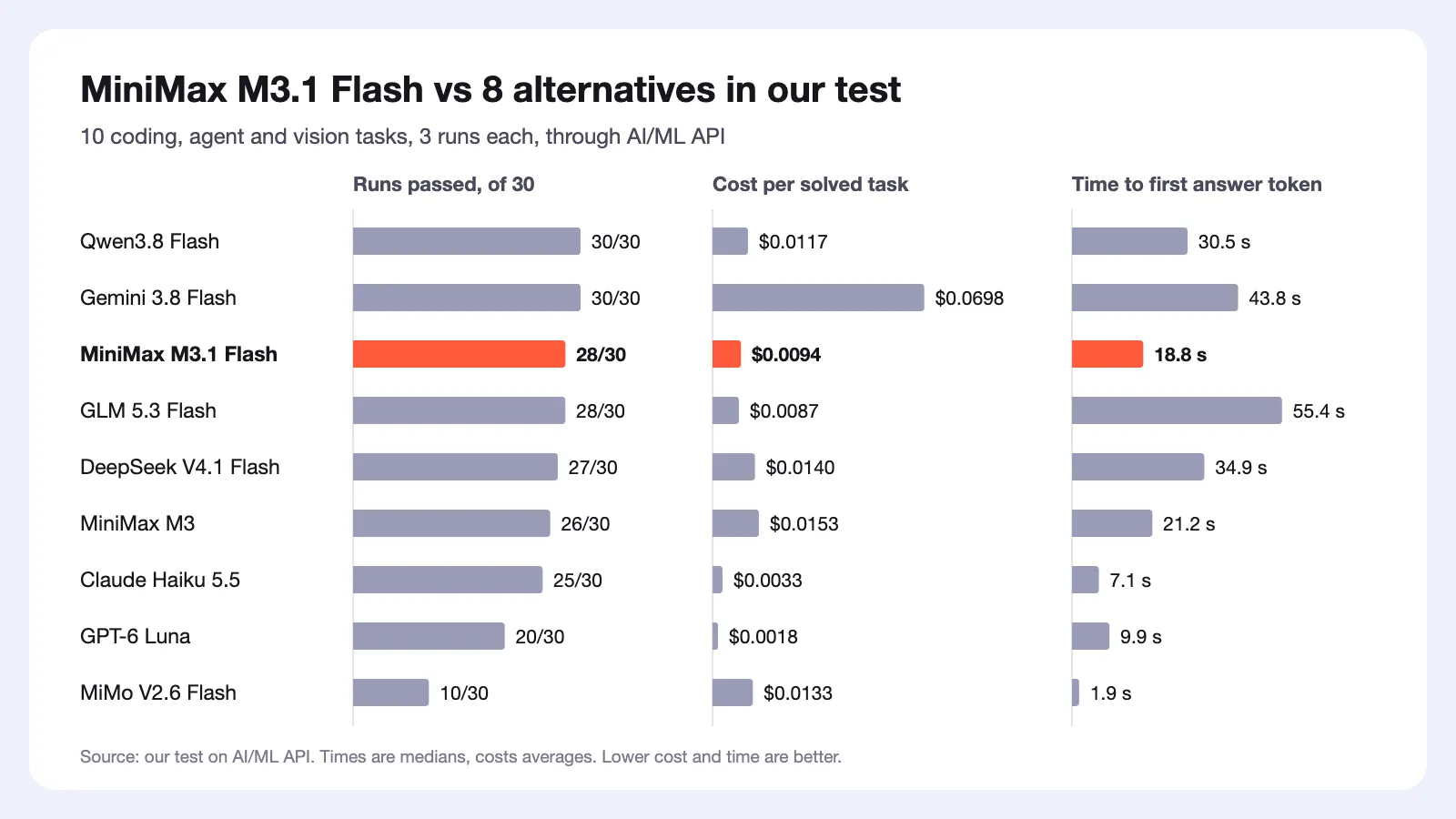
Response times and output speeds are medians. Reasoning token counts and costs are averages.
Coding was the least challenging category for most models, with seven out of nine passing at least 11 of 12 runs. The bigger differences appeared in agent and vision tasks, where models often overlooked policy restrictions or incorrectly interpreted information in images. Since all nine models ran the same tasks, you can also use these results to compare DeepSeek V4.1 Flash alternatives or Claude Haiku alternatives.
Which MiniMax M3.1 Flash alternative should you choose?
Here are the MiniMax alternatives we recommend for each workload we tested:
- For coding and debugging, choose Claude Haiku 5.5. If you're building a coding assistant or need help fixing bugs, response time matters. Haiku started answering in a median of 11 seconds, compared with 217 seconds for MiniMax. It also costs less, making it the best cheap LLM for coding in our tests.
- For autonomous agents, choose Qwen3.8 Flash. Agents often need to follow instructions across multiple tool calls, and a single missed condition can invalidate the entire task. Qwen was the least expensive model to pass every agent test, which makes it the best LLM for agents on a budget.
- For image and document understanding, choose GPT-6 Luna. If your application extracts information from screenshots, scans, or handwritten notes, Luna is worth considering. It passed all nine vision runs, as did GLM, Qwen and Gemini, and was the cheapest of them at $0.0007 per image task.
- For fast, simple requests, choose MiMo V2.6 Flash. Not every API call needs extensive reasoning. If you're processing short requests where speed matters and results can be checked automatically, MiMo is an option.
- For long documents and repeated prompts, choose DeepSeek V4.1 Flash. Applications that analyze large documents or repeatedly send the same system instructions can benefit from DeepSeek's inexpensive cached input.
- For factual questions, choose GLM 5.3 Flash. GLM was considerably less likely to invent information in our earlier testing and had a lower hallucination rate on AA-Omniscience.
- For complex tasks where failures are expensive, choose Gemini 3.8 Flash. Gemini was faster than Qwen on demanding coding tasks. However, it costs considerably more than the other alternatives.
- For self-hosted deployments, consider MiniMax M3 or GLM 5.3 Flash. Both offer open weights, so you're not limited to running them through a hosted API. MiniMax M3 may appeal to teams already using the MiniMax ecosystem, while GLM is worth considering when factual reliability is a priority.
What to consider when switching from MiniMax M3.1 Flash
If you're using MiniMax M3.1 Flash through AI/ML API, switching to another model is straightforward. All eight alternatives use the same OpenAI-compatible endpoint and API key, so you can test different models without setting up separate integrations.
For example, to switch from MiniMax to Qwen3.8 Flash, you only need to change the model parameter:
However, API compatibility doesn't mean every model behaves the same way. Before making a switch, don't forget to check your reasoning settings. MiniMax M3.1 Flash always uses reasoning, even at its lowest reasoning_effort setting. Several alternatives allow you to disable reasoning entirely.
FAQ
What is the best MiniMax M3.1 Flash alternative?
Qwen3.8 Flash is our top pick based on testing. It completed all 30 runs across coding, agentic, and vision tasks, compared with 28 for MiniMax M3.1 Flash. The main drawback is speed: Qwen can spend several minutes reasoning through complex coding problems. If you need similar accuracy with faster coding responses, Gemini 3.8 Flash is another option, although it costs considerably more.
What is the cheapest alternative to MiniMax M3.1 Flash?
GPT-6 Luna was the cheapest model in our tests, averaging just $0.0012 per request. It worked particularly well for coding and image understanding but failed all nine agent runs. For agent workflows, Qwen3.8 Flash is a more reliable option. For comparison, MiniMax M3.1 Flash averaged $0.0088 per request.
Which alternatives match the 1M-token context window?
All eight alternatives support large context windows, but MiniMax M3 is the only one limited to 524,288 tokens. The others support approximately 1 million tokens, with GPT-6 Luna offering up to 1,050,000. However, some models charge more for longer prompts. For example, Claude Haiku 5.5 becomes five times more expensive once the input exceeds 100K tokens.
Is MiniMax M3.1 Flash better than DeepSeek V4.1 Flash?
In our MiniMax vs DeepSeek comparison, both models performed similarly in coding and agent tests, but DeepSeek was slightly less accurate on vision tasks. MiniMax also started answering sooner and cost less per successful task. DeepSeek, on the other hand, generated output almost twice as fast and performed better on factual reliability benchmarks.
Is MiniMax better than Claude?
In a MiniMax vs Claude comparison, the answer depends on which Claude model you're comparing it with. MiniMax M3.1 Flash completed more tasks than Claude Haiku 5.5 in our tests (28 versus 25), but Haiku was much faster, especially for coding. Against the larger Claude Opus 5, MiniMax scored lower on Terminal-Bench 4.0 (26% vs. 49%), according to Artificial Analysis.
How does MiniMax compare with Kimi?
In a MiniMax vs Kimi comparison, MiniMax M3.1 Flash and Moonshot AI's Kimi K3 have similar overall intelligence scores on Artificial Analysis, with 43 and 44 points respectively. However, MiniMax is substantially cheaper to run. On Terminal-Bench 4.0, MiniMax also scored higher, reaching 26% compared with Kimi's 13%.
Do I need a separate API key for each alternative?
No. You can access all eight alternatives, MiniMax M3.1 Flash, and other supported models using a single AI/ML API key. There's no need to create separate accounts or manage billing with each provider.
Is MiniMax a Chinese company?
Yes. MiniMax is an AI company based in Shanghai, founded in December 2021 by former SenseTime researchers. Its CEO is Yan Junjie, and its investors include Tencent, Alibaba, and miHoYo. The company develops AI models for text, video, speech, and music, including the MiniMax M-series and Hailuo video models.
Why is MiniMax so cheap?
MiniMax uses a mixture-of-experts (MoE) architecture, which activates only a fraction of the model's parameters for each token. For example, MiniMax M3 has approximately 428 billion parameters but uses only 23 billion at a time. This helps reduce inference costs compared with running all parameters for every token. MiniMax M3.1 Flash uses an even sparser architecture, according to the company.
Is MiniMax M3.1 Flash free?
No. On AI/ML API, which routes requests to the MiniMax API, MiniMax M3.1 Flash costs $0.195 per million input tokens, $0.0195 per million cached input tokens, and $0.78 per million output tokens, with reasoning tokens billed as output. In our tests, that came to an average of $0.0088 per task.