
OpenAI Alternatives: The Best Options for API Access, Chat, and Open-Source in 2026
OpenAI still has the largest ecosystem and the most polished tooling. GPT-5.5 is the top-ranked model on several intelligence leaderboards in April 2026. None of that means it's automatically the right choice for your stack.
The AI landscape in 2026 is genuinely competitive in a way it wasn't 18 months ago. Claude Opus 4.7, Gemini 3.1 Pro, DeepSeek V4, and Llama 4 Scout have all closed the benchmark gap substantially. The real question isn't "is there anything as good as OpenAI?", it's "given my specific use case, budget, and infrastructure requirements, what's the smartest provider mix?"
This guide is structured for three audiences: developers replacing OpenAI at the API layer, users looking for a ChatGPT alternative for daily work, and teams evaluating open-source or self-hosted options. Jump to whichever section fits.
Why developers are moving away from OpenAI Direct
Before diving into alternatives, it's worth naming the actual friction, because the right alternative depends entirely on what's bothering you.
Cost at scale
GPT-5.5 is not cheap. For high-volume applications, the per-token cost compounds fast. DeepSeek V4 delivers roughly 90% of GPT-5.4's capability at about 1/50th the cost. Claude Sonnet 4.6 gives close to Opus-level performance at a fraction of the price. For teams processing millions of tokens per day, these differences are the dominant line item.
Vendor lock-in and reliability
OpenAI has had significant outages over the past two years. If your product is meaningfully impacted when the API goes down — and you're not routing to a fallback — that's a real business risk. Multi-provider architecture has become standard practice in production AI systems precisely because no single provider is 100% reliable.
Capability gaps on specific tasks
No single model wins every benchmark. Gemini 3.1 Pro leads on graduate-level scientific reasoning with 94.3% on GPQA Diamond. Claude Opus 4.7 posts the strongest results on nuanced long-form writing. Llama 4 Scout has an unmatched 10 million token context window. For specialized workloads, routing to the best-fit model matters.
Data residency and compliance
EU teams with GDPR requirements, healthcare organizations, and financial services firms often cannot route sensitive data through US-based infrastructure. Self-hosted open-source models, or EU-based providers like Mistral, are the only viable paths for those use cases.
Best OpenAI API alternatives in 2026
If you're replacing or augmenting OpenAI at the API layer — building apps, agents, or pipelines — these are the options worth evaluating.
AI/ML API — multi-provider access, one key
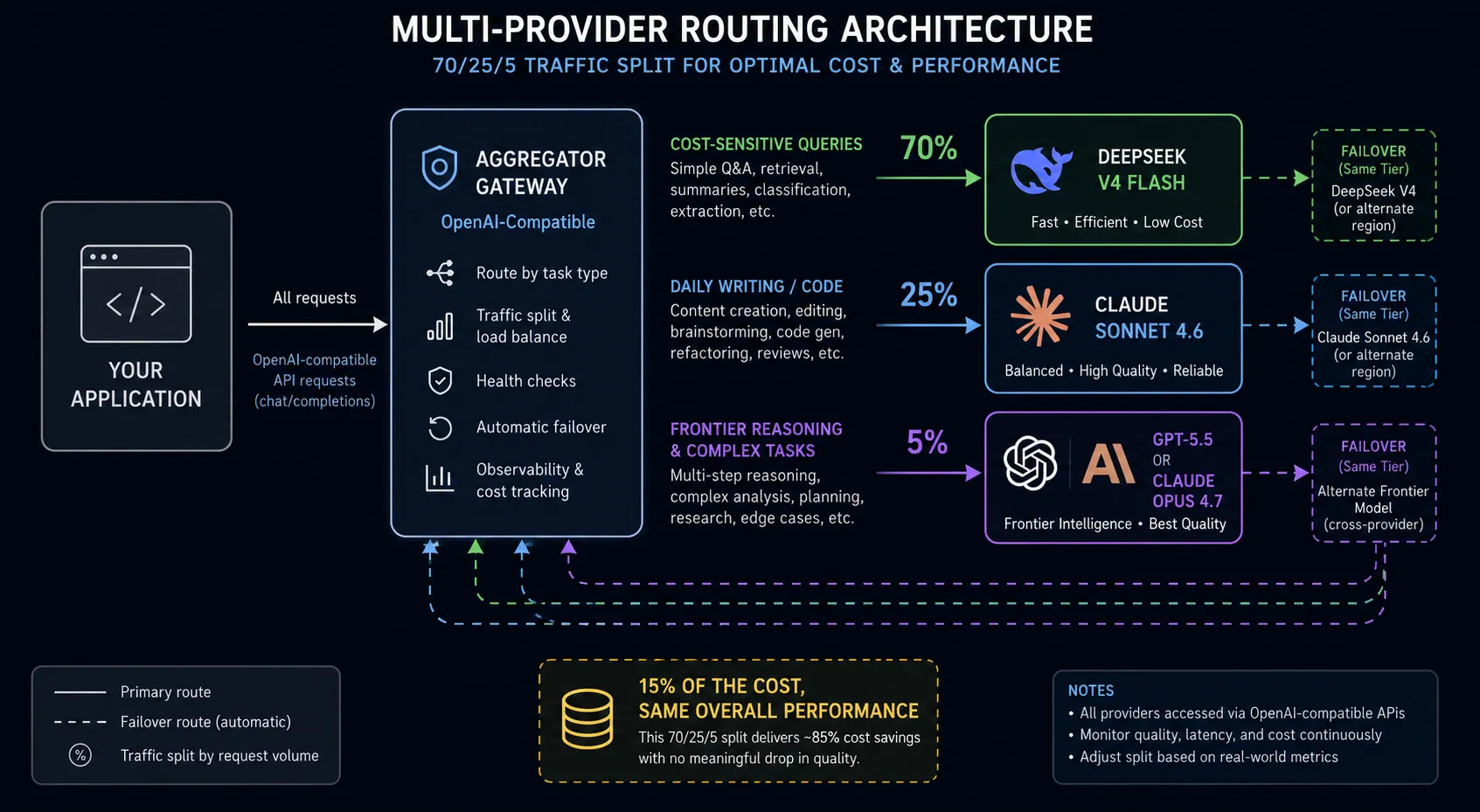
AI/ML API has become the default starting point for developers who want GPT-5.5, Claude Sonnet 4.6, Gemini 3.1 Pro, DeepSeek V4, and Llama 4 all accessible under a single OpenAI-compatible API key. One integration covers over 400 models. You change base_url, keep your existing SDK code, and you're done.
- The real production benefit: When GPT-5.5 hits a rate limit or goes down, you're one config change away from routing to Claude Sonnet 4.6 or DeepSeek V4 — without touching your application logic or managing separate credentials.
Volume pricing on aggregator platforms typically runs 40–80% below direct provider rates. The gap is largest on high-throughput workloads where direct provider pricing doesn't offer meaningful discounts. You also gain access to models like DeepSeek V4 at $0.28/million tokens and Gemini 3.1 Flash-Lite at $0.25/million — options that dramatically reshape the cost math for cost-sensitive workloads.
Anthropic API — Claude Sonnet 4.6 and Opus 4.7 direct
If Claude is your primary model, going direct to Anthropic makes sense. Claude Opus 4.7 is their current flagship, positioned for complex reasoning and long-running agent workflows. Claude Sonnet 4.6 is the everyday workhorse — close to Opus performance at significantly lower cost, and what most production applications actually use.
Anthropic's API is well-documented, has a generous free tier, and the SDK is straightforward to work with. The tradeoff: a separate vendor relationship and a non-OpenAI-compatible SDK, which matters if you're already standardized on the OpenAI client.
Google AI Studio / Vertex AI — Gemini 3.1 Pro
Gemini 3.1 Pro is the reasoning leader in April 2026, with 94.3% on GPQA Diamond and the best scores across 13 of 16 major benchmarks in recent evaluations. The 1 million token context window on Gemini 3.1 Flash-Lite — priced at $0.25/million — sets a new floor for affordable large-context inference.
Google AI Studio covers free experimentation. Vertex AI handles enterprise requirements: IAM, VPC controls, data residency options, and SLAs. If long-context processing or scientific reasoning is central to your workload, Gemini 3.1 is the strongest choice right now.
Together AI and Fireworks AI — open-source inference
Both platforms specialize in fast, cost-optimized inference for open-weight models. Together AI has strong fine-tuning support and batching. Fireworks AI focuses on latency — often the fastest option for real-time applications. Both support Llama 4, Qwen 3.5, DeepSeek V4, and Mistral with OpenAI-compatible endpoints.
Best ChatGPT alternatives (chat interface)
For users who want a different daily AI assistant — not for API development, just for research, writing, and thinking — here are the strongest alternatives.
Claude vs ChatGPT in 2026
The practical difference in April 2026: Claude Sonnet 4.6 and Opus 4.7 consistently produce more natural prose and handle nuanced, multi-constraint instructions more precisely. ChatGPT (GPT-5.4/5.5) has the broader tool ecosystem, more third-party integrations, and is the stronger all-rounder across diverse task types. Claude is the better writing model; GPT-5.5 is the best generalist.
Gemini 3.1 Pro vs ChatGPT
Gemini 3.1 Pro is the reasoning leader on graduate-level benchmarks and has the largest context window for closed models at affordable pricing. It's also the strongest multimodal option — particularly for tasks involving images, video, and audio. ChatGPT's ecosystem advantage and general familiarity still make it the default for most users who aren't running specialized workloads.
Open-source OpenAI alternatives
The gap between open-source and proprietary models has nearly closed in 2026. For teams with compliance requirements, data privacy constraints, or the engineering capacity to self-host, open-weight models are now genuinely viable for many production workloads.
Meta Llama 4 Scout & Maverick
Llama 4 is the most significant open-source release of the cycle. Scout ships with a 10 million token context window — the largest of any model, open or closed. Maverick is the higher-capability variant for tasks that need more reasoning depth. Both are freely available for most commercial use cases.
- Self-hosting reality check: Running Llama 4 Maverick at production scale requires significant GPU infrastructure. For most teams, managed inference via Together AI, Fireworks AI, or an aggregator is more practical than owning the hardware. Factor total cost of ownership — not just token price — into your evaluation.
DeepSeek V4
DeepSeek V4 is arguably the most disruptive model of 2026. Built on Huawei Ascend chips without Nvidia GPUs, it runs at 1 trillion parameters and costs $0.28/million input tokens for the standard variant — with a Flash variant at $0.14/million. It delivers roughly 90% of GPT-5.4's benchmark performance at a fraction of the cost. The weights are open and the API is OpenAI-compatible.
Qwen 3.5 (Alibaba)
Qwen 3.5 has become the most cost-efficient option for teams with multilingual requirements. The 9B model hits 81.7% on GPQA Diamond at $0.10/million tokens — a benchmark score that was frontier-class just six months ago, now available at commodity pricing. Strong across CJK languages and the clearest choice for applications with substantial non-English content.
Mistral Large 2
Mistral remains the European open-source benchmark. Weights are available for self-hosting; the managed API is EU-infrastructure-based. Strong multilingual performance, particularly on French and other European languages. The natural choice for EU-based teams that need both open-source flexibility and a clear GDPR story.
How the top 2026 models compare
No single model dominates every task. Here's where each major alternative actually leads in April 2026:
Feature matrix: OpenAI Direct vs. multi-provider access
This is the comparison that actually matters if you're evaluating whether to go direct or use an aggregation layer like AI/ML API.
Which alternative fits your situation
You want to reduce API costs without rewriting your app
Use an OpenAI-compatible aggregator. Point your existing SDK at a new base_url. Keep running GPT-5.5 where you need it, and route cost-sensitive queries to DeepSeek V4 Flash at $0.14/million or Gemini 3.1 Flash-Lite at $0.25/million. You get immediate savings and fallback capability in a single move.
You want Claude Sonnet 4.6 or Gemini 3.1 Pro in your app
An aggregator is the fastest path here too — no second SDK, no second billing account. You're already accessing these models through an OpenAI-compatible layer. Alternatively, go direct to Anthropic or Google if you need features specific to their platform (Anthropic's tool use beta, Google's Workspace data connectors).
You need a fallback strategy for production
Build multi-provider routing. Either implement an abstraction layer yourself, or use a platform that handles failover. A common production pattern in 2026: route 70% of traffic to a cost-efficient model like DeepSeek V4, 25% to Claude Sonnet 4.6, and reserve GPT-5.5 or Claude Opus 4.7 for the 5% of requests that genuinely need frontier-level reasoning. Same overall performance, 15% of the cost.
You have data residency or compliance requirements
Self-hosted Llama 4 or DeepSeek V4 on your own infrastructure is the right answer. The quality gap with closed frontier models has narrowed to a point where most enterprise workloads are well-served by open-weight models. Alternatively, Mistral offers an EU-based managed option with clear GDPR compliance.
You need the largest context window available
Llama 4 Scout's 10 million token context is unmatched for processing entire codebases, large document collections, or extended conversation histories. For closed-source options, Gemini 3.1 Flash-Lite offers 1 million tokens at $0.25/million — the most affordable large-context option from a major provider.
You're a non-technical user looking to replace ChatGPT
Claude.ai is the most direct substitute — comparable interface, strong writing quality, sometimes better on nuanced topics. Perplexity is the stronger choice if your main use is research and you want live web sources with citations. Google Gemini is worth trying if you're already in the Google Workspace ecosystem.
Verdict
The 2026 AI landscape has made the question "best OpenAI alternative" almost too narrow. OpenAI is one of six or seven serious frontier model providers, not a category unto itself. The real question is whether to use one provider or build with the flexibility to use multiple — and for most production teams, the answer is clearly the latter.
- For most developers: Use a multi-provider aggregator as your primary API layer. Access GPT-5.5, Claude Sonnet 4.6, Gemini 3.1 Pro, and DeepSeek V4 through one OpenAI-compatible key. Treat each model as a specialist rather than a default. Route by task type, cost, and availability. This is now standard architecture, not a workaround.
For chat users who want something different from ChatGPT: Claude.ai is the strongest alternative for writing and nuanced work; Perplexity for research with citations; Gemini for Google-native workflows.
For teams with compliance or data residency requirements: Llama 4 and DeepSeek V4 have genuinely closed the quality gap. Self-hosting is a legitimate production path in 2026 in a way it simply wasn't in 2024.
The era of picking one model and committing to it indefinitely is over. The architecture that wins in 2026 is model-agnostic by design, routing intelligently across providers based on what each task actually needs.
AI/ML API gives you GPT-5.5, Claude Sonnet 4.6, Gemini 3.1 Pro, DeepSeek V4, and 400+ more models under one OpenAI-compatible API key — with volume pricing that cuts inference costs by up to 80%.
Frequently asked questions
Is DeepSeek 4 actually as good as GPT-5.5?
On math, science, and pure coding benchmarks, DeepSeek 4 trades blows with GPT-5.5 and occasionally wins. On complex instruction-following, nuanced writing, and tasks requiring cultural context, GPT-5.5 and Claude 4 Opus maintain edges. The honest answer is: it depends heavily on your specific task type. Run your own evals on your actual workload before deciding.
Can I switch providers without rewriting my codebase?
For most setups, yes. If you're using the OpenAI Python or Node SDK, changing the base_url parameter and the model name is typically sufficient to switch to any OpenAI-compatible API. Providers like AI/ML API, Together AI, and OpenRouter all support this. Edge cases exist if you use function calling with very specific schema formats, but those are generally minor adaptations.
What's the best free OpenAI alternative?
For zero-cost access, Gemini 2.5 Flash has a generous free tier via Google AI Studio. Qwen 3.5 has free access through Alibaba's API. Llama 4 Scout is entirely free to run if you have the hardware. For commercial use at low volume, most major providers have free tiers — just read the rate limits carefully before building on them.
Is Claude a good alternative to ChatGPT for everyday use?
Claude 4 Sonnet and Opus are routinely rated higher than ChatGPT by users doing extended writing tasks, research, and anything requiring careful, nuanced reading of long documents. It's a matter of personal preference for casual use, but for professional workflows — particularly writing and analysis — Claude has a strong case.
What about open-source alternatives to OpenAI?
Llama 4 Scout from Meta is the most capable open-weight model as of early 2026, with Qwen 3.5 and Mistral Large 2 close behind. "Open source" means different things across these — Llama 4 Scout is open weights with some use restrictions, while Mistral's Apache-licensed models offer more genuine freedom. For self-hosted production inference, these are real, viable options rather than compromises.
How much can I realistically save by switching from OpenAI?
It varies by workload, but real-world figures from teams that have made the switch range from 30–70% cost reduction for like-for-like tasks, with some high-volume summarization and classification workloads seeing savings closer to 80% when moving to DeepSeek 4 or Gemini Flash through an aggregator. The savings are real — they just require doing the routing work rather than pointing everything at the most expensive model by default.