

Qwen 3.6 Series: Alibaba's Open-Source LLM Revolution in 2026
What is Qwen 3.6?
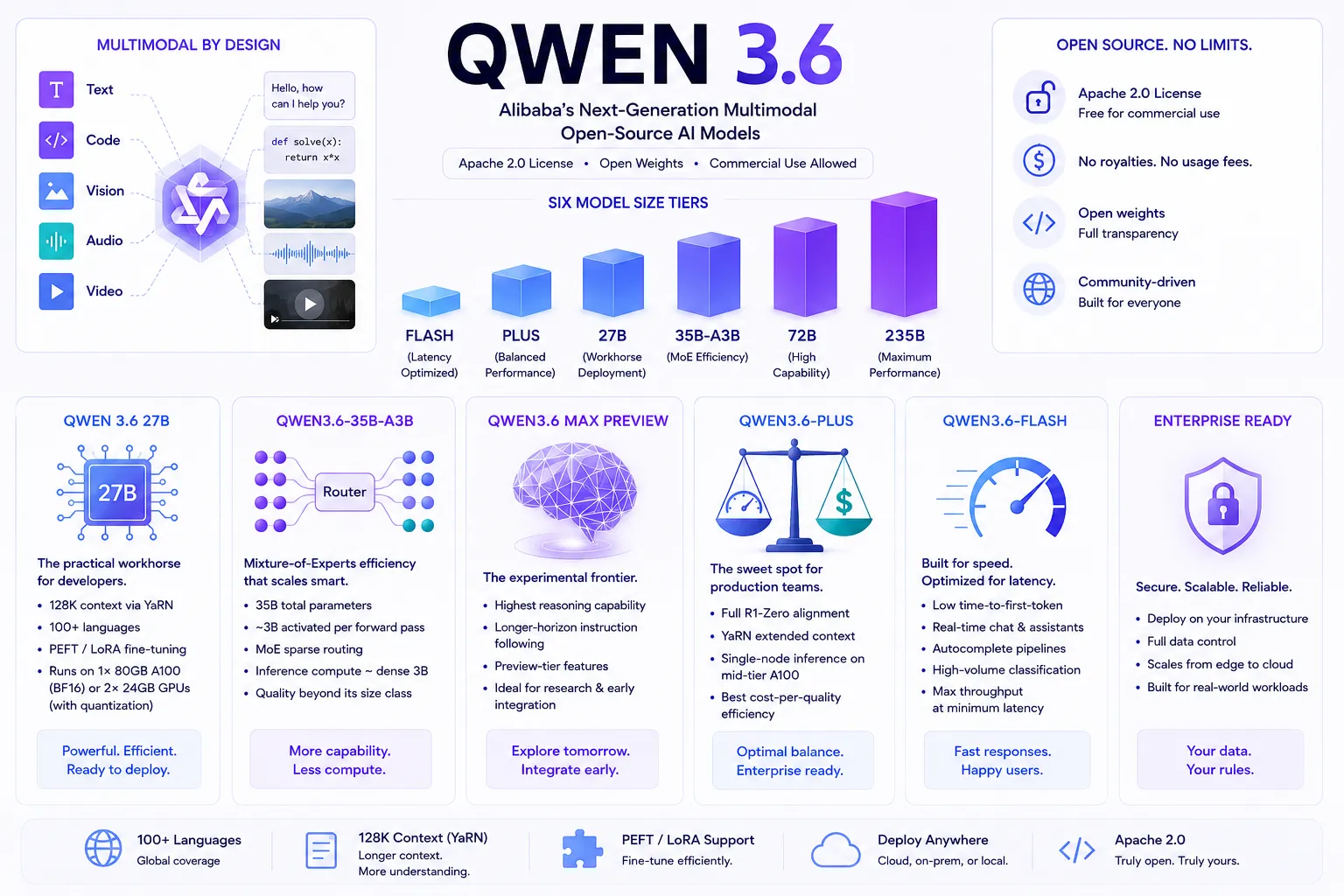
Qwen 3.6 is Alibaba's latest generation of multimodal, open-source large language models. "Multimodal" here is not a marketing qualifier — the series genuinely handles text, structured code, vision (via the Qwen 3.6-VL variants), and in select builds, audio and video processing. Released under the Apache 2.0 license, all weights are free for commercial deployment without royalties or usage fees, which is a meaningful distinction from comparably capable proprietary systems.
The model family spans six primary size tiers, giving teams the flexibility to match computational budget to task complexity. On the large end, the 235B variant demonstrates that open-source scaling is not stalling.
Qwen 3.6 27B
The 27B is the variant most likely to become a workhorse across mid-sized deployments — large enough to handle genuinely complex language tasks, small enough to fit comfortably on a single 80GB A100 in BF16 or two consumer 24GB GPUs with quantization. It covers the full Qwen 3.6 feature set: 128K context via YaRN, multilingual competence across 100+ languages, and PEFT/LoRA fine-tuning compatibility through Hugging Face. For developers who want a capable local model without the operational overhead of managing a 72B deployment, 27B hits a practical ceiling that's hard to argue with.
Qwen3.6-35B-A3B
The 35B-A3B designation tells you exactly what this model is doing architecturally: 35 billion total parameters with approximately 3 billion activated per forward pass through Mixture-of-Experts sparse routing. That gap between total and active parameter counts is the entire value proposition. In practice, 35B-A3B delivers inference compute closer to a dense 3B model while drawing on the representational capacity of a much larger network when the routing decisions call for it. For teams running on constrained GPU budgets who still need quality that punches above their hardware weight class, this variant is one of the more honest implementations of the MoE efficiency promise in the current open-source landscape.
Qwen3.6 Max Preview
Max Preview sits at the experimental edge of the Qwen 3.6 lineup — Alibaba's staging ground for capabilities that aren't yet hardened for production but are close enough to be genuinely useful for research and early integration work. Expect higher scores on complex multi-step reasoning and longer-horizon instruction following than the standard release variants, alongside the occasional rough edge that comes with preview-tier software. Developers building agentic systems or evaluating frontier capability ceilings will find Max Preview the most informative variant to probe, precisely because it hasn't been smoothed for general release yet.
Qwen3.6-Plus
Qwen3.6-Plus occupies the sweet spot that most production teams will actually deploy: meaningfully more capable than Flash, meaningfully cheaper to run than the 72B or 235B configurations. It inherits the full R1-Zero alignment treatment and YaRN extended context, while being sized for single-node inference on mid-tier A100 hardware. Enterprise teams evaluating RAG pipelines, document analysis, or multilingual support workflows will find Plus the most cost-per-quality-efficient entry point in the series — capable enough to handle nuanced tasks, lean enough that scaling horizontally stays within budget.
Qwen3.6-Flash
Built for speed without sacrificing coherence, Qwen3.6-Flash is the latency-optimized member of the family. It targets applications where response time is the primary constraint — think real-time chat interfaces, autocomplete pipelines, and high-volume classification tasks where you're processing thousands of requests per minute. Flash trades some reasoning depth for dramatically lower time-to-first-token, making it the practical default for consumer-facing products that can't afford to keep users waiting. If you've been leaning on GPT-4o mini purely for its speed, Qwen3.6-Flash is the open-weight answer worth benchmarking against your own traffic.
Architecture Innovations Under the Hood
Transformer Upgrades and MoE Efficiency
The headline architectural change in Qwen 3.6 is a mature implementation of Mixture-of-Experts (MoE) sparse activation. Rather than activating the entire parameter space on every forward pass, MoE routing dynamically selects the most relevant expert sub-networks per token. In practice, this means the 235B model uses compute closer to a much smaller dense model during inference — important for cost-sensitive production deployments.
Extended context is handled via YaRN (Yet another RoPE extensioN), which interpolates positional encodings to support sequences up to 128K tokens without the degradation seen in naive position extension approaches. Inference is further accelerated by AITemplate, Alibaba's kernel fusion framework, yielding approximately 2× throughput on comparable hardware relative to Qwen 2.5 deployments.
Qwen 3.6 vs Qwen 2.5 — architecture comparison
Multimodal Capabilities in Qwen 3.6
Vision-language tasks are handled by the Qwen 3.6-VL family. These variants integrate a dedicated visual encoder alongside the core language model, enabling document OCR, diagram interpretation, image-grounded question answering, and dense image captioning — all at the quality level that was exclusive to premium API products a year ago. Select variants extend this further with audio understanding, meaning a single model deployment can process spoken instructions, transcribed meetings, or mixed-media documents in a unified context window.
Qwen 3.6 Benchmarks: How It Stacks Up in 2026
Leaderboard performance across reasoning, math, and coding
The Qwen 3.6 benchmarks tell a story of a model family that has closed the gap at every level. The 72B dense variant — the most practically deployable large configuration — sits comfortably at the frontier tier on the three metrics that matter most for production NLP applications.
Top Qwen 3.6 Features for Developers and Enterprises
Coding Mastery
Best-in-class open-source performance on Python, Rust, and TypeScript. Supports multi-step agentic code workflows, unit test generation, and refactoring pipelines without proprietary API lock-in.
Multilingual Edge
Superior handling of Chinese–English mixed-language tasks, Russian literary translation, and low-resource languages at the 7B scale, outperforming comparably-sized Western-centric models.
Inference Efficiency
AITemplate kernel fusion delivers roughly 2× inference throughput on consumer-grade A100 and RTX 4090 setups, reducing both latency and compute cost at deployment.
Fine-Tuning Friendly
Full PEFT and LoRA adapter support via Hugging Face transformers. Domain-specific fine-tunes for legal, medical, and financial text run in under 8 hours on a single A100.
Extended Context (128K)
YaRN-based positional extension enables retrieval-augmented generation over full codebases, lengthy legal documents, or entire academic papers — within a single inference call.
Vision + Language Fusion
Qwen 3.6-VL handles chart understanding, document OCR, and image-grounded reasoning. Demonstrated use case: extracting structured data from scanned invoices at 95%+ accuracy.
Qwen 3.6 Use Cases
Enterprise AI
- Customer support chatbots
- RAG over internal docs
- SEO content generation
- Contract clause extraction
Developer Tools
- VS Code / JetBrains plugins
- ModelScope inference
- Agentic code workflows
Creative & Research
- Literary analysis
- Music lyrics translation
- Academic paper summarization
- Multilingual journalism tools
Qwen 3.6 vs Competitors: Head-to-Head
Qwen 3.6-72B measured against major alternatives
The primary trade-off when choosing Qwen 3.6 over GPT-4o is ecosystem maturity — third-party integrations, fine-tuned checkpoints, and community support are still catching up. Against open-source peers like DeepSeek V3, Qwen 3.6 differentiates on multilingual depth and vision-language capabilities.
Future of Qwen 3.6: Roadmap and Updates
Conclusion
The Qwen 3.6 series is the clearest demonstration yet that frontier-level language model performance is no longer a proprietary moat. With Apache 2.0 licensing, a 72B variant that matches GPT-4o on coding and reasoning, genuine multilingual depth, and an architecture engineered for efficient deployment, it represents a mature, deployable choice for teams at every scale. The benchmarks are compelling, but the real proof is in your pipeline.